How Deep an Italian Greyhound’s Chest Should Be
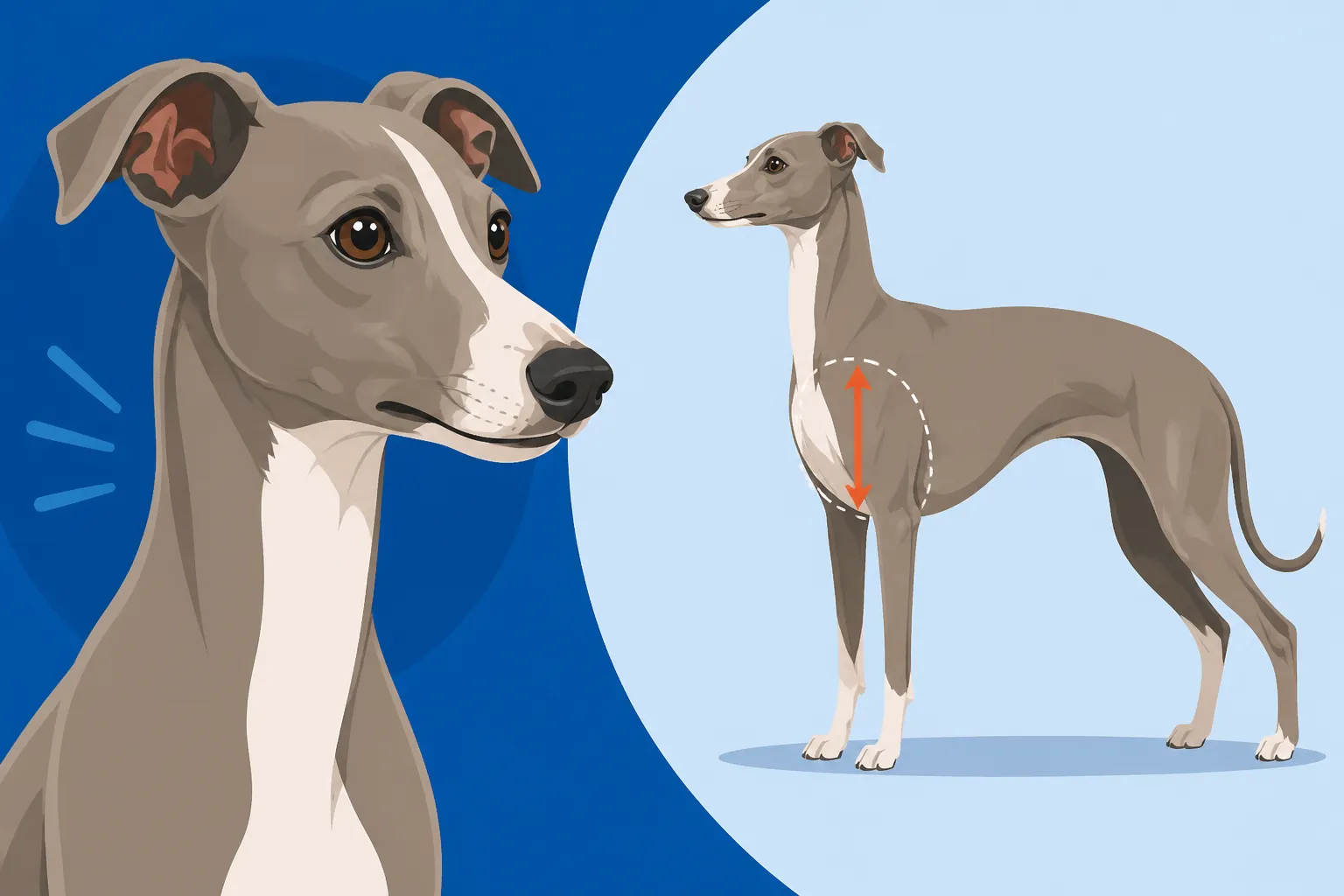
An Italian Greyhound’s chest should be deep and narrow, with its lowest point reaching close to the elbows when the dog stands naturally. That can look surprisingly different from the broad, rounded chest many people picture in other breeds. This guide explains what “deep” means, how to assess chest shape without confusing it with weight or health, and what to consider when choosing a harness.
What a deep chest means in an Italian Greyhound
Depth is measured from the back toward the sternum
When a breed description calls for a deep chest, it is talking about the distance from the dog’s topline down to the underside of the chest. In an Italian Greyhound, the chest should extend downward to approximately the level of the elbows, or as close to it as the individual dog’s proportions allow. The sternum is the breastbone at the bottom front of the chest.
That is different from chest width. Italian Greyhounds are built with a relatively narrow, elegant front, so a deep chest does not mean a wide, heavy barrel. Look at the dog from the side to judge depth, then from the front to understand width. Trying to assess both angles at once can make a naturally lean outline seem either too slight or too broad.
The breed’s overall proportions matter, too. The chest sits within a body that has a long, fine outline and a noticeable rise from the underside of the chest toward the abdomen. If you are comparing proportions, What an Italian Greyhound Weighs and How Tall It Stands and What Height the Italian Greyhound Standard Asks For offer useful context: chest depth is one part of a whole silhouette, not a standalone measurement.
The chest should approach the elbow, not look exaggerated
For a quick visual check, stand your dog on a level, nonslip surface and look at the side profile. The bottom of the chest should come down near the elbows. It does not need to appear excessively low, broad, or heavy to qualify as deep. Breed descriptions are about the relationship between body parts, not a single dramatic feature.
It also helps to watch the dog standing comfortably rather than holding it in a pose. A dog that is leaning forward, sitting slightly, stretching, or shifting weight may make the chest appear higher or lower. Take a few moments and let your Italian Greyhound settle into a natural stance before you decide what you are seeing.
The topline and underline help complete the picture. The underside rises behind the chest toward the waist, creating the characteristic tuck-up. For a closer look at that neighboring feature, see What an Italian Greyhound's Tuck Up Should Be. A deep chest and a tucked abdomen are related parts of the outline, but neither should be judged in isolation.
How to assess chest depth at home
Use a calm, natural standing position
Start with your dog standing on a flat floor, with all four feet supporting its weight. A side view is usually easiest. Look for the lowest point of the chest and compare it with the elbow area. The goal is not to make your dog hold a rigid show pose; it is simply to see the body in a neutral position.
If your dog is wiggly, take several short looks rather than trying to restrain it. You can ask a family member to offer a treat while you observe from the side. A phone photo taken at the dog’s chest height may also help, because looking down from above can distort proportions. Keep the camera level and avoid using a wide-angle setting close to the body.
Do not press on the ribs or try to force the elbow into position. A visual assessment is enough for a general understanding, and a veterinarian or experienced breed mentor can help if you have a specific concern. If you are learning the breed outline, What Judges Look For First in an Italian Greyhound and Whether a Correct Italian Greyhound Looks Fragile can help distinguish refined breed type from simply appearing thin.
Do not mistake visible ribs for chest depth
Italian Greyhounds are naturally fine-boned and lean, and some rib outline can be normal. But visible ribs do not tell you whether the chest reaches the elbows. Those are separate observations: chest depth concerns the body’s structure, while rib coverage relates to body condition and the amount of soft tissue over the ribs.
Likewise, a dog can have a deep chest and still be underweight, overweight, or in healthy condition. Feel and observe the whole dog rather than relying on one photograph or one feature. For a practical body-condition check, How to Feel an Italian Greyhound's Ribs and What an Italian Greyhound Weighs and How to Tell If It Is Right are more useful than comparing your dog with a picture online.
Age can affect what you see. A young dog is still growing, and its proportions may look temporarily uneven as the legs, body, and chest develop at different rates. A puppy should not be judged against the finished outline of an adult. If you are unsure whether a change is normal growth or a health concern, ask your veterinarian to assess the dog’s overall development.
Chest depth, fit, and everyday comfort
A deep chest affects harness fit
A harness needs to sit securely without restricting the chest or rubbing behind the front legs. Because Italian Greyhounds combine a deep chest with a narrow build, a harness that fits the ribcage may still be loose around the neck or shift when the dog moves. Conversely, tightening a strap to stop shifting can create pressure or friction.
Measure your dog according to the harness maker’s instructions, and compare the chest measurement with the product’s size guidance. Chest circumference is not the same as chest depth: circumference is measured around the body, while depth describes how far the chest extends downward. One measurement cannot reliably substitute for the other.
When comparing options on Chewy, check the measuring instructions and look closely at where the harness is designed to rest. Consider whether the chest strap sits away from the throat and whether the fit can be adjusted around both the ribcage and the neck. If a listing gives only a general weight range, treat that as a starting point rather than a guarantee of fit.
| What you are checking | What it tells you | What it does not tell you |
|---|---|---|
| Side view from topline to chest bottom | How far the chest extends toward the elbows | Harness circumference |
| Chest circumference | How the harness may fit around the ribcage | Whether the chest is deep enough |
| Front view | How narrow or broad the front appears | Whether the dog is at a healthy weight |
| Rib feel and body condition | Whether the dog’s condition may need review | Whether the chest matches breed type |
After putting a harness on, check that you can fit it comfortably according to the manufacturer’s directions and that your dog can walk, sit, and turn without rubbing. Watch for repeated scratching, hair rubbed away, redness, or reluctance to move in the harness. If the harness slides toward the throat or rotates around the body, the shape or size may not suit your dog.
Chewy may be one place you compare sizing charts and return policies, but rely on the individual product’s current instructions rather than assuming every style fits the same way. A harness designed for a broad-chested dog can sit awkwardly on a narrow sighthound, even when the listed weight seems appropriate.
Chest shape is not a diagnosis
A chest that looks higher, shallower, or differently shaped than you expected is not automatically evidence of illness. Dogs vary, and posture, age, coat, camera angle, and body condition can all affect appearance. Breed standards describe an ideal type; they are not a checklist for diagnosing a pet’s health.
Pay closer attention to changes in comfort and function. Contact your veterinarian if your dog develops labored breathing, persistent coughing, unusual exercise intolerance, pain when touched, or a sudden change in posture. Those signs deserve professional assessment regardless of whether the chest appears deep enough.
If the concern is about show conformation, ask a knowledgeable Italian Greyhound breeder, breed-club mentor, or qualified judge to explain what they see in the dog’s proportions. A useful discussion looks at the whole outline—including chest, topline, legs, and movement—not one isolated measurement. What a Correct Italian Greyhound's Topline Looks Like provides helpful context for understanding that overall balance.
Common mistakes when judging an Italian Greyhound’s chest
Comparing your dog with a single photo
Photos can be misleading. A low camera angle may make a chest appear deeper, while a camera held above the dog can make the body look shorter or narrower. A dog photographed while stretching forward may also seem to have a different chest position than one standing squarely.
Online images can show dogs at different ages, weights, and stages of movement. Some are posed for a show ring; others are curled up on a sofa or captured mid-stride. They are not consistent reference points. If you want to compare, use several clear side views of adult dogs standing naturally, and remember that even good examples will not all look identical.
Treating breed wording like a ruler measurement
“Reaching close to the elbows” is a practical description, not an instruction to measure every dog with a ruler and declare it correct or incorrect. Elbow position varies slightly with stance, and the chest can look different when the dog is relaxed compared with when it is alert. A small visual difference does not necessarily mean there is a problem.
If you are choosing a puppy, focus on responsible breeding, health, temperament, and overall structure rather than demanding an exact chest measurement. If you are evaluating an adult companion, prioritize comfort and normal function. For a broader view of build and proportion, What Shape an Italian Greyhound's Feet Are can be read alongside the other structure topics, since the breed’s outline is best understood as a coordinated whole.
When shopping for equipment, do not try to “correct” your dog’s shape with a tighter harness or restrictive clothing. If you compare harnesses on Chewy, use the maker’s size chart, measure carefully, and inspect the fit in motion at home. A comfortable, secure fit matters more than making the chest look a certain way.
A well-proportioned Italian Greyhound has a chest that descends toward the elbows while remaining narrow and balanced with the rest of the body. You can assess that general outline from a relaxed side view, but avoid using chest depth as a proxy for weight, health, or quality. For a specific concern, an in-person assessment by your veterinarian or an experienced breed professional is more useful than trying to reach a verdict from one photo.
Disclaimer
This article is for general informational purposes only and does not constitute professional advice. Laws, prices and regulations vary by location and change over time. Consult a qualified professional for guidance on your specific situation.