Which Fence Height Contains an Italian Greyhound
One of the biggest worries for any Italian Greyhound owner is keeping their precious, delicate, yet surprisingly athletic companion safe and contained. You’ve heard the stories, or perhaps even experienced it firsthand: one minute they’re lounging, the next they’ve spotted a squirrel and are gone in a flash, or found a way over or under what you thought was a perfectly secure barrier. This guide is here to walk you through exactly what kind of fence is truly needed to contain an Italian Greyhound, diving into the nuances beyond just height.
Understanding the Italian Greyhound's Escape Artist Tendencies
Before we even talk about fence height, it's crucial to understand why Italian Greyhounds are such prodigious escape artists. They might look like delicate lapdogs, all grace and elegance, but beneath that sleek exterior lies a miniature sighthound with an incredible prey drive and surprising athleticism. This combination makes them masters of escape, challenging even the most well-intentioned containment efforts.
The Power of Prey Drive
If you've ever seen an Italian Greyhound lock onto a moving target – a squirrel, a leaf blowing across the yard, or even a distant bird – you know exactly what I mean. Their instincts are ancient and powerful, wired to chase. Once that prey drive kicks in, the world narrows. All the training, all the calls, can vanish in a blur as they focus solely on the pursuit. This isn't stubbornness; it's instinct. It’s why an Italian Greyhound simply Cannot Be Trusted Off Leash, Ever in an unfenced area. That powerful urge to chase can override everything else, including any respect they might have for a fence line. They don't weigh the risks; they simply react. You'd be amazed at What an Italian Greyhound Does When It Sees a Rabbit or other small critters.
Surprising Athleticism and Agility
Many people underestimate the physical capabilities of an Italian Greyhound. They are slender, yes, but incredibly agile and capable of impressive bursts of speed and vertical leaps. Don't let their dainty appearance fool you. They can spring from a standstill, clearing obstacles that seem impossibly high for a dog of their size. They are also incredibly flexible and can squeeze through surprisingly small gaps, testing every weakness in your fencing. Their light bones and high energy mean they can cover ground incredibly quickly, reaching What Speed an Italian Greyhound Reaches in a short burst, making a quick dash to the fence line easy. This agility also allows them to often use minor footholds to scale fences, transforming a simple fence into a ladder.
The "Velcro Dog" Paradox
While Italian Greyhounds are famously known as "Velcro dogs" who adore human companionship and want to be glued to your side, this doesn't diminish their desire to explore or chase if given the opportunity. In fact, if they perceive an opening or a tantalizing scent, even the most devoted IG might seize the chance for a solo adventure. Their intense bond with you makes them want to be with you, but their sighthound nature makes them want to run. These aren't mutually exclusive, and it's the latter that will test your fence.
Minimum Fence Height Recommendations for an Italian Greyhound
So, knowing their capabilities, what's the magic number for fence height? This is where reality often clashes with perception. While some might suggest a standard 4-foot fence for a small dog, that's simply not going to cut it for an Italian Greyhound.
Why Four to Five Feet Is Generally Insufficient
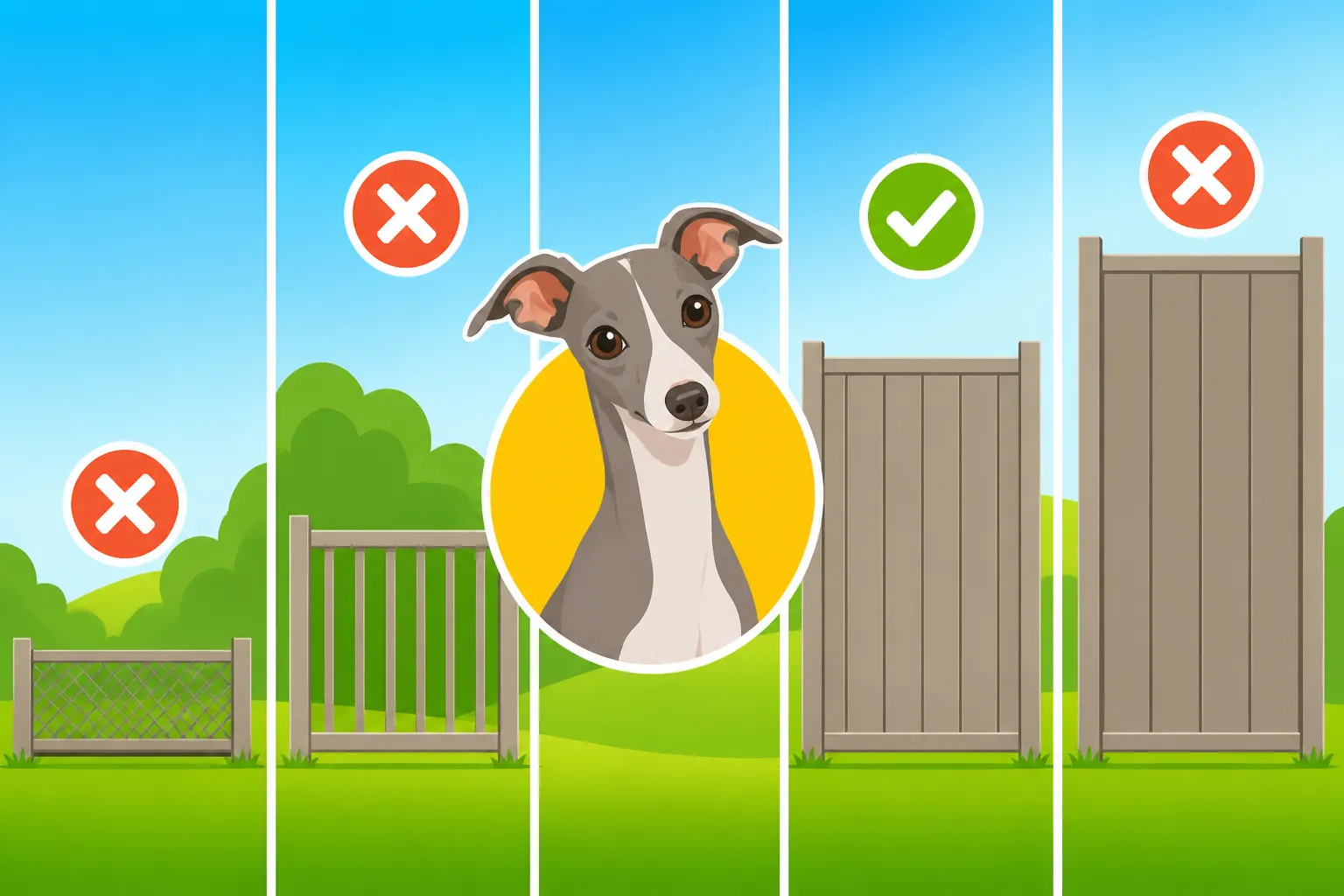
Let's be blunt: a 4-foot fence is essentially an open invitation for many IGs. A determined Italian Greyhound, especially one with a high prey drive or a penchant for climbing, can clear a 4-foot fence with relative ease, particularly if there's anything near the fence line they can use as a boost. Think about it: a dog that can jump onto your kitchen counter might not see a 4-foot fence as much of a challenge. Even 5 feet, while better, still leaves a lot to be desired for true peace of mind.
Consider these scenarios:
- The Opportunistic Leap: Your IG spots a rabbit on the other side. With the adrenaline pumping, a 4 or 5-foot fence becomes a hurdle, not a barrier.
- The Snowdrift Effect: If you live in an area with snow, remember that snowdrifts can effectively reduce your fence's height, giving your agile IG a perfect launchpad. Suddenly, your 5-foot fence acts like a 3-foot fence.
- The Climbing Advantage: Some IGs are natural climbers. If the fence offers even slight footholds (like chain link), they can shimmy their way up and over.
The Six-Foot Standard and Beyond
For most Italian Greyhounds, a minimum of a 6-foot fence is highly recommended. This height starts to present a real deterrent for many, requiring a significant jump or climb that not all IGs will attempt, or can achieve consistently.
However, even 6 feet isn't foolproof, especially if your Italian Greyhound is particularly athletic, motivated, or has a clear line of sight to something enticing. For absolute peace of mind, especially if you have an IG that has shown escape tendencies or you live in an area with lots of wildlife, an 8-foot fence is the gold standard. It’s a serious investment, but it drastically reduces the chances of a successful escape.
Summary of Fence Height Considerations:
| Fence Height | Suitability for Italian Greyhounds | Key Considerations |
|---|---|---|
| 4 feet | Generally Insufficient | Easily jumped or scaled by most IGs, especially if motivated. |
| 5 feet | Borderline | Better, but still vulnerable to athletic or determined jumpers/climbers. |
| 6 feet | Recommended Minimum | Deters many, but not all. Requires vigilance and consideration of fence type. |
| 8 feet | Ideal for Peace of Mind | Highly effective, significantly reduces escape risk, especially with solid construction. |
Beyond Height: Other Critical Fence Features for Italian Greyhounds
Height is paramount, but it's only one piece of the puzzle. A fence isn't just a vertical barrier; it's a complete enclosure, and every aspect needs to be secure to truly contain an Italian Greyhound.
Solid Construction vs. Climbable Materials
The material of your fence makes a huge difference.
- Chain Link: While common, chain link fences are notorious for providing excellent footholds for nimble dogs. An Italian Greyhound can use the mesh like a ladder, scaling it surprisingly quickly. If you have a chain link fence that is less than 8 feet, it's generally not secure enough unless it has an outward-sloping top section to prevent climbing.
- Wood or Vinyl Privacy Fences: These are often better because they don't offer climbing footholds. The solid surface means an IG can't get a grip to scale it. However, the downside is that they also block your view of your dog, meaning you might not see an escape attempt until it's too late. They also create a visual barrier for your dog, which can be a double-edged sword: it might reduce reactivity to outside stimuli, but it also means you can't monitor them as easily.
- Wrought Iron or Ornamental Fences: These can be beautiful, but the gaps between the pickets are a major concern. An Italian Greyhound's slender build means they can often squeeze through surprisingly narrow spaces. You need to ensure the vertical bar spacing is narrow enough that your dog cannot get their head through, generally no more than 3-4 inches apart, and even then, some IGs are slender enough to test those limits.
Preventing Digging and Squeezing Underneath
While Italian Greyhounds aren't typically known as avid diggers like some terrier breeds, a motivated IG might still try to dig under a fence if a scent is strong enough or if they find a loose spot. More commonly, they'll exploit any small gap or soft ground where the fence doesn't meet the ground securely.
- Burying the Fence: For maximum security, the fence material itself should extend below ground level by at least 6-12 inches, ideally with a bend at the bottom (an L-footer) pointing inward to prevent digging out.
- Concrete Kickboards: A more aesthetic and permanent solution is to install a concrete or sturdy timber kickboard along the bottom of the fence, directly on the ground. This prevents digging and eliminates any gaps an IG might try to squeeze through.
- Checking for Gaps: Regularly walk your fence line, particularly after heavy rains or ground shifts, to look for newly formed gaps or areas where the soil has eroded, creating an escape route.
Secure Gates and Latches
Your fence is only as strong as its weakest point, and often, that's the gate.
- Self-Closing and Self-Latching: Gates should ideally be self-closing and self-latching to prevent accidental openings.
- Double-Locking Mechanisms: Standard gate latches might be accidentally bumped open or even figured out by a clever dog. Invest in double-locking mechanisms or a sturdy padlock.
- No Gaps at the Bottom: Just like the fence line, ensure the gate doesn't have a gap underneath that an Italian Greyhound could squeeze through. Consider a sweep or rubber gasket along the bottom edge.
- Clearance from Obstacles: Make sure there are no trash cans, compost bins, or even tall shrubs near the gate that an IG could use to climb or jump over.
Addressing Interior and Exterior Aids
Take a good look at what's inside and outside your fenced area.
- Inside the Yard: Are there dog houses, sheds, firewood piles, large rocks, or sturdy planters close enough to the fence to act as a launchpad? Move anything that could give your Italian Greyhound a boost. Even a small step stool can be enough for a determined jumper.
- Outside the Yard: Be mindful of anything on the exterior that could aid an escape, though this is harder to control. Overhanging tree branches are a big one – can your dog climb a tree near the fence and then jump over? This is a particular concern for IGs, who are surprisingly agile climbers. You might need to trim branches back significantly.
Supervise, Train, and Supplement: The Human Factor
Even with the perfect fence, human vigilance and consistent training remain absolutely critical for the safety of your Italian Greyhound. A fence is a tool, but it's not a substitute for responsible ownership.
Constant Supervision is Key
Never assume your fenced yard is 100% escape-proof, especially if your Italian Greyhound has a strong prey drive. An IG should ideally not be left unsupervised in a fenced yard for extended periods. Things happen: a gate might be left ajar, a small hole appears, or a truly determined IG finds an unexpected way out. Your presence allows you to intervene immediately.
Think of it this way: your Italian Greyhound is a highly intelligent, curious, and often impulsive creature. They don't have the same safety consciousness we do. A quick trip to the mailbox or a moment of distraction could be all it takes for them to slip away.
Training for Boundary Respect
While a physical fence is essential, reinforcing boundaries through training can only help. This doesn't mean your Italian Greyhound will ever be reliable off-leash, but it can contribute to their understanding of where they belong.
- Positive Reinforcement: Use high-value treats and praise to reward your Italian Greyhound for staying away from the fence line or coming when called even when distractions are present. The BAXTER & Bella online puppy school, while often focused on younger dogs, offers excellent resources for positive reinforcement training that can be adapted for boundary work.
- Recall Practice: Practice a strong recall regularly, even within the fenced yard, with increasing levels of distraction. This is a life-saving skill if they ever do get out. While IGs can be notoriously difficult to recall once their prey drive takes over, consistent practice can make a difference.
- "Leave It" and "Stay": Teach these commands to deter them from fixating on something outside the fence or attempting to clear it.
Exploring Supplementary Measures
Sometimes, even with a great fence, extra precautions are warranted.
- Long Lines: If you have concerns about your fence or want an extra layer of security, especially during early morning or evening potty breaks when wildlife is most active, consider using a long line. A 15-30 foot lightweight lead, like those found on Amazon, can give your Italian Greyhound room to explore while keeping them securely tethered to you. This is particularly useful in areas where a quick escape could lead to dangerous situations, like a busy road.
- Secure Enclosures within the Yard: For specific periods, like when you need to step away for a moment or want to ensure absolute containment, a secure kennel run or a smaller, fully enclosed "exercise pen" with a secure top within your main fenced yard can be a great option. These are typically smaller, more robustly built, and offer an extra layer of protection.
- GPS Trackers: These devices, often small and lightweight, attach to your dog's collar and can help you locate them if they do manage to escape. They offer immense peace of mind, though they are a reactive measure rather than a preventative one. Why a Microchip Is Not Enough for an Italian Greyhound highlights the limitations of chips and the value of active tracking.
Remember, owning an Italian Greyhound means understanding their unique blend of elegance and athletic prowess. A secure fence is a non-negotiable part of responsible ownership, protecting them from the dangers of the outside world and giving you peace of mind that your beloved companion is safe within their domain. It's an investment in their safety and your tranquility.
Disclaimer
This article is for general informational purposes only and does not constitute professional advice. Laws, prices and regulations vary by location and change over time. Consult a qualified professional for guidance on your specific situation.