What Excavated Skeletons Say About the Italian Greyhound
It’s truly fascinating to peer back through the mists of time and try to understand the origins of our beloved Italian Greyhounds. So often, we talk about history as if it’s perfectly documented, but the truth is, piecing together the story of a breed that’s thousands of years old can be quite a puzzle, leaving many of us wondering what we really know. This guide dives deep into what archaeology, specifically excavated skeletal remains, tells us about the ancient ancestors of the Italian Greyhound, helping us uncover their genuine historical footprint.
The Archaeological Quest for Ancient Italian Greyhound Ancestors
Tracing the lineage of any dog breed back thousands of years without the benefit of written records or reliable DNA testing from antiquity is a monumental task. For a delicate breed like the Italian Greyhound, whose small, slender bones are easily lost or damaged, the challenge is even greater. Yet, archaeological findings have provided crucial clues, allowing us to connect the dots between ancient small sighthounds and the sleek companions we cherish today. These discoveries don't always give us a definitive "Italian Greyhound" as we know it, but rather reveal the existence of small, greyhound-like dogs that fit the ancestral profile.
The Difficulty of Pinpointing a "Breed" in Antiquity
When we talk about dog breeds today, we think of standardized physical traits, specific purposes, and often, documented pedigrees. However, ancient dogs weren't "bred" in the same formal sense. Instead, dogs developed through natural selection influenced by human needs and preferences in different regions. What archaeologists often find are skeletal remains that show a consistent type of dog within a certain geographical area and time period. For the Italian Greyhound, the challenge is identifying these ancient "types" that share common features with our modern Iggys, distinguishing them from other small dogs or miniature versions of larger breeds. It's less about finding an exact match and more about identifying a consistent evolutionary pathway.
Unearthing Clues from the Mediterranean Basin
The narrative that The Italian Greyhound Is Two Thousand Years Old often points to the Mediterranean basin as their cradle. And indeed, this region is a treasure trove for archaeological evidence. Dig sites across what was once ancient Greece, Turkey, and Italy have yielded skeletal remains of small, elegant dogs that strongly resemble the Italian Greyhound. These aren't just isolated finds; rather, they appear with enough regularity to suggest a distinct type of dog that was valued and kept by the people of these civilizations. These findings offer tangible proof that small, sighthound-like dogs were not just artistic interpretations but actual living creatures in ancient societies, providing a concrete foundation for the breed's historical claims.
Key Skeletal Discoveries and Their Implications
So, what exactly do these ancient bones tell us? They speak volumes about size, build, and even the general health and care these dogs received. Unlike sculptures or paintings, which can be stylized, skeletal remains offer an unvarnished look at the physical reality of these ancient canines.
Size and Build: A Consistent Miniature Sighthound Form
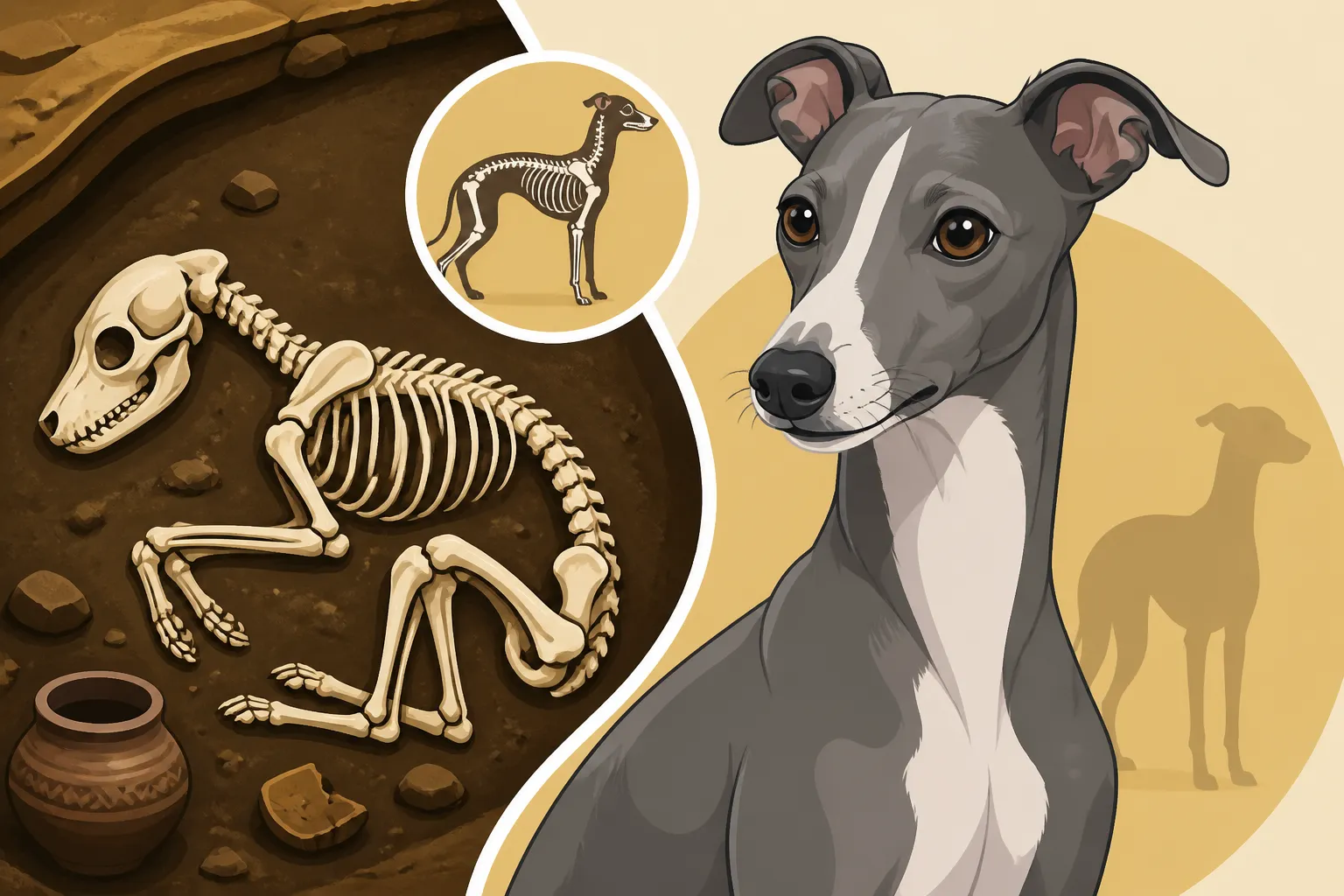
One of the most striking consistencies in the excavated skeletons from the Mediterranean region is their size. Many of these ancient remains point to dogs that were distinctly smaller than traditional Greyhounds or even Whippets, yet retained the characteristic sighthound build – slender, fine-boned, and agile. These dogs weren't simply runts of larger sighthounds; they exhibited proportions that suggested a deliberate selection for smaller stature while maintaining the elegant, athletic frame.
For instance, excavations at sites like Pompeii in Italy, or various ancient Greek settlements, have yielded dog skeletons whose measurements align closely with a modern Italian Greyhound's frame. Their long, delicate limb bones, narrow skulls, and distinct rib cage structure all whisper tales of dogs designed for speed and grace in a compact package. This helps answer questions like What an Italian Greyhound Weighs and How Tall It Stands by showing that the small, refined stature isn't a modern development but has ancient roots.
| Feature | Ancient Small Sighthound (Skeletal Evidence) | Modern Italian Greyhound (Typical) |
|---|---|---|
| Size | Small, delicate bones, miniature sighthound proportions | Small, delicate, fine-boned |
| Skull | Narrow, elongated, slight stop | Narrow, elongated, slight stop |
| Leg Bones | Long, slender, indicating speed and agility | Long, slender, delicate |
| Rib Cage | Deep, providing ample lung capacity | Deep, well-sprung |
| Overall Build | Elegant, athletic, adapted for quick bursts of speed | Graceful, athletic, compact |
Evidence of Domestic Life and Human Companionship
The contexts in which these skeletons are found also provide invaluable insights. Many remains are discovered in association with human dwellings, burials, and even accompanied by objects that suggest they were cherished pets. This differs from findings of larger hunting dogs, whose remains might be found near game or in working animal contexts. The presence of small sighthound skeletons within homes, or buried with their human companions, strongly supports the historical perception of the Italian Greyhound as primarily a companion animal, even in ancient times.
Think about it: if an ancient pet owner in a bustling Roman city needed to get supplies for their cherished canine, perhaps even a special blanket to keep them warm, they would have certainly appreciated the convenience of something akin to Chewy, delivering right to their doorstep! This consistent placement within domestic settings reinforces the idea that these dogs were part of the family, sharing in daily life and likely providing comfort and companionship, just as our Iggys do today.
Differentiating Ancient Italian Greyhounds from Other Breeds
It's easy to look at any small dog skeleton and think "Italian Greyhound ancestor," but the key is in the details – the specific proportions, the fine bone structure, and the consistent sighthound morphology. This is where anatomical analysis becomes critical in distinguishing them from other small breeds of antiquity.
Not Just Any Small Dog
While many small dog breeds existed in ancient times, the "Italian Greyhound type" skeletons consistently display characteristics unique to sighthounds. Their long, lean limbs, arched backs (a feature often discussed when looking at What a Correct Italian Greyhound's Topline Looks Like), and deep chests are distinct from the more cobby, robust builds of ancient terriers or spitz-type dogs. This refined structure is a hallmark of the sighthound family, indicating a lineage geared towards speed and visual hunting, even if their size made them more suitable for smaller prey or companion roles. These distinct features help experts like those publishing studies or specialized books, which you might find on Chewy, categorize these ancient findings accurately.
Separating from Whippets and Larger Greyhounds
Another important distinction is comparing these ancient small sighthound skeletons with those of their larger sighthound relatives, like Greyhounds and Whippets. While the general sighthound blueprint is shared, the ancient "Italian Greyhound type" skeletons are consistently smaller and often more delicate in bone structure than even ancient Whippet remains. This supports the idea that the Italian Greyhound was not merely a recent miniature version of a larger sighthound, but rather a long-standing, distinct small sighthound type that developed and maintained its unique characteristics over millennia. The question Whether the Italian Greyhound Was Bred Down From Greyhounds is often explored through these very skeletal comparisons.
What Skeletal Evidence Doesn't Tell Us (and What We Can Infer)
While bones offer an incredible window into the past, they don't tell the whole story. There are aspects of ancient Italian Greyhounds that we can only infer or that remain forever lost to time.
The Mysteries of Coat, Color, and Temperament
Skeletal remains cannot, of course, tell us about coat color, texture, or the temperament of these ancient dogs. We rely on artistic depictions, like those in ancient frescoes or mosaics, to give us a glimpse of their appearance, but these are often stylized. We can infer that their short coats made them susceptible to cold, just like modern Iggys who often shiver at The Indoor Temperature an Italian Greyhound Starts Shivering At, but the exact shade or pattern remains a mystery. Similarly, while we know they were companions, the nuances of their personality – whether they were shy, playful, or prone to Signs an Italian Greyhound Has Separation Anxiety – are beyond the scope of archaeological bone evidence.
We can, however, make educated guesses about their needs. If these dogs were indeed companions, then their owners likely provided them with warm bedding, protection from the elements, and a close bond. The need for warmth, a topic covered extensively in Keeping an Italian Greyhound Warm Is Daily Work, Not a Winter Job, has likely been a constant for these slender dogs throughout history. Even today, finding the right gear for an Italian Greyhound, from cozy sweaters to specialized beds, is a common search on platforms like Chewy.
The Role of Human Selection Over Millennia
The consistent appearance of these small sighthound skeletons over vast stretches of time and geography strongly suggests that human selection played a significant role in their development. People evidently cherished these elegant, miniature dogs and actively chose to breed them, shaping their lineage. This ongoing human preference is what ultimately led to the refined breed we recognize today. The story of the Italian Greyhound isn't just about natural evolution; it's a testament to the enduring appeal these unique dogs have held for people for thousands of years, solidifying their place as one of the oldest and most distinct small companion breeds. Understanding Where the Italian Greyhound Comes From truly puts into perspective the journey these incredible dogs have taken alongside humanity.
Disclaimer
This article is for general informational purposes only and does not constitute professional advice. Laws, prices and regulations vary by location and change over time. Consult a qualified professional for guidance on your specific situation.