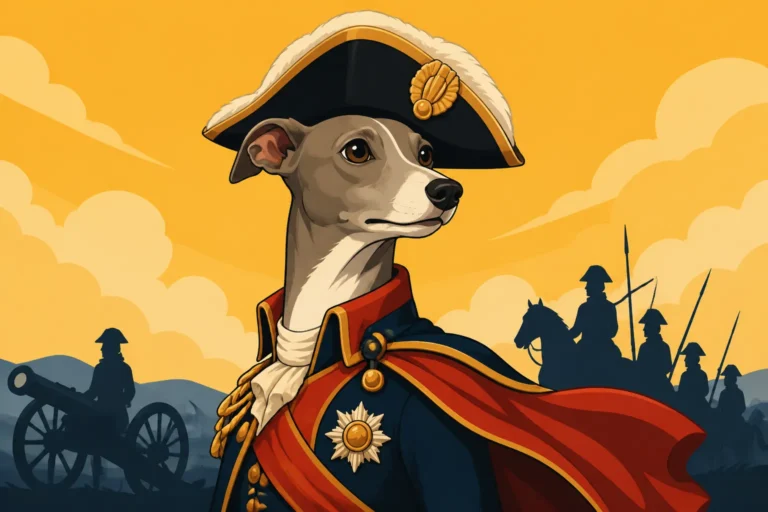
Which Came First, the Italian Greyhound or the Whippet
The Italian Greyhound and the Whippet look like close relatives, so it is easy to assume one was bred from the other. The short answer is that the Italian Greyhound came first as a recognizable small sighthound type. The Whippet took shape much later in Britain, though neither breed’s early history can be pinned to one exact date or a neat family tree.
The short answer depends on what “came first” means
The Italian Greyhound has the older history
Small, fine-boned sighthounds resembling Italian Greyhounds appear in historical art and accounts long before the Whippet emerged as a named, deliberately developed breed. Dogs with a similar elegant outline were kept in the Mediterranean world and later became favorites in European courts. That long visual record is why the Italian Greyhound is often described as an ancient breed.
But a picture of a small, slender dog is not the same thing as a modern pedigree record. Artists did not label every dog, and a dog that looks like an Italian Greyhound in a painting cannot automatically be identified as one by today’s breed standards. It is safer to say the small sighthound type has a long history than to claim that today’s breed existed unchanged thousands of years ago. For a broader overview of the disputed early record, see Where the Italian Greyhound Comes From and How Old the Italian Greyhound Breed Is.
The Whippet developed as a distinct breed later
The Whippet is a comparatively modern breed, shaped in Britain, particularly in working-class communities in the north of England, during the 18th and 19th centuries. Small, fast dogs were valued for chasing rabbits and competing in informal races. Over time, those dogs developed into the recognizable Whippet breed.
The Whippet’s history is more closely tied to the development of a specific British breed than the Italian Greyhound’s is. That does not mean that no small dogs resembling Whippets existed earlier; it means the Whippet as a distinct, named breed took shape later. The best short answer is therefore: the Italian Greyhound’s small-sighthound ancestry and type predate the Whippet breed, but the two are related members of a broader sighthound family, not a simple parent-and-child pair.
| Question | Italian Greyhound | Whippet |
|---|---|---|
| Which has the older breed history? | Older small-sighthound type and longer historical record | Developed later as a distinct British breed |
| Where is its history most associated? | Mediterranean Europe and later European courts | Britain, especially northern England |
| Was one simply bred from the other? | No clear basis for treating it as the Whippet’s direct ancestor | No; the Whippet developed through a broader, separate breeding history |
| What makes the early history difficult to date? | Art and descriptions do not prove modern pedigree continuity | Breed formation happened gradually rather than on one exact date |
Why their family histories are easy to mix up
Similar bodies do not prove a direct line of descent
Both breeds share the classic sighthound shape: a narrow waist, long legs, deep chest, and a light, streamlined frame. Both can accelerate quickly and use sight to pursue moving animals. When you see an Italian Greyhound beside a Whippet, the resemblance can make the family relationship seem obvious.
Still, resemblance is not proof that one breed came directly from the other. Breeders in different places can select for similar traits—speed, agility, and a body built for quick bursts of movement—without creating a direct line from one modern breed to another. Across the wider sighthound family, related body shapes developed for comparable purposes. The Italian Greyhound and Whippet are cousins in the broad sense of sharing a sighthound heritage, but their separate histories matter.
Their size difference can also encourage a misleading story: that the Italian Greyhound is simply a miniature Whippet. The Italian Greyhound is a breed with its own history and standard, not just a smaller version of a larger dog. For a practical comparison of their builds and characteristics, read How an Italian Greyhound Differs From a Whippet.
“Italian Greyhound” does not mean the breed began in Italy
The name can make the origin sound more certain than it is. The Italian Greyhound became especially associated with Italy and its art, nobility, and courts, but that association does not establish that the breed originated there. Breed names often reflect where a dog became fashionable or widely recognized, rather than the precise birthplace of its earliest ancestors.
The same issue comes up when people look for evidence in ancient art. A slender dog in a tomb painting or sculpture may resemble an Italian Greyhound, but visual similarity alone cannot establish an unbroken line to the modern breed. The question of ancient representations is fascinating, but it deserves a careful distinction between “a dog that looks similar” and “a documented Italian Greyhound.” For more on that distinction, see Whether Italian Greyhounds Appear in Egyptian Tombs and Why the Breed Is Called the Italian Greyhound.
What the historical record can and cannot tell us
Art offers clues, not a complete pedigree
Portraits, sculptures, and written descriptions help show that small, elegant dogs were valued in different eras. In European portraits especially, these dogs appear as companions of wealthy families and members of royal courts. Their presence helps explain why the Italian Greyhound became so closely connected with companionship and refined domestic life.
Historical images can tell us about appearance and social role, but they rarely provide the details needed to trace a modern breed precisely. An artist might exaggerate a dog’s legs or proportions, and a written description might use a name that does not map neatly onto a current breed. The safest historical reading is gradual: small sighthounds were present, admired, and selectively bred over time, while the modern breed identity developed through later conventions.
That distinction also answers a common question about whether today’s Italian Greyhound has existed for a precise number of centuries. There is evidence of a long-standing type, but the exact moment when that type became the modern breed is hard to establish. A detailed look at that question is available in How Old the Italian Greyhound Breed Is.
Breed standards are much newer than breed-like dogs
A breed standard describes the traits expected of a recognized modern breed, such as size, proportions, coat, and movement. Standards and formal breeding records are relatively recent compared with the centuries of dogs that may have resembled the breed. So a historical dog can look very much like an Italian Greyhound without meeting today’s standard—or without having been called an Italian Greyhound at all.
This is why “which breed is older?” has two possible answers. If you mean which modern breed received formal recognition first, that depends on the specific country’s kennel-club records and what point in the recognition process you count. If you mean which type of dog has the longer historical presence, the Italian Greyhound’s small-sighthound ancestry is older than the Whippet as a distinct British breed.
For readers interested in how physical standards shape the way a breed is identified today, What Height the Italian Greyhound Standard Asks For offers useful context. The standard describes the modern breed; it cannot, by itself, settle the full story of its ancient origins.
How the breeds relate today
Both are sighthounds, but they are not interchangeable
The Italian Greyhound and Whippet share broad sighthound traits, but their differences are real. Italian Greyhounds are much smaller and more delicate in build. Whippets are larger, with a more substantial frame, though still lean and athletic. Those differences influence everyday life: handling, exercise, clothing, safe play, and the kinds of environments that suit each dog.
Their shared instincts can also surprise people who assume a small companion dog will behave like a purely indoor pet. Both breeds may notice fast-moving animals and respond with a chase. A secure, enclosed area is important for running, and neither breed should be trusted off leash in an open space simply because it knows its name. If you are weighing a Whippet against an Italian Greyhound for your home, Italian Greyhound or Whippet for an Apartment can help you think through practical fit.
DNA can clarify relationships without supplying a perfect timeline
Genetic studies can help show how breeds are related and distinguish broad ancestry from superficial resemblance. But DNA does not usually answer a simple historical question like “Which came first?” in the way a dated document might. A breed’s genetic profile reflects many generations of breeding, mixing, and selection; it does not provide a single birth certificate for the breed.
It is also worth separating the ancestry of a modern breed from the history of the dogs that came before it. Genetic evidence may point to relationships among sighthounds, but the precise sequence of early populations and local breeding choices can remain uncertain. For that reason, claims that one breed is definitely the direct ancestor of another should be treated cautiously unless supported by clear historical evidence. More background is available in What DNA Studies Say About the Italian Greyhound.
A simple way to remember the answer
Think of the Italian Greyhound as the older small-sighthound type, with a long and somewhat difficult-to-document history, and the Whippet as a later breed developed in Britain. Their shared outline reflects a broader sighthound heritage, not proof that the Whippet was created by enlarging an Italian Greyhound or that the Italian Greyhound was made by shrinking a Whippet.
If you encounter an especially confident claim—such as an exact ancient origin date or a direct breed-to-breed family tree—look for what kind of evidence is being offered. Historical art can suggest resemblance, breed standards define modern appearance, and genetic studies can reveal relationships. None of those, alone, necessarily supplies a complete chronology. Keeping those distinctions in mind makes the answer both clearer and more honest: the Italian Greyhound came first as a historical type, while the Whippet became a distinct breed later.
Disclaimer
This article is for general informational purposes only and does not constitute professional advice. Laws, prices and regulations vary by location and change over time. Consult a qualified professional for guidance on your specific situation.