Where Bosch Put an Italian Greyhound
Bosch never captioned a dog as an Italian Greyhound, so the animal people notice in his painting cannot be identified with certainty. The familiar candidate appears in The Garden of Earthly Delights, among the crowded figures of the central panel. Here’s where to look, what the image may suggest, and why “Italian Greyhound” is best treated as a modern comparison rather than a confirmed label.
Where to Look in Bosch’s Painting
The dog in The Garden of Earthly Delights
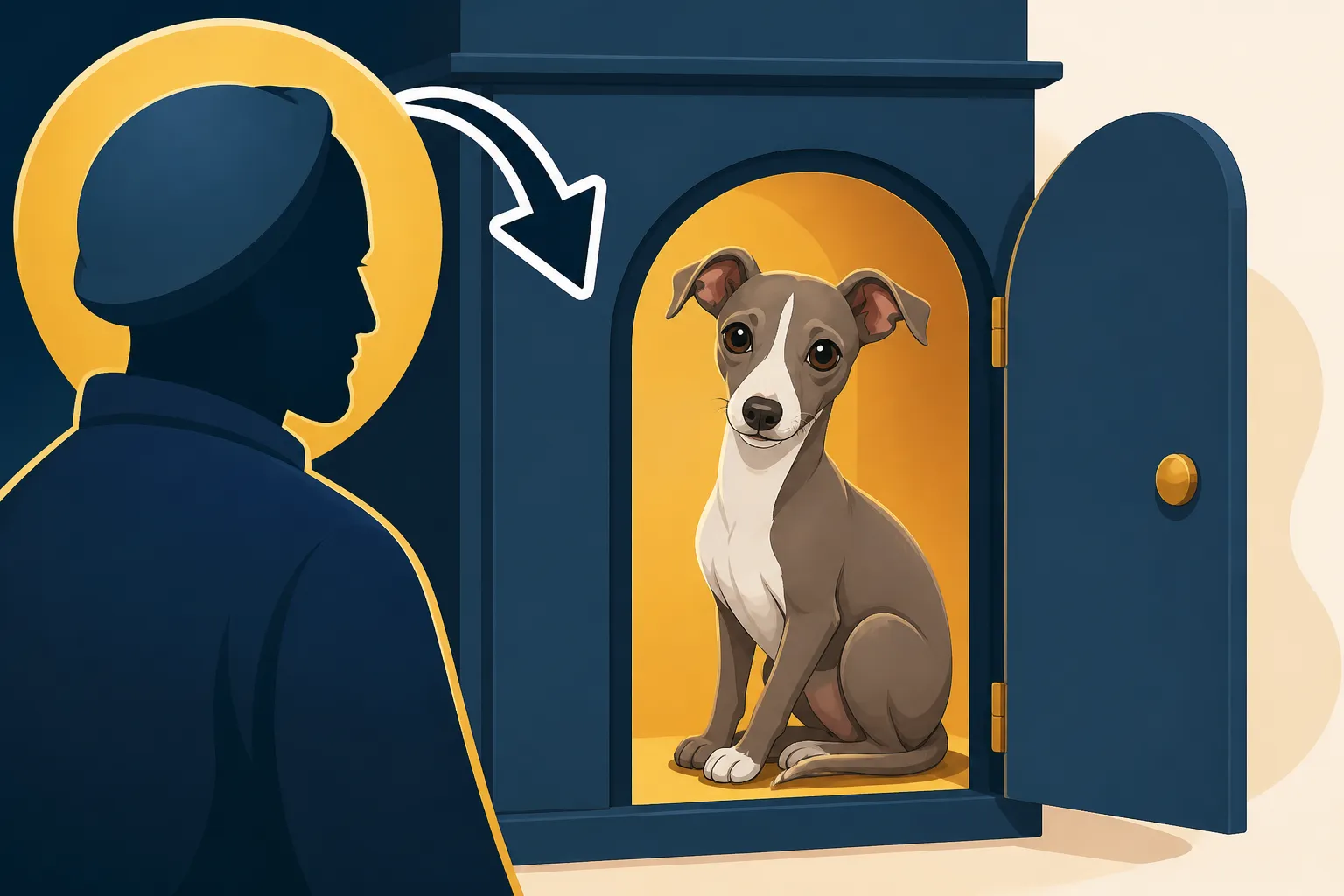
Start with The Garden of Earthly Delights, Bosch’s large triptych now held at the Museo del Prado in Madrid. The slender dog commonly compared with an Italian Greyhound appears in the lower part of the central panel, among the human figures and other creatures. It is easy to miss at first: the painting is packed with small scenes, and your eye may keep jumping from one strange detail to another.
The central panel shows a fantastical world of people, animals, fruit, and playful or unsettling encounters. Bosch gives no caption explaining the dog, and there is no written note from the painter naming its breed. That means the identification rests on visual resemblance: the animal looks lean and fine-boned, with the general outline people associate with a small sighthound.
If you’re viewing the triptych in person, give the central panel a slow scan rather than trying to take it all in at once. A high-resolution reproduction can help, too, because small figures are difficult to pick out from across a gallery or in a quick glance. The dog is a detail within the scene, not the painting’s subject.
Why a tiny detail draws so much attention
Part of the appeal is the contrast. Bosch’s painting is crowded with extraordinary inventions, yet a familiar-looking dog can suddenly feel like a small, recognizable point of contact. For anyone who loves Italian Greyhounds, it’s natural to wonder whether the breed’s long history has reached back into the picture.
That curiosity is reasonable, but resemblance alone can’t establish a breed. Many dogs share a slender body, narrow head, and long legs. A painter could also simplify or stylize an animal to suit the composition, rather than recording its proportions as a modern breed specialist would.
Bosch’s picture invites close looking, but it also rewards patience about what we can claim. The safest description is that the dog resembles a small sighthound or an Italian Greyhound to modern eyes. The stronger claim—that Bosch deliberately painted a dog of the formally defined breed we recognize today—goes beyond the evidence visible in the painting.
Is It Really an Italian Greyhound?
A resemblance is not a pedigree
The phrase “Italian Greyhound” is useful as a visual comparison, but it can mislead if it sounds like a documented identification. Bosch left no label beside the animal, and the image itself cannot tell us the dog’s ancestry, owner, or exact type. Even a striking likeness is not the same as proof.
The dog may reflect the appearance of small, elegant sighthounds familiar in Bosch’s world. Dogs with a similar general build existed before modern kennel clubs and breed standards. Over time, people bred dogs toward particular traits, and formal descriptions helped make breed identity more consistent. That process makes it tricky to map a present-day breed name neatly onto a dog painted centuries ago.
For a little more context on the breed’s long history, see The Italian Greyhound Is Two Thousand Years Old and Where the Italian Greyhound Comes From. Those topics help explain why the breed is often associated with older European art, while also reminding us that the history of a dog type and the history of a standardized breed are not identical.
What the painting can and cannot tell us
A painting can show how an artist imagined an animal’s shape, movement, or place in a scene. It can also offer clues about what kinds of animals people knew or found interesting. But a painted dog is not a record card: it does not supply a date of birth, breeding history, temperament, or verified breed name.
This distinction matters especially with historical artwork. Modern viewers may compare a painted dog with the Italian Greyhound’s fine frame and tucked-up outline, then conclude that it must be one. Yet another small sighthound, a mixed-type dog, or an artistic interpretation could account for the same appearance. Without a reliable written identification, those possibilities remain open.
Bosch’s image is therefore most useful as a prompt for looking and asking questions, not as proof of a particular bloodline. If you’re interested in the development of the breed’s appearance, How Italian Greyhound Type Has Changed Since 1900 and What DNA Studies Say About the Italian Greyhound explore why present-day labels and historical comparisons need to be handled carefully.
| What you can observe | What it may suggest | What it cannot prove |
|---|---|---|
| A slender dog with a fine outline | A small sighthound-like appearance | A confirmed Italian Greyhound identity |
| The dog’s position among the central panel’s figures | Bosch included it as part of a crowded scene | The dog’s role or symbolic meaning |
| A resemblance to modern breed images | A useful comparison for viewers today | The animal’s ancestry or breeding history |
| The painting’s historical setting | Small elegant dogs were part of the visual world of the period | That modern breed standards already existed |
Reading the Dog in Context
Bosch’s crowded, imaginative world
The Garden of Earthly Delights is famous for its abundance. Its panels are filled with human figures, animals, plants, unusual objects, and scenes that shift in tone from calm to bizarre. In that setting, a small dog is one detail in a much larger visual landscape. It can catch a viewer’s attention without necessarily being a central symbol or a portrait of a specific pet.
That scale can make interpretation frustrating. You may find a detail in a reproduction, then wonder whether it has a special meaning or whether the painter simply included it as part of the scene. With Bosch, it is wise to distinguish what is plainly visible from what is interpretation. The dog is there to be seen; its precise symbolic role is harder to establish.
A useful approach is to look at the dog in relation to its surroundings. Notice its position, posture, and the figures nearby, then ask what the whole scene is doing. This won’t produce a single guaranteed answer, but it avoids treating a small animal as though it were an isolated portrait with a known backstory.
Why viewers connect old art with modern breeds
Breed names make it tempting to sort every historical dog into a familiar category. A long-legged dog with a narrow body looks like an Italian Greyhound; a sturdier one may remind us of a Whippet. But today’s names and standards can make older, more varied populations seem more fixed than they were.
The Italian Greyhound has a distinctive modern identity, but its resemblance to dogs in historical art is part of a broader story about how people have lived with and depicted small sighthounds. For comparisons with related breeds, How an Italian Greyhound Differs From a Whippet and Whether the Italian Greyhound Was Bred Down From Greyhounds offer useful context. They also help separate a visual family resemblance from a definitive identification.
That distinction doesn’t make the painting less exciting. In fact, it gives the detail more room to breathe: you can appreciate the dog’s likeness to an Italian Greyhound without needing to prove that it belongs to the breed. Historical art often raises better questions than it can answer conclusively.
How to Explore the Detail Carefully
A simple way to examine the image
If you want to find the dog yourself, begin with a full image of the triptych so you understand the layout. Then focus on the lower portion of the central panel and enlarge the image. Moving gradually from the whole painting to one small area makes it easier to orient yourself; jumping straight into a tiny crop can leave you unsure where the detail sits.
Try a few passes. First, look only for the dog’s outline. Then notice its posture and nearby figures. Finally, pull back and see how the detail fits into the broader composition. This method works well in a gallery, with a museum’s online collection, or in a book that reproduces the painting clearly.
It can also help to compare descriptions rather than rely on one confident-sounding caption. Some writers may call the animal an Italian Greyhound, while others use broader language such as “small dog” or “sighthound.” When the painting supplies no name, broader wording is generally the more careful choice.
A helpful distinction between fact and interpretation
When discussing the detail, you can keep your wording both engaging and accurate. For example: “A slender dog in the central panel resembles an Italian Greyhound.” That states what a viewer can observe and makes clear that the breed comparison is an interpretation.
Avoid presenting the dog as a confirmed example of the modern breed unless you have independent evidence for that claim. The same caution applies to claims about what Bosch intended the dog to symbolize. A proposed meaning may be interesting, but it should be described as an interpretation rather than as a fact established by the image alone.
The broader history of Italian Greyhounds in art is a worthwhile subject in its own right. Which Renaissance Painters Included Italian Greyhounds and The Italian Greyhound in Carpaccio's Venice offer other avenues for exploring the breed’s artistic associations. As with Bosch, the best readings keep the difference between a recognizable resemblance and a documented identity in view.
If Bosch’s dog makes you curious about living with an Italian Greyhound today, remember that historical images can’t show the practical realities of modern care. A prospective owner might research warmth, safe handling, and dental care before bringing a dog home. Retailers such as Chewy may be one place to compare everyday supplies, but a painting is not a care guide—and practical decisions should be based on the needs of an individual dog, not its appearance in art. Chewy is relevant to that present-day shopping question, not to identifying Bosch’s painted animal.
Disclaimer
This article is for general informational purposes only and does not constitute professional advice. Laws, prices and regulations vary by location and change over time. Consult a qualified professional for guidance on your specific situation.