The Italian Greyhound in Carpaccio’s Venice
A slender dog in a Renaissance painting can look unmistakably like an Italian Greyhound, but resemblance is not proof of breed. Vittore Carpaccio’s Venetian scenes offer a fascinating glimpse of small dogs in domestic life—and a useful reminder that paintings show us how people imagined and valued animals, not always what breed they were.
The painting behind the question
Who Vittore Carpaccio was
Vittore Carpaccio was a Venetian painter working around the turn of the sixteenth century. He is known for detailed scenes that make historical and religious subjects feel grounded in the everyday life of Venice: its architecture, clothing, public spaces, and domestic interiors. That interest in lived detail is one reason viewers keep returning to the animals in his work.
Carpaccio’s paintings are not modern portraits of named pets, and their small dogs are not accompanied by breed labels. A dog may be carefully observed, but the artist’s purpose was usually broader than documenting its ancestry. The animal might help establish a scene’s domestic setting, add movement, or contribute to the social atmosphere.
That distinction matters when looking for Italian Greyhounds in Renaissance art. A long-legged, fine-boned dog can resemble the breed, but a painting alone rarely lets us confirm the dog’s lineage. The same caution applies when comparing images across periods, a question explored in Which Renaissance Painters Included Italian Greyhounds.
The Venetian scene most often discussed
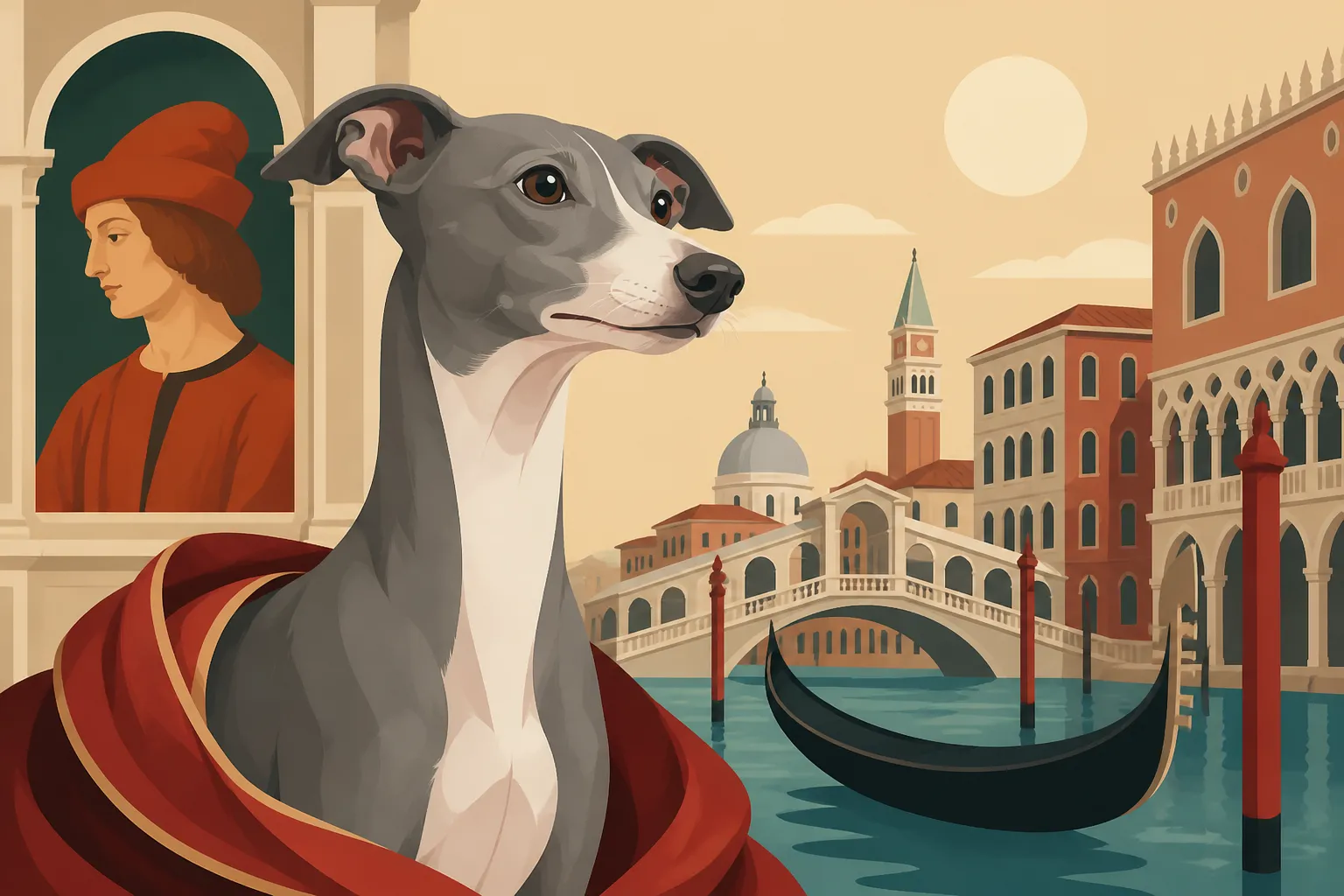
Carpaccio’s Two Venetian Ladies, generally dated to around 1490, is often brought into conversations about small dogs in Renaissance Venice. The painting shows two richly dressed women seated in a domestic setting, with animals and objects that contribute to the scene’s carefully observed atmosphere. It is also associated with a larger composition: the work now known as Hunting on the Lagoon is understood as a related fragment of that broader painted scene.
The small dog in Two Venetian Ladies draws attention because its narrow, elegant outline can evoke a greyhound-type dog. For a modern viewer familiar with Italian Greyhounds, that resemblance may feel immediate. But the image does not provide enough evidence to identify the dog as an Italian Greyhound with certainty.
Paintings can preserve visual clues: proportions, posture, coat, and the way an animal is held or positioned. They cannot, on their own, establish a modern breed identity. A careful reading therefore separates what we can see from what we infer.
| What the painting can show | What it cannot establish by itself |
|---|---|
| A small dog’s visible shape and posture | A documented pedigree or exact breed |
| The dog’s place in a domestic or social scene | Whether it matches today’s breed standard |
| How the animal contributes to the painting’s mood | Whether the artist intended a specific breed reference |
| That small companion dogs appeared in elite Venetian imagery | How common that type of dog was among all households |
What the dog may suggest about Venetian life
A companion animal in an affluent interior
The setting of Two Venetian Ladies is important. The dog appears within a world of fine clothing, furnishings, and leisure. That does not prove that only wealthy people kept small dogs, but it does show that companion animals could be included in images of elite domestic life. The dog is part of the scene’s human world rather than a distant piece of background scenery.
For viewers today, that can feel familiar. An Italian Greyhound tucked beside someone on a sofa is not merely decorative; it is part of the household’s rhythm. In Carpaccio’s painting, the small dog similarly helps make the scene feel inhabited, although we should avoid assuming that its relationship with the women was identical to the bond people form with pets now.
The image also suggests why artists might include an animal even when it is not the main subject. A dog can make a composed interior feel more personal, bring a point of visual contrast to carefully arranged clothing, or signal a life of leisure. These possibilities are part of a wider discussion in Why Painters Used the Italian Greyhound as a Symbol.
Status, affection, and the limits of interpretation
A small dog shown near fashionable people may invite a status reading: keeping and depicting an elegant companion animal could fit an image of refinement. But status is not the only possible meaning. The dog may also simply belong in the scene because small dogs were familiar companions, or because the painter wanted to add a lively detail.
It is tempting to read a Renaissance animal as a direct statement about its owner’s personality. That can lead us too far. A painting may tell us that an animal was considered suitable for a particular setting, but it cannot reliably reveal whether the women adored the dog, how they cared for it, or what it did when the painter was not looking.
Portrait symbolism is similarly layered. A dog can suggest loyalty, intimacy, privilege, or domestic comfort, depending on the image and its context. Those interpretations are useful when handled as possibilities rather than certainties, as discussed in What an Italian Greyhound Signaled in a Portrait.
Is Carpaccio’s dog an Italian Greyhound?
Why the resemblance is plausible
Italian Greyhounds have a distinctive visual impression: a fine, slender body, long legs, a narrow head, and a delicate outline. When a small dog in an old painting shares some of those proportions, modern viewers understandably make the connection. The resemblance is especially compelling because Italian Greyhounds and other small sighthound-like dogs have long been associated with elegant domestic settings.
Still, “looks like an Italian Greyhound” is not the same as “is an Italian Greyhound.” Dogs were not classified and recorded in the same way as modern pedigree breeds, and historical images often simplify or stylize animal anatomy. An artist could also combine traits from observation, convention, and artistic design.
The most responsible description is therefore that Carpaccio’s dog may look greyhound-like to modern eyes. Calling it definitively an Italian Greyhound goes beyond what the image alone can prove. That distinction is especially useful when discussing the breed’s long history, explored in The Italian Greyhound Is Two Thousand Years Old.
Why modern breed standards cannot settle the question
Today’s breed standards describe defined features such as size, proportions, coat, and movement. Those standards are useful for understanding present-day Italian Greyhounds, but they cannot be applied as a reliable identification test to a dog painted centuries ago. The artwork may not show every feature clearly, and the historical population of small dogs did not necessarily map neatly onto modern breed categories.
A painting also freezes one moment and one angle. A dog standing sideways may look more elongated than it would from the front. A seated or partly obscured animal may conceal the very features a modern breed expert would want to examine. Even the artist’s choices about scale and contour can affect how viewers read the dog.
That is why careful writing about historical dogs uses phrases such as “resembles,” “appears greyhound-like,” or “may represent a small sighthound.” Those terms preserve the visual observation without pretending that an image supplies a pedigree. For a modern comparison of body type and appearance, see How an Italian Greyhound Differs From a Whippet.
How to look at Carpaccio’s dog with care
Separate observation from interpretation
A satisfying close reading starts with simple observations. Is the dog small or large relative to the people? Are its legs long? Is its body narrow? What is its posture, and where is it placed in relation to the people and furnishings? These questions describe the image before assigning it a breed or symbolic role.
Next, consider the scene. A dog positioned within a domestic setting may contribute to a sense of private life; one shown alongside a person may emphasize companionship or social identity. Those are interpretations, not facts visible in the same way as a dog’s outline. Keeping the two categories separate makes the analysis more persuasive.
Finally, ask what remains unknown. The painting cannot tell us the animal’s name, temperament, daily routine, or exact ancestry. It can, however, invite a thoughtful discussion of how dogs appeared in art and how viewers have understood them. For a broader look at artists and the breed’s place in painted history, see The Renaissance Painters Who Put Italian Greyhounds in the Frame.
Appreciate the history without forcing a modern label
Carpaccio’s Venice is compelling partly because it gives small details room to matter. The dog in Two Venetian Ladies may remind us of an Italian Greyhound, but the painting’s value does not depend on proving that identification. It remains a vivid image of a dog included in an elegant domestic world, and that alone tells us something about the place animals could occupy in visual culture.
For Italian Greyhound enthusiasts, the painting offers a pleasing point of connection across centuries. It encourages us to notice the breed’s graceful silhouette in older art while respecting the gap between resemblance and documented identity. The same distinction helps make historical discussions more interesting, not less: we can enjoy the possibility without turning it into certainty.
If you want to explore the breed’s older associations with human companionship, Why the Italian Greyhound Was Bred Purely for Company offers a useful companion topic. For another historical angle on the breed’s relationship with people and domestic life, see The Italian Greyhound as a Bed Warmer.
Disclaimer
This article is for general informational purposes only and does not constitute professional advice. Laws, prices and regulations vary by location and change over time. Consult a qualified professional for guidance on your specific situation.