The Italian Greyhounds in Giotto’s Frescoes
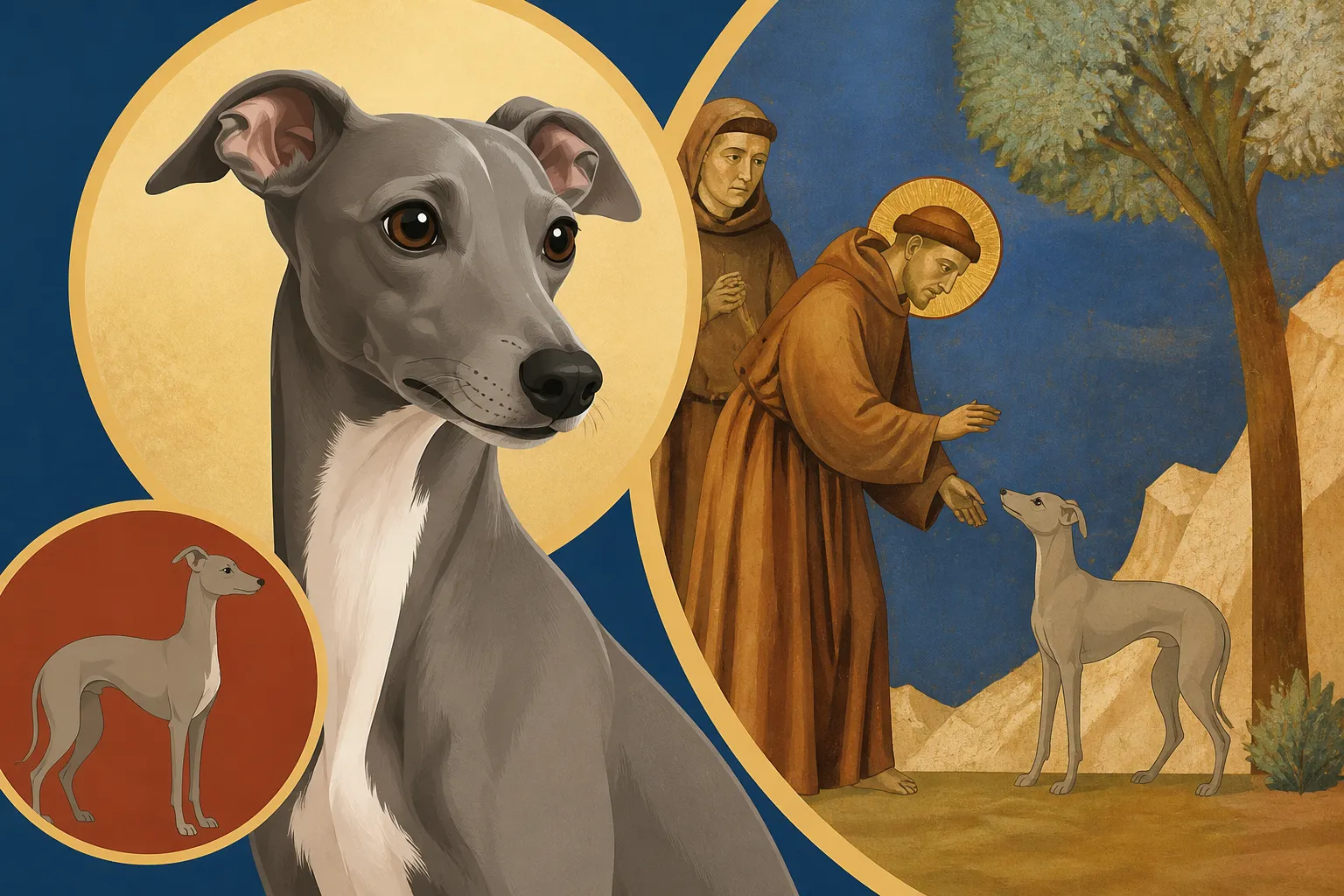
A slim dog in a Giotto fresco can look remarkably like an Italian Greyhound, especially when you already know the breed’s elegant outline. But medieval paintings are not breed records, and a resemblance alone cannot establish ancestry. This guide explains where to look, what the paintings can tell us, and why it is wise to treat claims about Giotto’s dogs with care.
Giotto’s frescoes and the dogs within them
Where to look for Giotto’s painted dogs
Giotto di Bondone is closely associated with the Scrovegni Chapel in Padua, where his fresco cycle tells stories from the lives of the Virgin Mary and Christ. The chapel is best known for its expressive faces, carefully arranged scenes, and attention to everyday human experience. Animals appear within that world too, though they are usually supporting details rather than the focus of a composition.
When looking at a dog in a fresco, start with the whole scene. Is the animal part of a domestic setting, a crowd, or a symbolic episode? Is it shown clearly enough to assess its proportions, or is it small, partly obscured, or softened by age and restoration? Those questions matter because a quick glance at a dog’s narrow body can encourage a modern viewer to see a familiar breed where the artist may simply have painted a lean, small dog.
Giotto is often discussed as an important figure in the shift toward more naturalistic painting. That does not mean every animal in his work is a portrait of a specific breed. Artists could draw on observation, workshop conventions, and visual shorthand at the same time. An animal might be recognizable as a dog without being intended to represent a particular type.
Why the word Renaissance needs a little care
Giotto worked in the late medieval period and is often described as a forerunner of the Renaissance or an early Renaissance master. The categories overlap, and art historians may use them differently depending on the context. Calling him simply a Renaissance painter is common shorthand, but it can hide how much his work belongs to the art and religious culture of the Middle Ages.
That distinction is useful when considering the Italian Greyhound. Modern breed names, written standards, and familiar ideas about pedigree developed over long periods. A medieval painter could not have been documenting a standardized breed in the modern sense just by depicting a small, fine-boned dog. For a broader look at dogs in Italian art, see The Renaissance Painters Who Put Italian Greyhounds in the Frame.
There is also a difference between a historical claim and a visual comparison. “This dog resembles an Italian Greyhound” describes what a present-day viewer sees. “This fresco proves that Italian Greyhounds existed in this exact form in Giotto’s time” makes a much stronger claim—and one the image alone cannot support.
Does a dog in a Giotto fresco look like an Italian Greyhound?
What a painted silhouette can and cannot show
People usually recognize an Italian Greyhound by its delicate build, long legs, narrow head, tucked-up waist, and fine coat. If a painted dog has some of those features, the resemblance can be striking. Yet medieval painting does not give us the kind of evidence needed to identify a dog with confidence: there is no measured body, confirmed pedigree, genetic sample, or detailed written description tied to the animal.
Even the apparent proportions can be misleading. A fresco is a two-dimensional image, and perspective, scale, pose, and the condition of the plaster all affect what we see. A dog shown in profile may appear unusually long-legged; a small figure in a crowded scene may have been simplified so it reads clearly from a distance. Restoration and surface wear can further soften outlines and details.
A helpful approach is to describe what is visible without turning those observations into a firm breed label. You might say that a dog appears small and slender, or that its outline recalls a sighthound. Those are careful visual observations. Calling it definitively an Italian Greyhound goes beyond what the fresco can establish.
A useful evidence check
When you encounter a claim that a particular Giotto dog is an Italian Greyhound, ask what the claim rests on. Is it based on the image’s appearance alone, or is it supported by a contemporary description, a reliable catalogue, or a well-established scholarly interpretation? The more specific the claim, the more important it is to look for evidence beyond resemblance.
| Claim about the fresco | What can support it | What it does not prove |
|---|---|---|
| A dog appears in a scene | The visible painted figure | Its exact breed |
| The dog looks slender or long-legged | The figure’s apparent outline | That it matches a modern breed standard |
| The dog resembles an Italian Greyhound | A comparison of visual features | A direct line of descent |
| The dog documents the breed in Giotto’s time | Independent historical evidence would be needed | The fresco alone cannot establish this |
This caution does not make the comparison useless. It simply keeps the interpretation honest. A painting can be an evocative clue about how people imagined or observed dogs without functioning as a precise record of breed history. The same distinction helps when considering broader questions about the breed’s early roots, including Whether the Italian Greyhound Really Dates to Ancient Egypt and What Excavated Skeletons Say About the Italian Greyhound.
What Giotto’s dog imagery tells us about medieval life
Animals as part of everyday visual storytelling
A dog in a religious fresco may help make a scene feel lived-in. Medieval viewers were familiar with animals in homes, streets, farms, and public spaces, so a dog could contribute to the ordinary texture of a narrative. Its presence might also help balance the composition or give a human figure something to look toward or interact with.
That does not mean every dog was painted from a specific animal sitting in the workshop. Artists often used repeated visual forms and inherited conventions. A dog may be rendered with enough individuality to feel present while still following a pattern that served the scene. We should be cautious about reading modern ideas of pet ownership or breed identity directly into that image.
The dog can still invite worthwhile questions. Was it meant to signal domestic life? Is it simply part of the setting? Does its position draw attention to a human figure or to the action? Those questions keep the viewer close to what the artwork actually offers rather than asking a small painted animal to carry the entire history of a breed.
From medieval companions to modern breed history
Italian Greyhounds have a long association with human companionship, but the history of a recognizable modern breed is not identical to the history of every small, slender dog shown in earlier art. Images, written descriptions, bones, and later breeding records each offer different kinds of evidence. None should be treated as interchangeable.
For example, a painted dog can suggest that artists and viewers knew small dogs with certain general features. It cannot tell us how those dogs were bred, whether they formed a stable population, or whether they are direct ancestors of today’s Italian Greyhounds. That broader question is part of the discussion around Why the Italian Greyhound Was Bred Purely for Company and What DNA Studies Say About the Italian Greyhound.
Later depictions can help trace changing tastes in dogs, but they also need context. A dog’s appearance may reflect the artist’s style, the owner’s preferences, or the conventions of a particular period. For perspective on how much the breed’s type has shifted over time, see How Italian Greyhound Type Has Changed Since 1900. That history makes it even more important not to expect a medieval image to match a contemporary show-ring silhouette exactly.
How to interpret a Giotto fresco responsibly
A simple method for evaluating breed claims
If a caption, article, or social post identifies a dog in Giotto’s work as an Italian Greyhound, use a few practical checks before repeating the claim:
- Identify the artwork and location. Giotto’s name is attached to several important cycles and commissions, and attributions can be complicated. Confirm which fresco the discussion refers to.
- Look closely at the image. Note what is genuinely visible: size, posture, proportions, and any distinctive features. Avoid filling in details that are too small or worn to see.
- Separate resemblance from identification. “Looks like an Italian Greyhound” is a visual comparison. “Is an Italian Greyhound” is a historical identification that needs stronger support.
- Check the wording of the evidence. A reliable discussion should explain whether it is offering an interpretation, a comparison, or a documented conclusion.
- Keep breed history in view. Modern standards and pedigree systems cannot simply be projected backward onto medieval paintings.
This method is useful beyond Giotto. Old artworks often show animals that resemble familiar breeds, and it is tempting to treat those pictures as snapshots of a modern dog’s ancestry. But artists were not necessarily making documentary records. Their images can preserve valuable clues about human relationships with animals while leaving important details unanswered.
Enjoy the resemblance without overstating it
There is nothing wrong with seeing an Italian Greyhound in a slender dog painted centuries ago. That recognition can make the fresco feel personal: suddenly, a familiar companion seems to have a place in a much older visual world. The key is to make room for both appreciation and uncertainty.
A balanced description might say that a dog in a Giotto-associated fresco has features that remind modern viewers of an Italian Greyhound, while noting that the painting cannot confirm its breed. That phrasing respects the artwork, avoids turning speculation into fact, and still captures why dog lovers find the image compelling.
The most rewarding way to view these frescoes is to notice the animal as part of Giotto’s broader effort to make sacred stories feel human and immediate. The dog may not settle the Italian Greyhound’s origins, but it can prompt a richer conversation about the long companionship between people and dogs—and about how carefully we should interpret the past.
Disclaimer
This article is for general informational purposes only and does not constitute professional advice. Laws, prices and regulations vary by location and change over time. Consult a qualified professional for guidance on your specific situation.