The Italian Greyhound Frederick the Great Took to War
Frederick the Great is remembered as a Prussian king and military commander, but he was also devoted to small greyhounds. Stories of an Italian Greyhound accompanying him during wartime have a special appeal—and leave plenty of questions about what really happened. This guide separates the well-established history from the anecdotes and explains why the little dog mattered to Frederick.
Frederick the Great and his Italian Greyhounds
A king with a well-known affection for dogs
Frederick II of Prussia, often called Frederick the Great, ruled from 1740 to 1786. His reputation was shaped by military campaigns and political ambition, but his private life included a deep attachment to dogs, especially small greyhounds commonly identified as Italian Greyhounds.
Accounts of Frederick’s dogs appear in stories about court life and his personal routines. He kept several over the years, and they were not simply decorative animals kept at a distance. They were companions who shared his living spaces and, according to historical accounts, were close to him in a way that surprised some observers.
That intimacy helps explain why tales of a dog beside the king during war have endured. The image is vivid: a powerful ruler moving through a dangerous military world with a small, fine-boned dog at his side. Yet the popular version can make the story sound more certain and uniform than the surviving details allow.
Frederick’s affection for the breed is part of a much longer European history of Italian Greyhounds as close companions to wealthy and royal households. Their small size, elegant outline and intense attachment to people made them suited to palace life, although their appeal was not limited to Frederick. For more context, see Which Royals Kept Italian Greyhounds and Why the Italian Greyhound Was Bred Purely for Company.
Who was Biche?
The dog most closely associated with Frederick is often called Biche. The name is French for a female deer, and the dog is commonly described as an Italian Greyhound. Frederick spoke and wrote French, and French names were familiar in his courtly world.
Biche appears in later accounts as a cherished companion. The stories do not all provide the same level of detail, and not every colorful anecdote can be treated as a firmly documented event. It is safer to say that Frederick’s attachment to his Italian Greyhounds is well known, while some specific scenes involving an individual dog have been retold with varying details.
That distinction matters because popular history tends to turn a collection of memories and anecdotes into one neat story. A beloved dog may become a single named character in every account, even when the original record is less tidy. When reading about Biche, it helps to separate the broader, widely repeated picture of Frederick as a devoted dog owner from claims about exactly where a particular dog travelled or what happened during a particular battle.
The dog’s place in Frederick’s life is still meaningful without embellishment. The surviving tradition reflects a ruler who wanted canine company and who did not treat small dogs as mere ornaments. It also sits within the wider story of the breed’s relationship with human companions, explored in The Italian Greyhound as a Bed Warmer.
Did Frederick really take an Italian Greyhound to war?
The wartime story and its limits
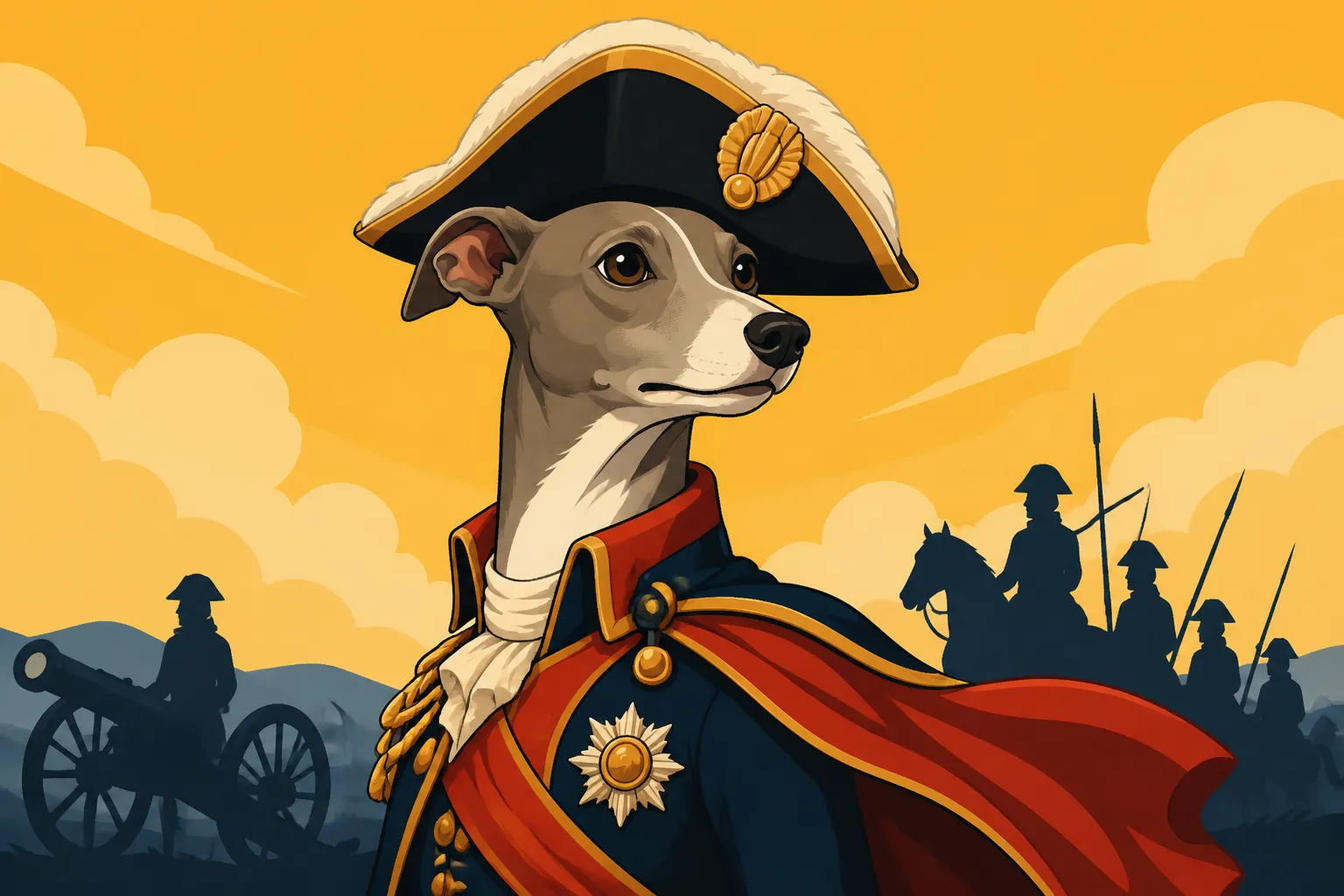
Frederick fought in major conflicts, including the War of the Austrian Succession and the Seven Years’ War. Stories connect his Italian Greyhounds with military campaigns, and the image of a small dog accompanying him has become part of the breed’s historical lore.
But “took to war” can mean several different things. It might mean that a dog travelled with a royal household during a campaign, was present at a military camp, or accompanied Frederick personally during some part of his service. It does not necessarily mean the dog was beside him on a battlefield during active fighting. The phrase often compresses a complicated journey into a memorable line.
Military life in the eighteenth century was not a modern deployment with standardized arrangements for pets. A ruler’s movements involved staff, attendants, horses, supplies and household members. A companion dog might travel with that wider household, with people responsible for its care. The practical details—where the dog slept, how often it travelled, and whether it remained near Frederick throughout a campaign—are not consistently established in retellings.
So the most balanced answer is that Frederick’s dogs are associated with his wartime life, but the precise extent of any individual dog’s presence during specific battles should be treated cautiously. The story is plausible in the context of his attachment to his dogs, but an evocative anecdote is not the same thing as a detailed military record.
Why a small dog could travel with a ruler
An Italian Greyhound’s size made close companionship physically possible in ways that would not suit a much larger dog. A small dog could be carried, kept near a person indoors, or transported with a household. That does not mean travel was comfortable or safe by modern standards, but it helps explain why a tiny companion could appear in a royal setting connected with military movement.
For Frederick, the dog’s value was likely emotional as much as practical. Campaigns could mean long separations from familiar routines and people. An animal that offered comfort and continuity could have been a reassuring presence amid uncertainty. That interpretation is reasonable, but it should not be mistaken for proof of exactly how Frederick’s dogs were managed on the march.
There is another reason these stories stick: the contrast is striking. Frederick’s public image is martial and commanding; the Italian Greyhound is delicate-looking, affectionate and physically vulnerable. Seeing those traits together makes the story feel almost cinematic. It also reminds us that even people whose lives were defined by power and conflict sought ordinary companionship.
| What is commonly said | What can be stated cautiously | What should not be assumed |
|---|---|---|
| Frederick kept and loved Italian Greyhounds | His affection for small greyhounds is a persistent part of his historical reputation | That every anecdote about a named dog is fully documented |
| Biche was one of his best-known dogs | Biche is commonly identified as an Italian Greyhound and associated with Frederick | That she was present at every campaign or battle |
| A dog accompanied Frederick during wartime | Stories link his dogs with military life and travel | That “at war” necessarily means on the battlefield during combat |
| Frederick wished to be buried near his dogs | His burial wishes and the dogs’ graves are part of the Sanssouci story | That every detail of the burial story happened exactly as later retellings describe |
For the related story of the king’s burial wishes, see Where Frederick the Great Buried His Italian Greyhound and Whether Frederick the Great Got the Grave He Asked For.
What the story tells us about Italian Greyhounds
A companion breed, not a miniature battlefield dog
The Italian Greyhound’s history is often told through its connection with courts, noble households and close human companionship. The breed’s light frame and refined appearance can make it seem fragile, and it does require sensible handling. But its historical role was not to serve as a military working dog. Its value was companionship.
Frederick’s story fits that pattern. The dog was noteworthy not because it had a battlefield job, but because it belonged within the king’s personal world. A companion could be important without carrying messages, guarding a camp or performing a formal task. That distinction is easy to miss when a story is framed around a king’s military career.
The breed’s delicacy also needs a little perspective. Italian Greyhounds are athletic dogs, capable of movement and bursts of speed, but their fine limbs and slim bodies call for thoughtful care. A modern owner should not interpret historical tales of travel as evidence that an Italian Greyhound can safely manage every environment or activity. A dog’s needs depend on its health, age, conditioning and surroundings.
To understand the breed beyond its royal associations, it helps to look at its broader development and reputation. The Italian Greyhound Nearly Died Out Twice in Europe describes how the breed’s fortunes changed over time, while The Italian Greyhound Against the Whippet and the Greyhound offers a useful comparison with its larger sighthound relatives.
Why the tale still resonates
People are drawn to the image of a king taking a little dog into a world of armies and danger because it feels personal. Historical figures can seem remote when described only through treaties, battles and political decisions. A beloved animal makes the person more recognizable: someone with routines, preferences and attachments.
For Italian Greyhound enthusiasts, the story also gives the breed a place in a broader cultural history. It is not just an elegant dog that appears in portraits or royal households; it is an animal whose people valued its closeness. That may feel familiar to anyone who has lived with an Italian Greyhound that follows them from room to room, seeks warmth, or settles beside them whenever possible.
There is a gentle irony in the story, too. The same qualities that make an Italian Greyhound seem vulnerable—its small frame, fine coat and close reliance on people—are part of what can make it such a devoted companion. The historical record does not need to prove that a dog stood beside Frederick in every crisis for the bond to matter. It is enough that these dogs were part of his life and that the relationship was remembered.
How to read the legend without losing the history
Separate the central fact from the dramatic retelling
When a historical anecdote has travelled through generations, ask what its core claim is. In this case, the core is that Frederick the Great kept and loved Italian Greyhounds, and stories associate his dogs with his life during wartime. The more specific the claim becomes—one exact battle, one dramatic rescue, or one unbroken journey—the more careful a reader should be.
This approach does not drain the story of its charm. It keeps the human truth while avoiding false certainty. Many meaningful historical relationships are known through incomplete records. An absence of detailed proof about every episode does not mean the relationship was invented; it means the details should be described with care.
It is also worth remembering that breed names and classifications have changed over time. A dog described in an older account as a small greyhound may not always be labelled using today’s exact terminology. Biche is commonly called an Italian Greyhound in accounts of Frederick, but broad historical descriptions do not always map perfectly onto modern breed paperwork.
The most responsible takeaway
Frederick’s Italian Greyhound is best understood as a cherished companion linked to a king whose public life was dominated by war. The popular story of a little dog taken to war captures something believable about their closeness, but claims about exactly what happened in particular campaigns need qualification.
That is a satisfying story in its own right. It shows how a small companion could matter in a life built around power and conflict—and why the relationship between people and Italian Greyhounds has remained part of the breed’s appeal. The history is strongest when the affection is acknowledged without turning every retelling into a confirmed battlefield scene.
Disclaimer
This article is for general informational purposes only and does not constitute professional advice. Laws, prices and regulations vary by location and change over time. Consult a qualified professional for guidance on your specific situation.