How Narrow the Italian Greyhound Gene Pool Became
A small breed population can carry less genetic variety than its headcount suggests, and the Italian Greyhound’s history includes periods when war, geography, and breeding choices made that concern especially real. This guide explains how the breed’s gene pool narrowed, what that means for health today, and how breeders and puppy buyers can think about genetic diversity without treating every pedigree as a warning sign.
What a narrow gene pool means for the Italian Greyhound
Headcount and genetic diversity are not the same thing
A breed can have many living dogs and still have limited genetic diversity. What matters is not just how many Italian Greyhounds exist, but how many unrelated family lines contribute to the next generation. If a small number of dogs produce a large share of puppies, their genes become common while other lines become harder to find.
This is one reason a pedigree can be long without representing a broad genetic base. A dog may have many ancestors listed on paper, yet some ancestors may appear repeatedly across both sides of the family. Repeated appearances are not automatically evidence of a problem, but they can show how concentrated a line has become.
A useful way to picture it is a neighborhood with many houses but only a few original families. The population looks large, but much of it may trace back to the same small group. In dog breeding, that concentration can happen through popular sires, limited access to breeding stock, or a sharp decline in the number of dogs available after a crisis.
Why bottlenecks matter
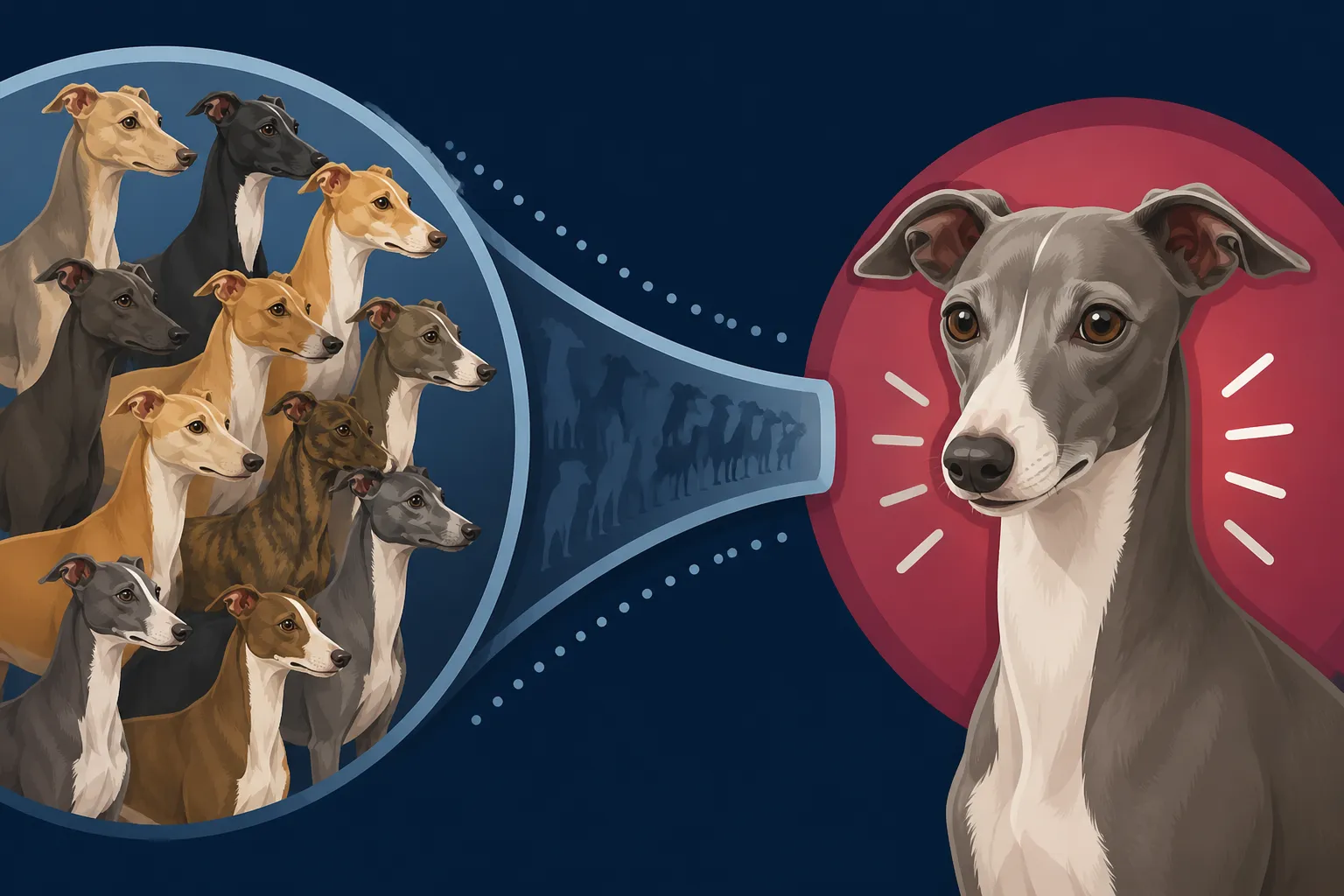
A population bottleneck occurs when the number of breeding animals falls sharply. The surviving dogs carry only part of the variation that existed before the decline. Even if the population later grows, lost genetic variants do not automatically reappear; they return only if they survive in another line or are introduced from a related population.
For the Italian Greyhound, historical disruptions in Europe are an important part of the story. Wars, economic hardship, and reduced breeding activity affected many dog populations. A small companion breed with a relatively limited breeding population is especially vulnerable when breeders are separated, breeding programs stop, or only a few dogs remain available for future litters. The wider background is explored in What World Wars Did to the Italian Greyhound.
A bottleneck does not mean every modern Italian Greyhound is unhealthy, nor does it mean the breed is destined to decline. It does mean breeders have a responsibility to understand how family lines connect and to avoid making breeding decisions based only on convenience, appearance, or a familiar kennel name.
Inbreeding and genetic diversity are related but not identical
Inbreeding describes how closely related a dog’s parents are. Genetic diversity describes the range of genetic variation across a population or within an individual. A close mating can increase the chance that a puppy inherits two copies of the same variant from a shared ancestor, including a harmful variant. But a low diversity measure is not itself a diagnosis, and a single number cannot tell an owner whether a dog will become ill.
Pedigree-based calculations also depend on how complete and accurate the records are. If older ancestors are missing, relatedness can be underestimated. DNA-based estimates may add useful information, but different tests measure different things and should be interpreted with a veterinarian or a knowledgeable breed geneticist rather than treated as a simple pass-or-fail score.
| Term | What it describes | Why it matters |
|---|---|---|
| Population bottleneck | A sharp reduction in breeding population size | Some genetic variation may be lost |
| Inbreeding | The parents’ degree of relatedness | Increases the chance of matching inherited variants |
| Genetic diversity | The range of genetic variation in a population or dog | Helps describe the breadth of the gene pool |
| Popular sire effect | A small number of males producing many offspring | Can spread both desirable and harmful variants widely |
| Genetic test | A test for specific variants or broader patterns | Useful only when the test and result are interpreted in context |
How the Italian Greyhound’s gene pool became vulnerable
War and rebuilding changed which lines survived
The breed’s history did not unfold as a steady, uninterrupted expansion. In parts of Europe, breeding populations were disrupted during the world wars, and the dogs and records that survived were not necessarily a representative sample of all earlier lines. When breeding resumed, recovery depended on the dogs and breeding knowledge that remained accessible.
This kind of rebuilding can preserve a breed while also narrowing its options. If only a small number of dogs are available, breeders may need to rely on them repeatedly. Later generations can grow in number, but the same founders may still appear often in pedigrees. For more on the postwar history, see What World War One Did to the Italian Greyhound, What World War Two Did to the Italian Greyhound, and Which Country Rebuilt the Italian Greyhound.
The history is not simply a story of one country saving the breed or one group of breeders making all the difference. Breeding populations move across borders, and individual dogs can have an influence far beyond the place where they were born. Whether Italian Breeding Stock Survived the War offers another angle on how survival and rebuilding affected the breed’s lines.
Popular sires can narrow a population even when breeding is careful
A popular sire is a male used widely because breeders value his structure, temperament, health, or show success. Using a high-quality dog is not inherently irresponsible. The concern arises when many breeders use the same male, especially before enough of his offspring have matured to reveal possible inherited health patterns.
If a sire passes along a harmful recessive variant, widespread use can make that variant much more common. Even without a known disease variant, heavy reliance on a few dogs reduces the number of distinct genetic contributions in future generations. The same effect can occur when a particular family becomes fashionable and breeders repeatedly select dogs from that family.
This is why a responsible breeding plan considers the wider population, not only whether two individual dogs look like a good match. A breeder may choose a dog with an excellent show record and still decide against using him heavily if his close relatives are already overrepresented. Genetic management is often about restraint and long-term thinking, not finding one perfect dog.
Breeding for extreme smallness can add pressure
The Italian Greyhound is a naturally fine-boned toy sighthound, but selecting ever smaller dogs can create additional welfare concerns. Very small size is not a substitute for soundness, and breeding choices that prioritize a fashionable miniature look can put health and structural quality second. The history of breeding very small dogs is discussed in Whether the Italian Greyhound Was Ever Bred Too Small and Why Very Small Italian Greyhounds Are Unsound.
A narrow gene pool and selection for a particular look can reinforce one another. If breeders repeatedly select from a small group of unusually tiny dogs, they may concentrate ancestry further while also narrowing the range of traits considered acceptable. That does not mean every small Italian Greyhound has a genetic problem; it means size should be considered alongside overall health, proportion, movement, temperament, and family history.
For puppy buyers, a breeder’s focus on “teacup” or unusually tiny puppies should prompt careful questions. The breed standard and a responsible breeding program are not about chasing the smallest possible dog. Ask what health information supports the breeding, how the breeder evaluates the parents, and whether the breeder can explain the strengths and limitations of the family line.
What genetic narrowing can mean for health today
A narrow gene pool changes risk, not destiny
When genetic diversity is limited, certain inherited variants can become more common. That can increase the chance of some health conditions appearing in a population, but it does not mean every dog will inherit a disorder or that every condition in the breed is caused by low diversity. Health is shaped by genetics, environment, veterinary care, and chance.
It is also important not to confuse a breed-wide risk with an individual diagnosis. A dog’s ancestry may help a veterinarian assess what to monitor, but a pedigree alone cannot establish that the dog is affected. Conversely, a dog with no obvious family history can still develop a health problem.
The practical response is informed screening, good recordkeeping, and breeding choices that consider both individual dogs and the population as a whole. Buyers can review What an Italian Greyhound Breeder Should Have Tested and What Health Testing an Italian Greyhound Breeder Should Show to learn what kinds of questions to raise. Testing is most useful when the breeder can explain what each result does—and does not—tell them.
DNA tests have limits
A DNA test can identify specific variants when a reliable test exists for the condition in question. It may also provide information about genetic relationships or diversity, depending on the test. But no single consumer test can certify that a dog is free from every inherited disease, and a clear result for one variant does not guarantee lifelong health.
Before relying on a result, ask what the test actually measures, whether it is intended for Italian Greyhounds, and how the findings should affect a breeding decision. A dog that carries a recessive variant may be healthy; the concern is how that dog is paired. In some cases, a carefully planned pairing with a dog that does not carry the same variant can preserve valuable genetic diversity while avoiding affected puppies.
Some owners first encounter genetic testing while browsing pet retailers such as Chewy. The important step is to identify the laboratory and the exact test, then discuss the result with a veterinarian or breeder who understands the breed. A retailer name alone does not tell you what a test covers or whether its results answer your question.
Health monitoring is more useful than fear
It is easy to hear “narrow gene pool” and conclude that every Italian Greyhound is fragile or genetically doomed. That is not a helpful reading of the issue. The breed has many healthy, active dogs, and careful veterinary care supports their wellbeing. What matters is avoiding complacency about inherited risks and resisting claims that a single test or pedigree label guarantees health.
A practical owner can keep copies of veterinary records, share relevant family history with the clinic, and follow age-appropriate preventive care. When a breeder provides health documentation, keep it with the dog’s records rather than relying on memory. If you use Chewy or another retailer for routine pet purchases, that does not replace medical records or veterinary interpretation; keep health documents in a separate, organized place.
If a test result raises questions, ask the veterinarian what it means for this dog’s care. If you are considering breeding, seek guidance from a veterinarian familiar with reproduction and inherited disease. The goal is to make decisions based on evidence about the individual dog and the wider family, not on online alarm or reassuring slogans.
How breeders and puppy buyers can support diversity
Questions worth asking a breeder
A responsible breeder should be able to discuss health, temperament, and ancestry in a straightforward way. The conversation should go beyond “the parents are healthy.” Ask which health evaluations were performed, what the results mean, and whether there are known conditions in close relatives. A good breeder may not have an answer to every question, but should be open about what they know and what they are still learning.
Ask how the breeder chooses a mate for a dog. Do they consider how often the same ancestors appear in the proposed litter’s pedigree? Do they avoid overusing one male? Are they willing to explain why a particular pairing supports the long-term health of the breed, rather than only why the puppies may look appealing?
You can also ask how the breeder keeps in touch with puppy families. Information about health and longevity in previous litters can help breeders make better future decisions. A breeder who welcomes updates—even years later—may be gathering the kind of real-world information that pedigrees and tests alone cannot provide.
What a buyer can and cannot control
A puppy buyer cannot fix the breed’s gene pool through one purchase, and it is not fair to expect an individual family to evaluate population genetics like a specialist. Still, buyers can favor breeders who are transparent, avoid marketing based on extreme size or unusual claims, and do not treat a single DNA result as proof that a dog is free of all health concerns.
If you are comparing puppies, focus on the quality of the information available: health records, the breeder’s explanations, the temperament of the parents, and the way puppies are raised. Be cautious if a seller refuses to discuss health history or insists that a particular coat color, size, or bloodline is automatically healthier. These claims need evidence, not just confidence.
A consumer DNA test can be part of an owner’s curiosity, but it should not be used as a shortcut for choosing a puppy or judging a breeder. If you are considering a kit bought through a retailer such as Chewy, check the test’s stated scope and ask your veterinarian how useful the result is for your dog. Genetic testing is one tool among several, not a substitute for careful breeding practices or regular veterinary care.
Why preserving options matters
A healthy breed population needs more than a handful of celebrated dogs. It needs a range of sound individuals and family lines, along with breeders willing to make thoughtful choices across generations. That can mean using dogs who are not the most fashionable, avoiding excessive dependence on one sire, and sharing health information honestly.
Genetic diversity is not a contest where the dog with the lowest number on a report automatically wins. A breeding decision must balance relatedness with health, structure, temperament, and the welfare of the dogs involved. Sometimes a line with valuable traits should be preserved carefully; sometimes a popular line should be used less often. Those choices are best made with complete records and experienced guidance.
For owners, the reassuring takeaway is that a narrow historical gene pool is a reason for thoughtful stewardship, not panic. Learn your dog’s family history where possible, keep veterinary care consistent, and support breeders who value long-term health. Those steady decisions help protect individual Italian Greyhounds while giving the breed more room to remain healthy and robust.
Disclaimer
This article is for general informational purposes only and does not constitute professional advice. Laws, prices and regulations vary by location and change over time. Consult a qualified professional for guidance on your specific situation.