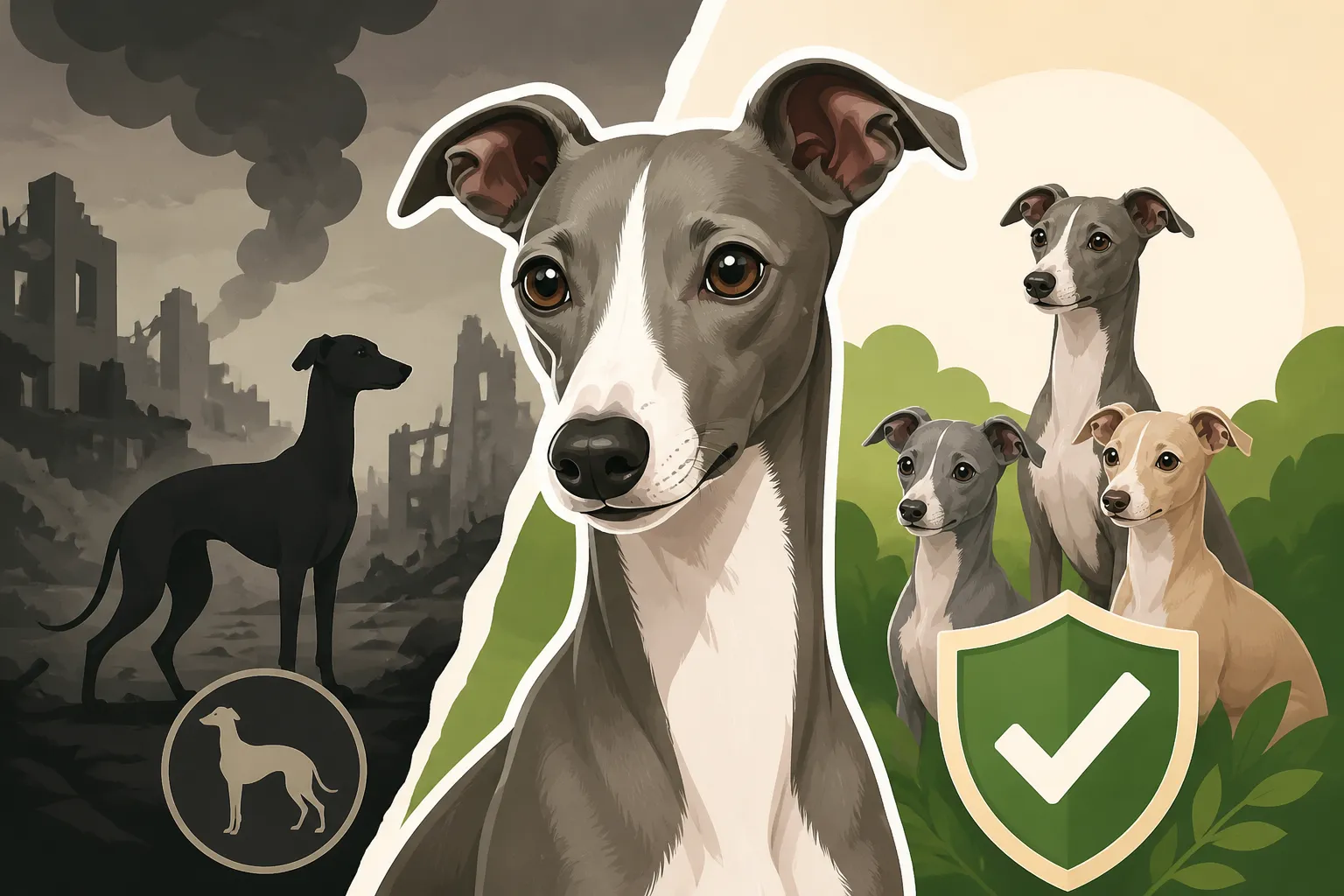
Whether Italian Breeding Stock Survived the War
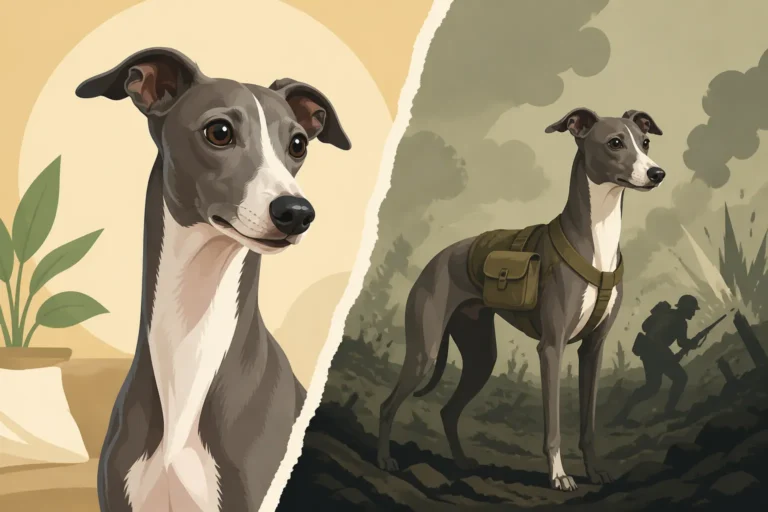
The Italian Greyhound did not disappear during the Second World War, but its European breeding population was badly disrupted. Dogs survived in private homes and kennels, while food shortages, displacement, and restricted travel made planned breeding difficult. This guide explains what “survival” means, how breeders rebuilt after the war, and why a surviving breed can still carry the effects of a narrow population.
Did Italian Greyhound breeding stock survive the war
Yes. Italian Greyhounds survived the war, including dogs that could later contribute to breeding. But survival did not mean that European kennels carried on as usual, or that every prewar bloodline remained available. In a period of upheaval, keeping an individual dog alive and maintaining a healthy, documented breeding population were very different challenges.
What survival meant for the breed
Breeding stock means more than dogs that lived through the war. It refers to dogs that were suitable for breeding and could pass on useful traits, with enough information about their ancestry to guide future matings. A dog might survive in a family home but never be bred. Another might be used for breeding, yet have a lost or incomplete pedigree. Both count as survivors in a broad sense, but only one may leave a clear trace in later pedigrees.
War also breaks the routines that make a breed population function. A breeder may lose access to food, veterinary care, transport, or safe housing. A planned litter may be postponed or abandoned. Dogs and their owners may be separated when families move, and local records can be lost or destroyed. Even when several dogs remain alive, those practical obstacles can prevent them from contributing to the next generation.
That distinction helps make sense of the breed’s postwar history. The Italian Greyhound survived, but many European breeding programs were weakened or interrupted. The broader account in What World War Two Did to the Italian Greyhound describes why the war threatened the breed without requiring us to mistake severe disruption for complete extinction.
Why survival was uneven across Europe
The war did not affect every place or kennel in the same way. Some dogs remained with private owners; some may have been kept by breeders who could still care for them. Elsewhere, people faced displacement and shortages that made keeping a small companion dog extraordinarily difficult. Conditions changed over the course of the war, too, so there was no single experience shared by every Italian Greyhound owner.
Borders and travel restrictions mattered as much as the dogs’ immediate safety. Before a war, breeders might exchange dogs or arrange matings across regions. During a conflict, those connections could become impossible. A healthy dog in one country could not necessarily help restore a kennel elsewhere if owners could not safely transport it or verify its pedigree.
For that reason, it is more accurate to say that breeding stock survived in a scattered, uneven way than to suggest that one intact European population remained untouched. A breed can endure while particular lines disappear, become difficult to trace, or fall out of use. That is one reason the Italian Greyhound’s near-loss in Europe is discussed alongside other periods of decline in The Italian Greyhound Nearly Died Out Twice in Europe.
How the breed was rebuilt after the war
When the war ended, breeders faced a practical problem: they needed dogs, records, and reliable opportunities to breed them. The answer was not simply to find any surviving Italian Greyhound. Rebuilding meant identifying usable dogs, working out which lines were related, and reconnecting breeders who had been separated by years of conflict.
Reconnecting dogs and breeders
Postwar rebuilding depended on people as much as on the dogs. Breeders had to locate one another, compare the dogs they still had, and work with whatever pedigree information survived. Kennel records and registration books could provide a starting point, but a record’s usefulness depended on its completeness and on whether breeders could connect it to a living dog.
A surviving dog might be valuable because its lineage was rare, because it had sound qualities breeders hoped to preserve, or simply because there were few other options. But rarity alone did not make a dog an ideal breeding choice. Breeders still had to consider health, temperament, structure, and the degree of relatedness between potential mates. When the available pool is small, those decisions become more constrained.
Rebuilding also took time. A single litter could not quickly restore the depth of a population that had been reduced or fragmented. Breeders needed several generations, careful record keeping, and cooperation across kennel communities. The history of Which Country Rebuilt the Italian Greyhound is useful context for understanding why recovery involved more than one dog or one kennel.
The role of American dogs in recovery
Italian Greyhounds continued to be bred in the United States during the war, where the breed’s circumstances differed from those in occupied and heavily disrupted parts of Europe. That did not mean every American line was automatically a perfect match for every European breeding program. It did mean that breeders outside the most affected areas could offer an additional source of dogs and pedigrees when European populations were being restored.
Moving a dog between countries is not the same as instantly repairing a breed. A breeder needs to assess the animal itself, understand its ancestry, and decide how it fits with the dogs already available. Imported dogs can expand a restricted population, but they can also introduce new challenges if records are incomplete or if breeders rely too heavily on a small number of popular individuals.
The movement of dogs across the Atlantic became part of the wider postwar story. How American Italian Greyhounds Went Back to Britain looks at that connection in more detail. It is a reminder that the breed’s recovery was shaped by international exchange, rather than by a single, isolated European rescue.
| Part of the story | What it tells us | What it does not prove |
|---|---|---|
| Individual dogs survived | The breed did not vanish completely | That every prewar bloodline continued |
| Some dogs remained available to breeders | Breeding could resume in some places | That every surviving dog had complete records |
| Dogs and pedigrees moved between countries | Breeders could draw on a wider pool | That imports alone restored genetic diversity |
| Registrations and pedigrees continued or resumed | Later family lines can sometimes be traced | That every gap in the record can be filled |
What the war changed in the breed’s bloodlines
A breed may survive in name and appearance while its population changes substantially. When breeding choices are limited, some lines can become more influential than others. Other lines may end without descendants, and a record of those losses may be incomplete. These changes are not unique to the Italian Greyhound, but the breed’s wartime disruption makes them important to consider when discussing its modern ancestry.
Why a surviving population can still be narrow
A population becomes genetically narrow when relatively few dogs contribute to later generations, especially if the same ancestors appear repeatedly in pedigrees. A breed might have more registered dogs years later than it had immediately after a crisis, yet still depend heavily on a limited number of founders or popular lines. Population size and genetic variety are related, but they are not interchangeable.
Imagine that several dogs survive in different places, but only a small group can be located, registered, or used for breeding. If those dogs produce many descendants, their influence can become substantial. This can happen even when breeders are working carefully and trying to restore the breed. The immediate goal is to bring the population back; the longer-term challenge is to avoid relying too heavily on the same ancestry.
That is why postwar recovery should not be described as a clean reset. The breed’s later pedigree structure reflects both the dogs that survived and the decisions breeders made afterward. For the broader genetic context, How Narrow the Italian Greyhound Gene Pool Became explains how a breed can retain continuity while still having limited diversity.
How pedigrees help reveal what happened
Pedigrees help trace family relationships across generations. They can show which dogs contributed to particular lines and where imported dogs entered a breeding program. When several pedigrees are compared, a breeder or historian may be able to identify common ancestors and notice where documentation becomes thin.
But pedigrees are historical records, not complete photographs of a population. A missing entry does not necessarily mean that no dog existed; it may mean the paperwork was lost, the dog was not registered, or the record has not been located. Conversely, a long pedigree does not automatically demonstrate broad genetic diversity. If many dogs in it share the same ancestors, the family tree may look extensive while the underlying population remains closely connected.
The postwar years also illustrate why records matter beyond satisfying curiosity. Accurate ancestry information helps breeders understand relatedness and make more informed choices. It does not remove every uncertainty, but it can prevent avoidable mistakes when the number of available lines is limited. What DNA Studies Say About the Italian Greyhound offers another way to think about ancestry, while remaining distinct from the historical record preserved in pedigrees.
How to understand claims about wartime survivors
Stories about a breed surviving a war can become simplified over time. One version may suggest that a country saved the breed single-handedly; another may treat every dog that lived through the conflict as part of a continuous breeding population. The reality is usually more complicated. A careful account distinguishes living dogs, documented breeding dogs, and the lines that contributed to later generations.
What evidence is useful
The strongest picture comes from comparing several kinds of evidence. Stud books and registration records can show which dogs were recorded and when. Pedigrees can connect those dogs to later generations. Kennel histories, dated photographs, and correspondence may offer context about where dogs lived and how breeders worked after the conflict.
Each source has limits. A photograph can confirm that a dog existed, but not necessarily whether it bred. A pedigree can document ancestry, but it may not explain what happened to dogs whose records were never registered. A later recollection may preserve useful details while still compressing events or leaving out uncertainty. Looking across sources helps keep the story grounded without pretending that every gap can be resolved.
It is also helpful to separate claims about a whole breed from claims about a specific kennel or family line. Saying “Italian Greyhounds survived the war” is broadly true. Saying that a particular line continued without interruption requires more specific evidence. The distinction is especially important when a history is used to explain modern pedigree patterns or breeding decisions.
What the survival story means for owners today
For most owners, the wartime history does not change how they care for their dog day to day. It does offer a clearer understanding of why the breed’s history includes periods of rebuilding and why ancestry is worth taking seriously. A breeder’s records, health practices, and willingness to discuss family lines tell you more than a dramatic claim that a puppy descends from a famous or “saved” line.
If you are researching an Italian Greyhound’s ancestry, ask for the documented pedigree and look at the names across several generations. Ask how the breeder approaches health and relatedness, and whether they can explain the reasoning behind a planned pairing. A responsible conversation should be specific and open, not built around a vague promise that a particular bloodline is rare or historically important.
The most balanced conclusion is that breeding stock did survive, but the war left the European breed population scattered and diminished. Recovery depended on the dogs that remained, the records breeders could use, and international cooperation in the years afterward. That history is not a tale of an untouched population; it is a story of continuity under pressure, followed by patient rebuilding.
Disclaimer
This article is for general informational purposes only and does not constitute professional advice. Laws, prices and regulations vary by location and change over time. Consult a qualified professional for guidance on your specific situation.