Whether an Italian Greyhound Suits a House With Toddlers
A toddler’s sudden grab, stumble, or enthusiastic chase can be frightening when the family dog is a small, fine-boned Italian Greyhound. This guide explains what life with both may look like, where the risks come from, and how to decide whether your household can provide the supervision, boundaries, and gentle handling this breed needs.
Can an Italian Greyhound live safely with a toddler
An Italian Greyhound can live in a home with young children, but that does not make every match a good one. This is a small, delicate dog, and toddlers are still learning how to control their movements and respect an animal’s space. Even a well-meaning hug or a stumble onto the dog can cause distress or injury.
The question is less “Are Italian Greyhounds good with children?” and more “Can the adults in this household reliably manage every interaction?” A calm dog, careful adults, and a thoughtfully arranged home all matter. None replaces active supervision.
Why the size difference matters
Italian Greyhounds are light and slender, with fine limbs that can be vulnerable to injury. A toddler may not be trying to hurt the dog when they reach, fall, or step close; they may simply be learning how their body moves. But an accidental fall or an attempt to pick the dog up can have serious consequences. For more on safe handling, see Why Children Should Not Carry an Italian Greyhound and How to Pick Up an Italian Greyhound Safely.
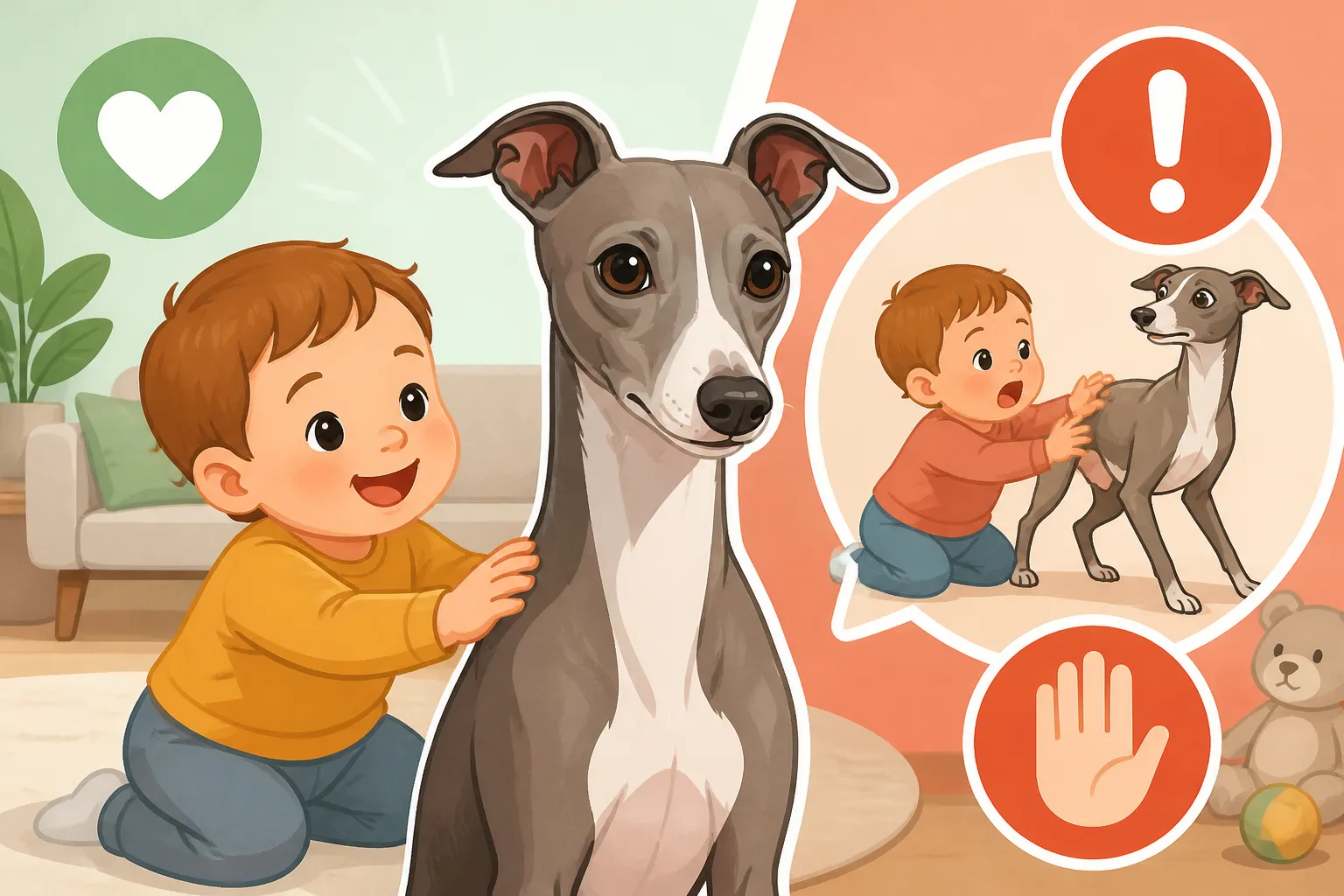
The risk works in both directions. A startled dog might snap or nip if a child grabs a sensitive area, corners them, or disturbs them while resting. That reaction does not mean the dog is inherently aggressive; it can be a response to fear, pain, or having no safe way to move away. A child can also be hurt if the dog bolts through a doorway or darts underfoot.
A toddler’s unpredictable movements can be especially challenging. A child might move quietly toward a sleeping dog one moment and squeal or run past it the next. A dog that copes comfortably with a calm older child may be unsettled by that change in pace. How an Italian Greyhound Behaves With Small Children explores the breed’s interactions with younger kids in more detail.
What temperament can and cannot tell you
Many Italian Greyhounds are affectionate and strongly attached to their people. Some enjoy being near a family and can learn to relax around respectful children. Others are shy, easily startled, or happiest in a quieter home. Individual temperament, early experiences, health, and the way people handle the dog all influence how a particular Italian Greyhound responds.
A friendly dog is not automatically comfortable with toddler handling. Seeking a lap, following an adult, or playing with a child under supervision does not mean the dog wants to be hugged, lifted, or followed everywhere. Watch the dog’s behavior rather than assuming that tolerance means enjoyment. Turning away, moving to a retreat, stiffening, hiding, or repeatedly trying to leave are reasons to give the dog space.
Breed tendencies are a useful starting point, not a guarantee. If you are still weighing up whether this dog fits your family’s everyday routine, Whether an Italian Greyhound Suits a Family offers broader considerations. For a toddler-specific perspective, How an Italian Greyhound Handles a Toddler focuses on the practical interaction itself.
The difference between living together and playing together
A dog and toddler can share a home without being playmates. In many households, the safest arrangement is for the dog to be nearby but separated during energetic play, meals, naps, and times when an adult cannot give full attention. Quiet coexistence is a perfectly good outcome; the child does not need to hug or handle the dog to have a positive relationship with it.
This distinction can be disappointing if you imagined a small dog happily joining every family activity. But Italian Greyhounds are not toys, and a toddler is not yet able to manage all the rules of dog handling independently. Adults need to set those boundaries every time, including when the dog seems relaxed and the child is being gentle.
What makes the match easier or harder
A good match depends on more than the child’s age or the dog’s personality. It also depends on the layout of your home, your ability to separate dog and child when needed, and whether every adult follows the same rules. If you are comparing the breed with other dogs, Why an Italian Greyhound Suits Older Children Better discusses why maturity and predictable handling can make family life easier.
Conditions that make a household a stronger fit
The match is more promising when an adult can actively supervise, the dog has a quiet place to retreat, and the toddler can be kept out of that resting area. Adults should be willing to interrupt unsafe interactions gently and consistently, even when the dog appears to be enjoying attention.
It also helps if the household can keep routines predictable. A dog that gets undisturbed sleep, calm walks, and time close to trusted adults may find family life easier than one expected to tolerate constant noise and contact. If the dog is already living with you, introduce changes gradually and watch how it responds. If you are considering bringing one home, ask about the individual dog’s history around children rather than relying on a broad breed description.
Situations that deserve extra caution
A home may be a poor fit if the toddler regularly grabs, chases, or falls on pets and the adults cannot keep those interactions separated. It is also difficult if the dog has a history of fear around children, guards resting spots or food, or has pain that makes handling uncomfortable. A veterinarian or qualified behavior professional can help assess concerns before they escalate.
A busy household can create practical obstacles even when everyone has good intentions. Imagine a parent preparing dinner while a toddler races through the living room and the dog is asleep beside the sofa. If the adults cannot reliably keep the child from climbing onto the dog or bothering it while it rests, the dog needs a secure separate space during that part of the day. Planning for those ordinary moments matters more than hoping everyone will remember the rules.
| Household situation | What it may mean for the match | A safer approach |
|---|---|---|
| Adults can supervise every interaction | More opportunity to teach calm, respectful contact | Stay close enough to intervene immediately |
| Toddler is active and unpredictable | The dog may be startled or accidentally hurt | Use gates and separate spaces during lively play |
| Dog has a quiet retreat | The dog can choose to rest without being approached | Keep the retreat off-limits to the child |
| Dog is fearful around children | Household contact may be stressful or unsafe | Seek professional guidance and consider whether the home is suitable |
| Adults are often occupied or out of the room | Supervision may be inconsistent | Separate dog and child whenever attention is divided |
Puppy or adult dog: neither is an automatic answer
An Italian Greyhound puppy may be introduced to a family early, but puppies are not automatically easier with toddlers. They can be lively, mouthy, and still learning how to move around people. They also need careful handling and rest. A small puppy can be at risk of injury from rough play, a fall, or being stepped on.
An adult dog’s past behavior may offer more information, but history is not a promise about how it will respond in a new home. Ask specific questions: Has the dog lived with young children? What does it do when a child runs or cries? Does it approach children, avoid them, or become tense? Can it settle behind a gate? If the answers are uncertain, plan for gradual introductions and get guidance before allowing close contact.
How to set up safe routines at home
Safety is not a single conversation with your toddler. It is a daily routine created by adults through supervision, physical barriers, and consistent rules. The aim is not to make the dog tolerate every interaction, but to prevent situations where either the child or the dog is overwhelmed.
Create dog-only spaces and use barriers
Give the Italian Greyhound a bed, crate, or gated room where the toddler cannot follow. This area should remain a genuine retreat, not a place where the child can reach through bars or toss toys inside. The dog should be able to rest without being touched, woken, or crowded.
Use a baby gate or another secure barrier to separate the dog and toddler when an adult is cooking, answering the door, or caring for another child. A gate is a management tool, not a substitute for supervision when they are together. For household supplies such as gates, washable bedding, and enrichment toys, you can compare options through retailers such as Chewy and choose what fits your home and dog.
Think through the layout before the dog arrives. If the dog’s bed is in the middle of the busiest play area, it may be difficult to protect its rest. A quieter corner or a separate room can make the routine much easier. Keep food, chews, and favorite toys out of the toddler’s reach, and do not allow the child to approach the dog while it is eating.
Teach simple rules through repetition
Toddlers need short, concrete rules repeated by adults. “Gentle hands,” “let the dog sleep,” and “call an adult” are more useful than expecting a young child to remember a long list of instructions. Model what gentle contact looks like, such as stroking briefly along the dog’s side only when an adult says it is appropriate.
Even a child who can repeat the rules will need reminders. Do not expect the toddler to manage the dog’s comfort alone or to recognize subtle signs of stress. Adults should calmly step in if the child follows the dog, reaches into its bed, pulls at its ears or tail, or tries to lift it.
For the dog, reward calm behavior around ordinary household sounds and movements without forcing close contact. Let the dog observe from a comfortable distance and move away when it chooses. If you use food rewards or toys as part of training, keep them under adult control; retailers such as Chewy may help you compare basic supplies, but a product cannot replace a safe setup and good supervision.
Supervise actively, not from across the room
Active supervision means staying close enough to intervene—not simply being somewhere in the same house. If your attention is on a phone, a meal, or another task, use a barrier to separate the dog and toddler. Never leave them alone together, even briefly, even if they have seemed comfortable before.
Watch the dog’s body language and give it space at the first sign that it wants to disengage. A dog that moves away should be allowed to leave. Do not hold it in place so the toddler can pet it, and do not punish a growl. A growl is a warning that the dog is uncomfortable; adults should calmly end the interaction and consider what needs to change. Repeated growling, snapping, or avoidance calls for professional advice.
Deciding whether an Italian Greyhound is right for your family
Before bringing an Italian Greyhound into a home with a toddler, be honest about the daily routine rather than focusing only on how sweet the dog looks. Can you supervise closely? Can you separate the dog and child whenever you are distracted? Will the adults consistently protect the dog’s rest and teach the toddler safe boundaries? Those answers are more useful than a simple yes-or-no judgment about the breed.
A practical readiness check
Consider these questions with everyone who will share responsibility for the dog:
- Can an adult stay close and focused during every interaction?
- Is there a dog-only retreat the toddler cannot access?
- Can you use gates or closed doors whenever you are busy?
- Will all adults follow the same rules about carrying, chasing, hugging, and disturbing the dog?
- Are you prepared for the dog and child to share space without being expected to play together?
- Can you respond calmly if the dog becomes fearful, avoids contact, or growls?
If several answers are no, it may be safer to wait until the child is older or to consider a different fit. That is not a failure. It is a responsible choice that protects both the child and the dog. Families who already own an Italian Greyhound can also make adjustments, such as adding a retreat, changing where the dog rests, and seeking professional advice about specific behavior concerns.
What to ask before choosing a dog
If you are speaking with a breeder, rescue, or current owner, ask for concrete examples of how the dog behaves around children rather than accepting “good with kids” as a complete answer. Find out whether it has lived with toddlers, what happens when children move quickly or make noise, and whether it willingly walks away from contact. Ask how it responds when resting and whether it has any known fear or handling sensitivities.
Arrange introductions carefully and keep them brief, calm, and adult-led. Do not let a toddler rush toward the dog or reach over its head. The dog should have room to move away, and an adult should be ready to end the interaction. If the dog seems uneasy, do not force another meeting to prove it will “get used to” the child.
An Italian Greyhound may thrive in some homes with toddlers, especially when adults are attentive and the dog has protected space. In other homes, the timing or practical demands may make the match too stressful. If you choose to proceed, build safety into the home from the start; retailers such as Chewy can be one place to compare household and pet-care supplies, while your veterinarian or a qualified behavior professional can advise on the needs of your particular dog.
Disclaimer
This article is for general informational purposes only and does not constitute professional advice. Laws, prices and regulations vary by location and change over time. Consult a qualified professional for guidance on your specific situation.