Who Anne of Denmark’s Italian Greyhounds Were
Anne of Denmark’s Italian Greyhounds belong to the story of royal life as much as to the history of the breed. The difficulty is that surviving records do not give us a neat, dependable list of the dogs’ names or biographies. This guide separates what can reasonably be said about Anne’s dogs from what portraits and later retellings may suggest.
Anne of Denmark and the royal dogs around her
A queen whose life crossed two courts
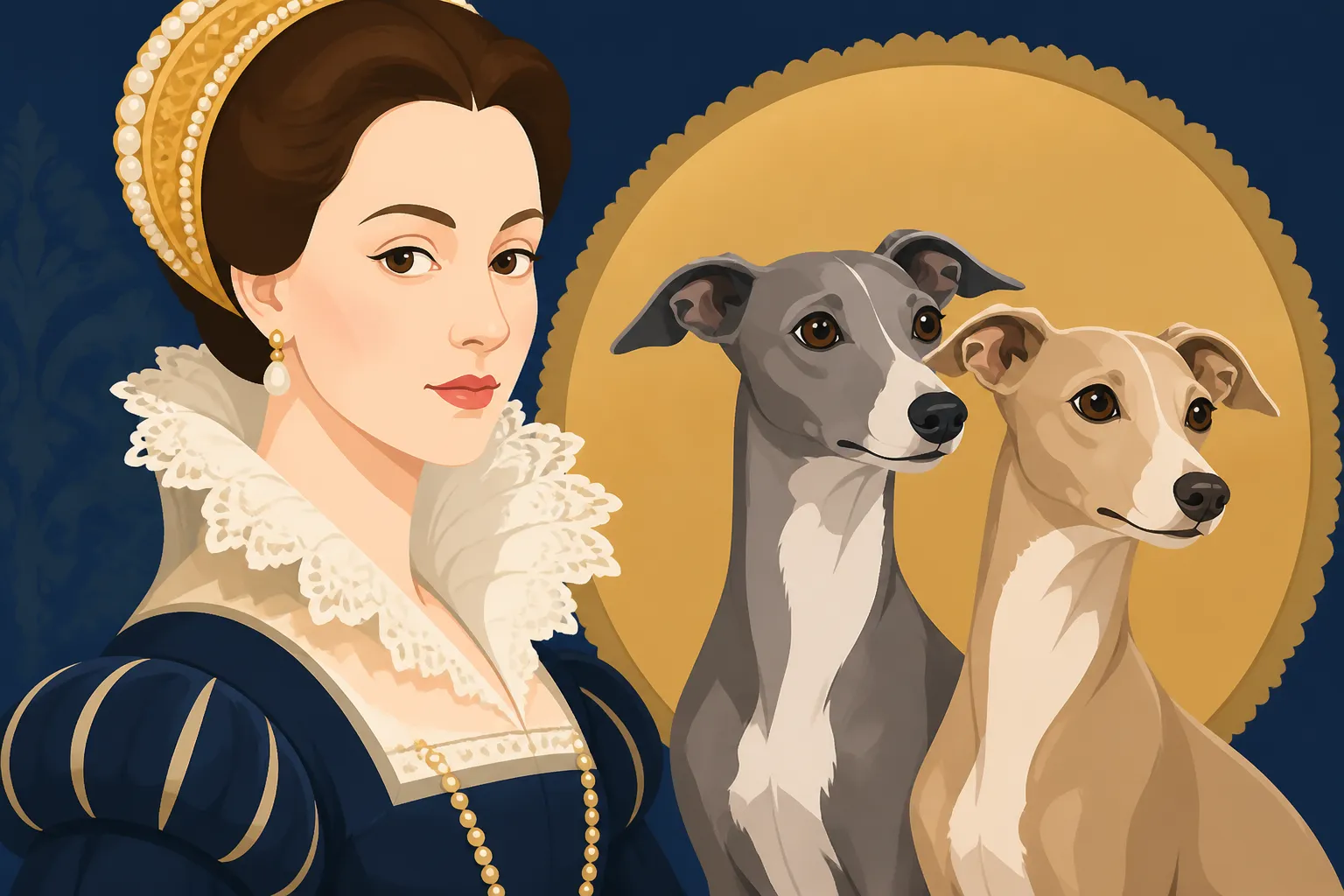
Anne of Denmark was born in 1574, married James VI of Scotland in 1589, and became queen consort of England when James inherited the English throne in 1603. Her life connected the Danish, Scottish, and English courts, with residences and court activity spanning places such as Edinburgh and London. A small companion dog in her household would have travelled in a world of attendants, formal ceremonies, hunting, and carefully staged royal display.
It is useful to remember that a royal household was not a modern home with one clearly documented family pet. Dogs could belong to the queen, another member of the household, or an attendant; they might also appear in inventories or artworks without a name or explanation. So when people ask who Anne’s Italian Greyhounds were, the most responsible answer is that they were small court companions associated with her household, but the surviving evidence does not provide a secure, complete roster of individual dogs.
Anne’s story also sits within a broader European fashion for elegant little sighthounds. Royal families and nobles kept dogs for companionship, display, and sometimes hunting-related interests. For a wider view of those connections, see Which Royals Kept Italian Greyhounds. The tradition stretches back beyond the Stuart court, as the history of When the Italian Greyhound Arrived in Italy helps illustrate.
Why an Italian Greyhound suited court life
The Italian Greyhound’s small size and close attachment to people made the breed a natural fit for indoor life among wealthy households. These dogs could sit beside a person, curl up in a warm room, and be carried between spaces more easily than a larger hunting dog. Their fine-boned shape and graceful outline also made them visually striking in portraits and court settings.
That does not mean every small greyhound at a royal court can be identified with certainty as the modern Italian Greyhound. Breed labels were not always used consistently, and the distinctions familiar to today’s dog owners were not necessarily applied in the same way centuries ago. Historical references may describe a dog by its size, shape, coat, or role rather than by a settled breed name. The breed’s association with indoor companionship is explored further in Why the Italian Greyhound Was Bred Purely for Company and The Italian Greyhound as a Bed Warmer.
What can be established about Anne’s Italian Greyhounds
The dogs are better understood as a group than as famous individuals
Anne’s Italian Greyhounds are not widely known today because of a single celebrated dog with a well-documented biography. They are better understood as part of the queen’s household and the wider royal taste for small companion sighthounds. Individual names, dates of birth, and stories about particular dogs are difficult to confirm from the evidence commonly repeated in popular accounts.
That gap can be frustrating. A reader naturally wants to know whether Anne had one beloved dog, several dogs over the years, or a named companion who appears in a portrait. But a painting or a general reference to a queen’s dogs does not automatically answer those questions. Unless a reliable record connects a particular dog, name, and date to Anne, it is safer not to treat a later anecdote as established fact.
| Question | What can be said cautiously | What remains uncertain |
|---|---|---|
| Did Anne’s household include small greyhounds? | Small companion sighthounds are associated with the royal and aristocratic world of her era. | A complete, verified list of Anne’s individual dogs is not readily established. |
| Were they Italian Greyhounds in the modern sense? | They may be described retrospectively as Italian Greyhounds based on their type and role. | Historical breed terminology did not always match modern categories. |
| Do we know their names? | Some later accounts may repeat names or stories. | A name should not be treated as certain without clear supporting evidence. |
| Can a portrait identify Anne’s dog? | A portrait can show a dog connected with courtly imagery. | The image alone may not prove ownership, name, or breed. |
A careful answer is not a less interesting one. It lets Anne’s dogs remain part of the real history of royal companionship without turning uncertain details into confident-sounding facts. For context on how artists used these dogs to convey status or intimacy, see What an Italian Greyhound Signaled in a Portrait.
Why names and ownership can be hard to pin down
Court records were created for specific purposes: accounting, household management, diplomacy, or ceremonial record-keeping. A dog might be included because someone had to feed or care for it, but that does not mean the entry captures the animal’s personality or the queen’s relationship with it. Conversely, a portrait might show a dog without recording who owned it or why the artist placed it there.
Ownership could also be shared in practice. A dog living in the queen’s apartments might be cared for by a servant or favored by another member of the household. Later writers sometimes simplify that complicated setting into a charming story about “the queen’s dog.” That shorthand may be plausible, but it should not be mistaken for a complete record.
How portraits help and where they can mislead
A dog in a royal portrait is meaningful, but not a name tag
A small dog in a portrait can contribute to the image’s mood and message. It may suggest affection, refinement, domestic ease, or the sitter’s connection to fashionable court life. With an Italian Greyhound’s long legs, narrow frame, and fine head, the animal could also provide a visual contrast to the richness of formal clothing and furniture.
Still, the dog’s presence does not settle every historical question. It may be a likeness of a household pet, a symbol chosen by the artist, or a detail included because small companion dogs were familiar among elite sitters. Unless the painting is accompanied by strong documentation, it is difficult to identify the dog as a particular animal belonging personally to Anne.
This is why it helps to keep two questions separate: “Does this portrait show a dog that resembles an Italian Greyhound?” and “Can we prove this is Anne’s named Italian Greyhound?” The first may be a reasonable visual interpretation; the second requires evidence beyond appearance. Similar caution is useful when looking at earlier works such as The Italian Greyhounds in Giotto's Frescoes or The Italian Greyhound in Carpaccio's Venice, where the image can tell us something about artistic taste without necessarily identifying an individual dog.
Historical breed labels do not always map neatly onto today’s breed
Today, Italian Greyhounds are recognized as a distinct breed with a familiar overall type. In Anne’s lifetime, however, dogs were not always described using the same precise categories people expect now. An artist or household record might use a broad term for a small greyhound, while later viewers identify the animal as an Italian Greyhound based on its proportions.
That makes careful wording important. “Italian Greyhound-type dog” can be more accurate than presenting a modern breed label as though it appeared in a contemporary record. It also avoids claiming that every small, slender dog in a historical painting belonged to the same lineage or had the same breed identity.
Anne’s legacy and the Italian Greyhound today
A glimpse of companionship, not a complete pet biography
Anne’s dogs matter because they help bring the royal household down to a human scale. Behind the formal portraits, ceremonies, and political responsibilities, court life also included familiar comforts and close relationships with animals. A small dog curled beside a person was not merely decoration; it could be a companion in private rooms and a reassuring presence amid a demanding public life.
At the same time, it is best not to invent individual personalities where the record does not preserve them. We can reasonably place small companion sighthounds within the world around Anne, while acknowledging that their exact names and stories remain uncertain. That distinction makes the history more trustworthy, not less vivid.
The modern connection is still easy to recognize
Italian Greyhound owners today often recognize the same appeal: a sensitive, affectionate dog that wants warmth and close company. The breed’s fine coat and slight build also mean that modern care can involve practical choices about soft bedding and suitable clothing. Owners comparing options for coats may browse retailers such as Chewy, while checking the fit carefully because a narrow chest and long back can make ordinary dog clothes sit awkwardly.
Warmth is not just a historical curiosity. A chilly Italian Greyhound may burrow under blankets or seek a sunny patch, and a comfortable bed can make a noticeable difference in daily life. Some owners look at Chewy when comparing bedding styles, but the useful priorities are fit, washability, and a safe, comfortable design rather than a particular brand. For more on the breed’s relationship with warmth, The Italian Greyhound as a Bed Warmer offers a natural link between past and present.
If you are learning about the breed before bringing one home, remember that those elegant portraits do not show all the everyday care. A real dog needs warmth, gentle handling, and a secure environment. Chewy is one place people may browse for basic supplies, but it is worth choosing items for the individual dog’s size and needs, rather than assuming a product marketed for small dogs will fit an Italian Greyhound well.
Disclaimer
This article is for general informational purposes only and does not constitute professional advice. Laws, prices and regulations vary by location and change over time. Consult a qualified professional for guidance on your specific situation.