Which Breeds Are Genetically Closest to the Italian Greyhound
The Italian Greyhound’s fine build and sprinting style make it easy to guess that it is simply a miniature Greyhound. Genetics tells a more nuanced story: it belongs among the sighthounds and shares ancestry with breeds such as the Greyhound and Whippet, but there isn’t one universally accepted ranking of its closest relatives. This guide explains what genetic closeness means and what it does—and doesn’t—tell you.
The breeds most closely related to the Italian Greyhound
Greyhounds and Whippets are the clearest comparisons
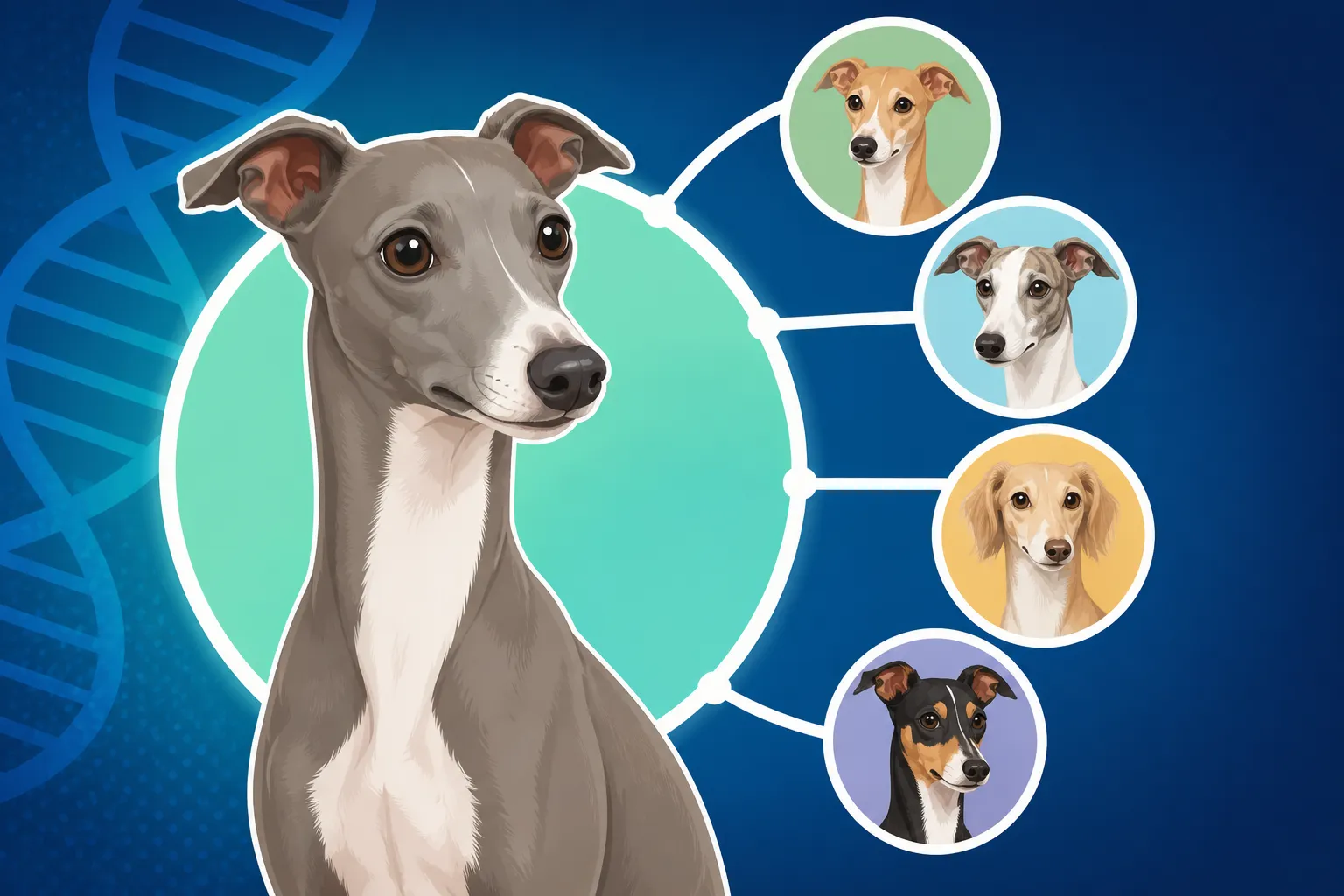
The Greyhound and Whippet are among the most useful breeds to compare with the Italian Greyhound. All three are sighthounds: dogs shaped by generations of selection for speed, a lean outline, and the ability to spot and pursue moving prey. Their similarities are visible, but the resemblance is not proof that one modern breed was simply made by shrinking another.
The Whippet often seems like the closest everyday match. It shares the Italian Greyhound’s streamlined silhouette and sprinting style, while being larger and generally more substantial. The Greyhound is a larger, more powerful sighthound, and it is also an important comparison because the Italian Greyhound’s name and appearance invite the “miniature Greyhound” assumption. For a practical side-by-side look, see How an Italian Greyhound Differs From a Whippet and The Italian Greyhound Against the Whippet and the Greyhound.
Genetic studies can support a broad relationship among sighthounds without producing a single, fixed answer about which breed is the Italian Greyhound’s nearest neighbor. Different studies may examine different dogs, use different genetic markers, and include different breeds in their comparisons. A study that samples several Greyhounds but few Whippets, for example, cannot offer the same kind of fine-grained comparison as one with balanced samples from both breeds.
Other sighthounds share a broader family resemblance
The Saluki and Afghan Hound are also sighthounds, and they can appear in discussions of the Italian Greyhound’s broader genetic neighborhood. That does not mean they are necessarily as close as the Greyhound or Whippet in every genetic analysis. “Related” can describe a shared breed group or older ancestry, while “closest” suggests a more specific comparison that requires suitable data.
Sighthounds are not interchangeable versions of one dog. Their histories, body sizes, coats, and breed development differ. Even when breeds share distant ancestry or were selected for similar work, those similarities don’t establish a direct parent-child relationship between modern breeds.
That distinction is useful if you are researching the Italian Greyhound’s origins. A family resemblance can point toward shared history, but it cannot by itself reveal exactly when two breeds separated or which population came first. For context on the breed’s background, read What DNA Studies Say About the Italian Greyhound and Which Came First, the Italian Greyhound or the Whippet.
What “genetically closest” actually means
A breed cluster is not a ranked family tree
When researchers study dog DNA, they compare patterns in genetic markers across the dogs included in a study. If breeds share more of those patterns than they do with other sampled breeds, they may appear close together in a genetic cluster. The result is a map of relationships within that particular dataset, not necessarily a definitive family tree with every breed ranked from nearest to farthest.
This is why two summaries can sound different without truly contradicting each other. One may emphasize the Italian Greyhound’s relationship to the Greyhound, while another groups it with a wider set of sighthounds. The outcome depends partly on which dogs were sampled and what question the analysis was designed to answer.
A useful way to read a claim about “the closest breed” is to ask what comparison it describes. Does it mean the closest breed in a particular study? The closest among a set of sighthounds? Or a breed with a similar appearance and history? Those are related questions, but they are not the same question.
Shared ancestry is different from looks or job
The Italian Greyhound, Whippet, and Greyhound look alike because they have a similar body plan and were shaped for similar kinds of movement. That resemblance matters, but looks alone do not measure genetic distance. Two breeds can converge on similar traits through selection while retaining different histories.
The reverse can happen, too: two breeds may share ancestry but look quite different today. Generations of selection for size, coat, or temperament can change a breed’s appearance without erasing all of its older genetic connections. So a dog’s delicate frame doesn’t automatically tell you which breed is genetically nearest.
The breed’s history is also more complicated than the simple idea that people took a Greyhound and bred it smaller. The Italian Greyhound is an established breed with its own history and characteristics. If you want to explore that distinction further, see Whether the Italian Greyhound Is a Miniature Greyhound and Whether the Italian Greyhound Was Bred Down From Greyhounds.
What breed DNA tests can and cannot tell you
An ancestry estimate is not a complete family history
A commercial dog DNA test may estimate which breeds contributed to a dog’s ancestry by comparing its genetic markers with reference samples. The result can be interesting, especially for a mixed-breed dog, but it is not the same as identifying the Italian Greyhound’s single closest living relative as a breed.
A breed ancestry estimate asks, in effect, which reference groups best match the tested dog’s DNA. A genetic relationship study asks how breeds compare with one another across a selected set of samples. Those are different analyses, even if both involve DNA and use breed names in their results.
If you’re comparing test kits on Chewy or elsewhere, read the listing and test description closely. Check whether the test is designed to estimate a dog’s breed ancestry, screen for selected genetic health markers, or do both. Those purposes shouldn’t be treated as interchangeable, and a test’s breed estimate shouldn’t be read as a definitive historical account.
Reference panels and breed coverage matter
A DNA test’s result depends in part on the reference dogs available for comparison. If a test has strong representation for some breeds and limited representation for others, its estimates may be more informative for some ancestry questions than for others. A close-looking result can be suggestive, but it may not resolve fine distinctions among related sighthounds.
This matters especially when trying to separate breeds with shared traits and ancestry. A result that identifies “Greyhound” or another sighthound in a mixed dog’s ancestry does not necessarily show that the Italian Greyhound descended directly from that breed. It shows how the dog’s DNA compares with the test’s available reference groups.
When browsing Chewy for a DNA test, check the current product details for what the kit examines and how it presents its results. If your question is specifically about the Italian Greyhound as a breed—not the ancestry of an individual dog—look for research that compares multiple breeds and explains its sampling. The difference can save you from expecting an ancestry kit to answer a broader evolutionary question.
How to interpret the Italian Greyhound’s genetic relationships
Use several kinds of evidence together
The most careful answer is that the Italian Greyhound belongs to the sighthound family and has close connections with breeds such as the Greyhound and Whippet. Other sighthounds may share broader ancestry, but a single, universally agreed closest-breed ranking is not a safe assumption without specifying the study and comparison group.
To evaluate a claim, look for three details: which breeds were included, how many dogs represented each breed, and what kind of genetic analysis was used. A broad study of dog breed relationships may answer a different question from a focused study of sighthound ancestry. A headline that leaves out those details can make a qualified result sound more certain than it is.
It also helps to separate three ideas: visual similarity, shared purpose, and measured genetic relationship. The Italian Greyhound can resemble a Whippet, share sighthound traits with a Greyhound, and still have a breed history that is not reducible to either one. Each kind of evidence adds context; none should be used alone to tell the whole story.
What this means for owners and prospective owners
For a prospective owner, genetic closeness does not predict that the Italian Greyhound will behave exactly like a Whippet or Greyhound. Temperament, training, socialization, health, and individual personality matter. Breed comparisons can help you understand the general sighthound pattern, but they are not a reliable shortcut for choosing a dog based on a presumed genetic twin.
For an owner curious about a mixed-breed dog, a DNA test can provide a useful estimate, provided its scope and limitations are clear. If the dog has an Italian Greyhound-like build, that resemblance alone cannot establish Italian Greyhound ancestry. A test may offer clues, but its output should be understood as an estimate based on the reference data it uses.
For anyone reading about breed history, the best takeaway is simple: the Italian Greyhound is not just a scaled-down copy of a larger sighthound. Its closest relationships are best discussed within the broader sighthound context, with Greyhounds and Whippets as especially relevant comparisons. Chewy and other retailers may list DNA kits for individual dogs, but product listings are not substitutes for research into breed relationships. For a deeper look at how breed history and genetic evidence fit together, see How American Breeders Saved the Italian Greyhound and How Narrow the Italian Greyhound Gene Pool Became.
Disclaimer
This article is for general informational purposes only and does not constitute professional advice. Laws, prices and regulations vary by location and change over time. Consult a qualified professional for guidance on your specific situation.