Whether Italian Greyhounds Appear in American Portraits
Yes, dogs that resemble Italian Greyhounds appear in American portraiture, but identifying them with certainty is harder than it sounds. Many portraits simply label the animal as a “dog” or “greyhound,” and a painted silhouette cannot always distinguish one small sighthound breed from another. This guide explains what the portraits can show, what they cannot prove, and how to research a specific image.
Do Italian Greyhounds appear in American portraits
The short answer is yes, with an important qualification
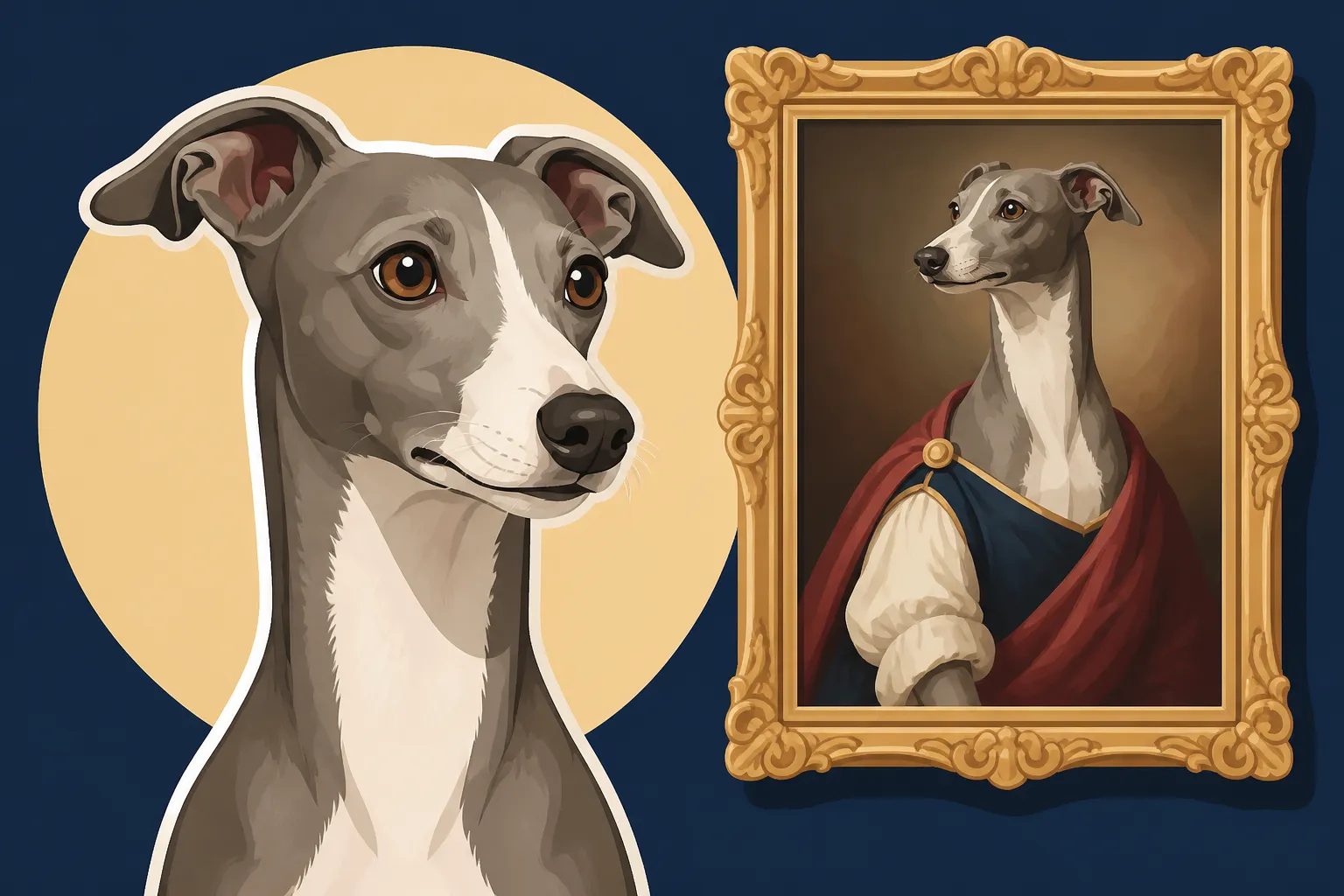
American portrait artists have depicted small, slender dogs alongside people, and some of those animals look like Italian Greyhounds. Their fine limbs, tucked-up waists, narrow heads, and elegant posture can be strikingly familiar to anyone who knows the breed today. But resemblance is not the same as a confirmed breed identification.
A portrait’s label may say only “dog,” “pet,” or “greyhound.” Those terms are broad, and historical catalog descriptions do not always identify the breed. Even when a dog looks very much like an Italian Greyhound, the artist may have used a generalized sighthound shape or adjusted the animal’s proportions to suit the composition.
So the careful answer is: Italian Greyhound-like dogs can be found in American portrait art, but not every slender dog in a painting can be confidently called an Italian Greyhound. It helps to separate what is visible in the artwork from what is documented in its title, records, or provenance.
What counts as an American portrait
“American portrait” can mean more than one thing. It might refer to a portrait painted by an American artist, a portrait of an American sitter, or a work made in the United States. These categories overlap, but they are not interchangeable. An American-born artist might have painted a portrait in Europe, for example, while a British artist might have painted an American family.
That distinction matters when you are trying to track the breed’s presence in American life. A dog in a portrait of an American sitter is evidence that the sitter was shown with a dog, but it does not necessarily show that the portrait was made in the United States or that the dog belonged to a locally established breed population.
The question also connects to a broader history of dogs in art. For comparison, The Renaissance Painters Who Put Italian Greyhounds in the Frame considers the breed’s appearance in earlier European art, while What an Italian Greyhound Signaled in a Portrait explores how an elegant companion dog could function in a portrait beyond simply recording a household pet.
How to tell an Italian Greyhound from a lookalike
Look at the overall outline, not one feature
Italian Greyhounds have a distinctive sighthound outline: a light, fine-boned body, a deep chest, a pronounced tuck-up, long legs, and a narrow head. Their ears are typically folded back rather than standing upright, and their posture can look poised and delicate. When several of these traits appear together, the dog may reasonably be described as Italian Greyhound-like.
Still, a painting is not a breed examination. Artists simplify anatomy, exaggerate an elegant line, or make a dog smaller to fit beside a seated person. A slim body alone does not establish breed. A long muzzle, for instance, can also appear in other small sighthounds or in an artist’s stylized depiction of a dog.
It is useful to compare the whole animal with the breed’s established form rather than relying on a single detail. Modern breed standards describe the Italian Greyhound as a small sighthound, but a portrait made before modern standards or breed organizations cannot be assessed as though it were a photograph of a registered dog. For a broader look at the type, see The Italian Greyhound Against the Whippet and the Greyhound.
Why older paintings can be difficult to identify
Breed names and classifications have changed over time. Owners and artists may have used everyday terms that did not map neatly onto the categories used by present-day kennel clubs. A portrait description calling a dog a “greyhound” might refer to its general appearance, not necessarily to the specific small breed now called the Italian Greyhound.
Art also presents practical limits. A dog may be turned away, partly covered by clothing, reduced to a small area of the canvas, or painted with little anatomical detail. A portrait made to convey status or affection may prioritize the animal’s visual role over precise physical accuracy. Even a skilled painter might alter a dog’s shape slightly to make it read clearly within the composition.
That is why responsible descriptions often use wording such as “appears to be,” “resembles,” or “possibly an Italian Greyhound.” Those phrases are not evasive; they reflect the difference between a visual interpretation and a documented identification.
What the portraits can tell us about the breed in America
They offer clues about taste, companionship, and status
When a small sighthound appears in a portrait, the dog can suggest that companion animals had a meaningful place in the sitter’s life. A pet might signal affection, refinement, wealth, or familiarity with fashionable European tastes. Its placement beside a person can make the relationship feel intimate, while a carefully posed animal can add movement and elegance to a formal composition.
That does not mean every dog in a portrait was included as a status symbol. It might simply have been a beloved household companion. The painter may also have included the dog because it helped balance the composition or gave the sitter something natural to interact with. Context matters: the dog’s position, the sitter’s pose, the clothing, and the portrait’s setting all affect interpretation.
A portrait is therefore useful evidence, but it is only one piece of a larger history. For more context on the breed’s place in society, Whether Italian Greyhounds Were Ever an American Fashion Dog looks at the idea of the Italian Greyhound as a fashionable American companion, and The Italian Greyhound as a Victorian Status Dog explores a related social role in Britain.
They do not prove a breed’s popularity by themselves
One portrait can establish that an artist depicted a dog with Italian Greyhound-like features. It cannot, on its own, demonstrate how common the breed was in a city, how many families kept one, or whether the dog was recognized by a particular name at the time. A painted pet is an individual example, not a population survey.
To understand whether Italian Greyhounds were becoming more familiar in the United States, researchers would look for several kinds of evidence together: dated portraits, family letters, estate inventories, newspaper notices, dog-show records, import records, and early breed publications. Each source answers a different question. A letter might name the dog but not describe its appearance; a portrait might show its build but omit its name.
The breed’s wider history is also relevant. When the Italian Greyhound Reached Britain provides a point of comparison for the breed’s movement through Europe, while How American Breeders Saved the Italian Greyhound addresses the development of the breed in the United States. Those broader histories can help place a portrait in context, but they do not automatically identify the dog shown in it.
How to research a portrait with a possible Italian Greyhound
Start with the catalog record and the date
If you have found a portrait in a museum, book, family collection, or online archive, begin with the object record. Note the artist, title, date, medium, sitter, and any description of the dog. Pay attention to whether the catalog says “Italian Greyhound” as a documented identification or uses more cautious wording such as “greyhound-type dog.”
The date can help you decide what kind of evidence to look for next. A portrait from a period before modern breed registration may use broad terminology. A later portrait may be accompanied by family records, show documentation, or a named pet that makes identification easier. The date does not settle the question, but it guides the research.
Museum catalogs at institutions such as the Metropolitan Museum of Art, the Smithsonian American Art Museum, and the National Gallery of Art can be useful starting points for searching American portraiture. Try several terms, including “dog,” “greyhound,” “pet,” and “Italian Greyhound.” Catalog wording varies, so a search using only the modern breed name may miss relevant works.
Compare visual evidence with written evidence
After locating a possible portrait, make two separate notes: what you can see, and what the record says. In the visual note, describe features without naming the breed too soon: small or large, fine-boned or robust, long-legged or short-legged, narrow-headed or broad-headed, with ears folded or upright. This keeps your observation from being shaped too strongly by the label you hope to confirm.
Then look for independent written evidence. Family correspondence, diaries, wills, inventories, and exhibition catalogs may name the dog or describe it as a particular kind of greyhound. A name alone is not conclusive, but it can connect the portrait to other records. If the dog appears in more than one image or document, compare the dates and descriptions rather than relying on a single source.
| Evidence | What it may help establish | What it cannot establish alone |
|---|---|---|
| The dog’s appearance in the portrait | Whether its outline resembles an Italian Greyhound | Its registered breed or pedigree |
| The museum catalog description | How the work is identified or interpreted | Whether that identification is supported by family records |
| A letter or diary naming the dog | The pet’s name, household, or role | Its exact appearance or breed |
| A dated portrait and family record together | A stronger link between a named dog and an image | A broader claim about how common the breed was |
| Multiple portraits or records from the same period | Patterns of ownership or artistic representation | The full population of Italian Greyhounds in America |
This approach is useful whether you are tracing a famous painting or a portrait that has been in your family for generations. For a broader comparison with earlier images, Which Renaissance Painters Included Italian Greyhounds can help you think about how artists depicted similar dogs in a different historical setting.
Use cautious language when you share your conclusion
If the documentation is incomplete, say so plainly. “The dog resembles an Italian Greyhound” is more accurate than stating that it is one as a certainty. If a museum or archival record identifies the animal by breed, mention that identification and distinguish it from your own visual reading.
It is also worth recording where each detail came from. Note the catalog title and wording, the source of any family story, and the features you observed in the image. That simple habit makes it easier to revise your conclusion if another record turns up later. It also prevents a tentative interpretation from becoming repeated as established fact.
The most satisfying discoveries often come from combining the picture with its surrounding history. A slender dog beside a sitter is an intriguing clue; a dated portrait, a named pet, and a matching letter make a much stronger case. Even when the breed cannot be confirmed, the image still tells us something valuable about the place dogs held in American homes and in the portraits people chose to preserve.
Disclaimer
This article is for general informational purposes only and does not constitute professional advice. Laws, prices and regulations vary by location and change over time. Consult a qualified professional for guidance on your specific situation.