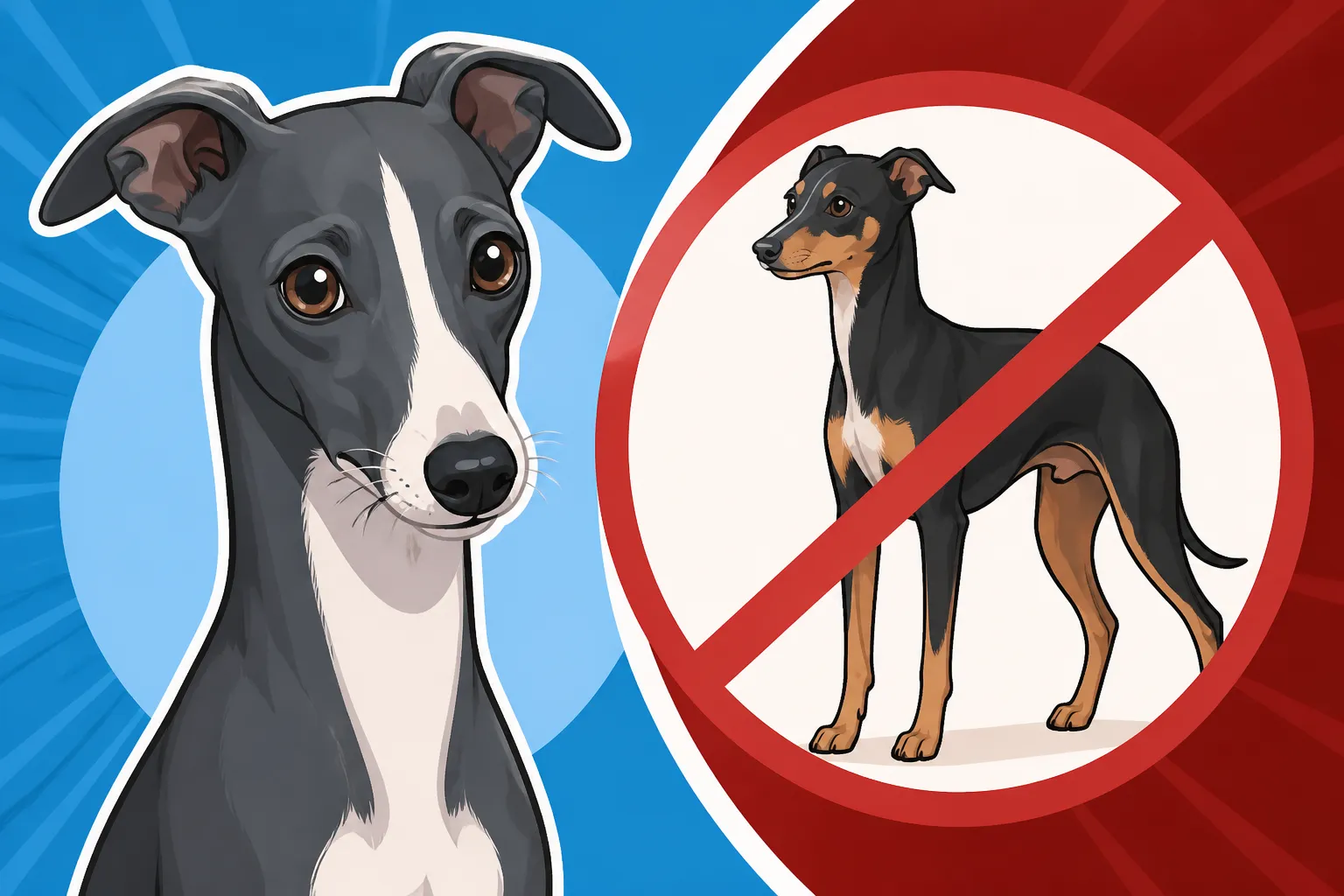
Why Black and Tan Markings Disqualify an Italian Greyhound
Black and tan markings can make an Italian Greyhound ineligible for conformation showing under breed standards that list the pattern as a disqualification. That can be confusing when the dog is healthy, beautiful, and clearly an Italian Greyhound. This guide explains what the marking looks like, why standards exclude it, how show eligibility differs from pet suitability, and what to ask a breeder.
What black and tan markings look like on an Italian Greyhound
Recognizing the tan-point pattern
A black and tan dog typically has a predominantly black coat with distinct tan areas in predictable places. These often include small spots above the eyes, tan on the muzzle and cheeks, and markings on the chest, lower legs, or beneath the tail. The pattern may be subtle in a puppy and become easier to recognize as the coat develops.
The important clue is the arrangement of the color, not simply the presence of black and tan hairs. A black Italian Greyhound with a small white patch is not displaying a black-and-tan pattern just because its coat contains more than one color. Likewise, a fawn or cream dog may have darker shading without having the distinct tan-point markings associated with black-and-tan breeds.
If you are unsure what you are seeing, take clear photographs in natural light and ask a knowledgeable Italian Greyhound breeder or show judge. A photo can help someone point out the pattern, but the final decision about show eligibility belongs to the organization and officials applying its standard. A dog’s color description on a registration document also does not necessarily settle whether its markings meet a show disqualification.
For a broader look at the breed’s accepted appearance, see Which Colors an Italian Greyhound Comes In and Every Color an Italian Greyhound Is Allowed to Be. Those topics can help separate common coat colors and markings from a specific pattern that a standard excludes.
Black and tan is a pattern, not just a color combination
People often use “black and tan” casually to mean any dog with both black and tan fur. In breed-standard language, however, the phrase usually refers to a recognizable tan-point pattern, like the markings seen in breeds such as Doberman Pinschers or Rottweilers. That distinction matters: a judge is not simply counting the number of colors on a dog.
The coat’s appearance can also change as an Italian Greyhound grows. Puppy coats may look softer or less sharply defined, and lighting can make dark shading appear more prominent than it is. If a young dog has markings that seem to be developing, keep dated photographs and ask the breeder how they describe the dog’s color. That conversation can clarify what the breeder observed, though it cannot guarantee a particular show outcome.
When you compare a dog with a written standard, look at the exact wording and the pattern it describes. Don’t assume that every brownish area is a tan point, or that every dog with black on its coat is disqualified. The structure and placement of the markings are central to the distinction.
Why breed standards disqualify the pattern
The standard defines a consistent breed appearance
A conformation standard describes the appearance and structure expected of a breed in the show ring. It gives judges a shared framework for evaluating dogs against the same written description. When a standard names a color pattern as a disqualification, that means a dog showing that pattern is not eligible to compete in conformation under that particular standard.
The rule is about the appearance specified by the standard. It is not, by itself, a finding that the dog is unhealthy, poorly bred, or less affectionate. A family may have a wonderful companion whose coat makes the dog ineligible for a particular show class. Those are different questions, and it helps to keep them separate.
Standards can differ among kennel organizations and countries, so the wording matters. If showing is a goal, check the rules of the organization and event you plan to enter rather than relying on a general online description. The title Whether a Black and Tan Italian Greyhound Can Be Shown addresses the practical show question, while Which Colors the Italian Greyhound Standard Accepts explores how accepted colors are defined.
A disqualification is not a health diagnosis
A black and tan pattern does not automatically mean that an Italian Greyhound has a medical problem. Coat color alone cannot establish whether a dog is healthy, and it should not be used as a substitute for veterinary assessment or responsible health screening. If your concern is health, ask about the dog’s family history, veterinary records, and relevant testing rather than trying to infer health from coat markings.
This is also why responsible breeders should be willing to discuss more than color. Ask what health evaluations were performed, what results are available, and whether the breeder can explain the results in plain language. A careful discussion of health and temperament is more useful to a future pet owner than a promise that a puppy’s color will qualify it for the show ring. You can read more in What an Italian Greyhound Breeder Should Have Tested.
For routine coat care, keep things simple: regular checks for irritation, gentle handling, and a dog-safe grooming product if one is needed. Some owners use retailers such as Chewy to browse basic grooming supplies, but grooming products cannot change a dog’s inherited markings or make a disqualified pattern show-eligible. If a patch of skin looks irritated, painful, or unusually bare, ask your veterinarian before trying to treat it at home.
What the disqualification means for showing and breeding
A pet Italian Greyhound can still be a lovely companion
If an Italian Greyhound has black and tan markings, the most immediate consequence may be that it cannot compete in conformation classes under a standard that disqualifies the pattern. That does not prevent the dog from enjoying ordinary family life, learning skills, going on walks, or participating in activities that do not require conformation eligibility. For most owners, those everyday experiences are far more important than a show ribbon.
It is understandable to feel disappointed if you planned to show a dog and only learned about the markings later. It can also feel unfair when the dog is otherwise a good match for your home. Give yourself room to adjust your expectations. You can still enjoy training, companionship, and dog sports where the event’s rules permit your dog to participate; check the event requirements before entering.
If you are choosing a puppy specifically for conformation showing, be direct with the breeder about that goal before committing. Ask how the breeder evaluates color and markings, what the relevant standard says, and what happens if a puppy develops a pattern that makes it ineligible. A breeder should not promise a show career based only on a very young puppy’s appearance.
Breeding decisions should consider more than coat color
A dog’s coat pattern is only one part of a breeding decision. Responsible breeding involves considering health, temperament, structure, pedigree, and the breed standard, along with the likelihood of producing puppies suited to their intended homes. A color preference should never replace those broader considerations.
If a breeder says a particular marking is permitted or disqualifying, ask which organization’s standard they are referring to. Then read the applicable wording yourself and discuss any uncertainty with someone who has experience judging or breeding Italian Greyhounds. This is especially useful if you live in one country but are looking at a dog registered or shown under another organization’s rules.
For the same reason, be cautious about claims that a puppy’s color guarantees its value, quality, or future success. A coat description is not a health clearance, and a show disqualification does not make a dog unsuitable as a pet. For a fuller look at why color should not be treated as a health forecast, see Whether Coat Color Predicts an Italian Greyhound's Health and What Health Testing an Italian Greyhound Breeder Should Show.
Questions to ask if your Italian Greyhound has these markings
Ask for a clear description and the applicable standard
Start with the practical question: are the markings a distinct black-and-tan pattern, or are they another combination of coat colors and shading? Ask the breeder, veterinarian, or an experienced breed representative to explain what they see and why. Helpful photographs include a side view, the face, the legs, and the underside, all taken in good natural light.
Then identify the organization whose rules matter to you. If your goal is conformation showing, ask the show organizer or relevant kennel organization how the standard is applied. If your dog is a pet and you are simply curious about its color, you may not need a formal ruling at all. Knowing the difference can keep a cosmetic question from becoming a source of unnecessary worry.
If you bought the dog with a written agreement or show-placement expectations, review the documents and speak with the breeder calmly. Clarify what was represented about the dog’s color, registration, and show potential. Keeping the conversation specific—what the contract says, what the markings look like, and which standard applies—usually leads to a more useful discussion than arguing over whether the dog is “purebred enough.”
Keep care focused on the dog, not on changing its color
There is no grooming method that removes inherited black and tan markings. Avoid dye, bleaching, or other cosmetic attempts to alter a dog’s coat for show purposes. Such changes can irritate skin, create a misleading impression, or conflict with event rules. If you have a concern about a stain, skin change, or unusual coat loss, ask your veterinarian what is safe.
For routine cleaning, choose gentle, dog-appropriate supplies and follow the label. Chewy is one retailer where owners may browse everyday grooming basics, but a product’s availability is not a recommendation for a particular dog’s skin condition. If your Italian Greyhound has sensitive skin or a recurring problem, get veterinary guidance before changing shampoos or adding topical products.
The main takeaway is simple: under standards that expressly disqualify black and tan markings, the pattern affects conformation eligibility—not a dog’s worth as a companion. Identify the pattern carefully, check the exact rules that apply to your plans, and make health and temperament central to any breeder conversation.
Disclaimer
This article is for general informational purposes only and does not constitute professional advice. Laws, prices and regulations vary by location and change over time. Consult a qualified professional for guidance on your specific situation.