What a Correct Italian Greyhound’s Topline Looks Like
An Italian Greyhound’s back can look gently curved even when the dog is standing square, which can leave new owners wondering whether that shape is correct or a sign of a problem. The breed’s topline is meant to have a subtle arch over the loin before sloping toward the croup. This guide explains what that outline looks like, how to assess it, and when a change deserves veterinary attention.
The Italian Greyhound topline, explained
What the topline includes
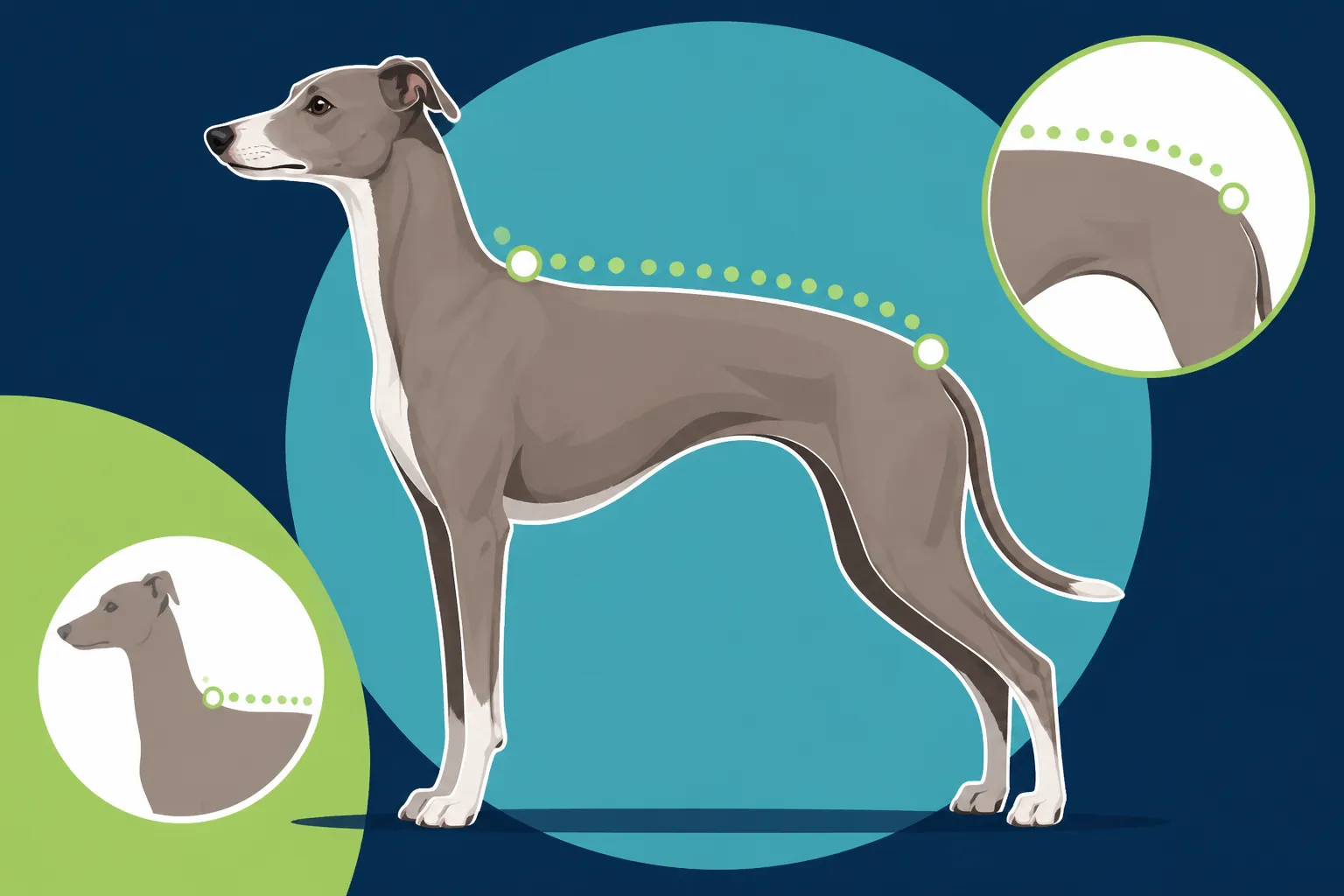
The topline is the outline along a dog’s back, from the withers—the area over the shoulders—to the croup at the top of the hindquarters. In an Italian Greyhound, it is not meant to look like a perfectly flat tabletop. The breed standard describes a straight back with a slight arch over the loin, then a fall away toward the croup.
That gentle curve is easiest to see when the dog is standing naturally on level ground. It should read as a smooth transition through the back and hindquarters, not as a sharp hump or a dip. The arch belongs mainly over the loin, the short section of back between the last ribs and the pelvis.
The topline is only one part of the dog’s outline. Chest depth, tuck-up, leg proportions, and the way the dog carries itself all affect the overall silhouette. For more context on those proportions, see How Deep an Italian Greyhound's Chest Should Be and What an Italian Greyhound's Tuck Up Should Be.
Why the back has a slight arch
Italian Greyhounds are small sighthounds with a distinctive, fine-boned outline. Their gently arched loin is part of the breed’s characteristic shape, not a feature that should be exaggerated. In profile, a correctly made dog often looks elegant and lightly built, with a smooth line over the back and a gradual slope toward the hindquarters.
The word “slight” matters. A pronounced hump can look dramatic in a photograph, but more curve is not automatically more correct. Likewise, a back that appears flat in one snapshot may look different when the dog shifts its weight, relaxes, or stands at a slightly different angle. The breed’s overall proportions matter more than a single frozen view.
If you are comparing outlines, Why an Italian Greyhound's Back Arches can help explain the shape, while What a Correct Italian Greyhound Looks Like Fragile puts that fine-boned appearance in context. A delicate-looking outline should not be confused with a weak or exaggerated structure.
What a correct topline looks like in real life
The shape from withers to croup
Look at the dog from the side while it stands comfortably on a flat surface. Find the withers first, then follow the back toward the loin. The topline should appear mostly straight through the back, with a modest upward curve over the loin. From there, it should slope down toward the croup rather than continuing into a high, sharply peaked arch.
The curve can be subtle, especially in a relaxed pet dog that is not posed for a show-ring photograph. You should not need to squint at an extreme angle to identify a correct outline, and you should not see a deep hollow in the middle of the back. A smooth, balanced shape is more useful to look for than a dramatic profile.
| What you notice | How it generally appears | What to keep in mind |
|---|---|---|
| Back from the shoulders | Mostly straight in profile | A relaxed stance can change the appearance |
| Loin | A slight, smooth arch | The curve should not look sharply peaked |
| Croup | The outline falls away toward the hindquarters | Check the whole body, not one isolated point |
| Overall silhouette | Balanced and lightly built | Fine-boned does not mean structurally weak |
The outline also makes more sense when you consider the dog’s height, length, and general proportions. What Height the Italian Greyhound Standard Asks For and What an Italian Greyhound Weighs and How Tall It Stands offer useful background, but measurements alone do not determine whether a topline looks balanced.
How stance and movement affect what you see
A dog that is leaning forward, stretching to sniff, or standing with its hind legs tucked under may appear to have a different topline from one standing squarely. A soft couch cushion, uneven ground, or a camera held above or below the dog can also distort the outline. Before judging the shape, give the dog a moment to settle on a level surface and look from the side at roughly the height of its back.
Movement offers another perspective. The outline should be considered alongside the dog’s stride and balance, rather than judged from a still image alone. An Italian Greyhound that is excited, turning, or accelerating may carry itself differently for a moment. That does not automatically mean its structure is incorrect.
The breed’s gait has its own recognizable character. The High Stepping Gait That Marks a Correct Italian Greyhound and What the Italian Greyhound's Gait Should Look Like explain how movement fits into the overall picture. If you are assessing a dog for conformation, watch it both standing and moving, and consider the full outline rather than trying to evaluate the back in isolation.
Common topline misunderstandings
A gentle arch is not the same as a pronounced hump
Because the Italian Greyhound’s loin is meant to arch slightly, photos can lead people to think that a stronger curve is always desirable. It is not. A very high or abrupt arch may reflect the pose, camera perspective, or the dog’s individual build; it should not be treated as a goal simply because it stands out in a picture.
A different common misunderstanding is that the back must be completely level to be healthy. That expectation does not match the breed’s characteristic outline. The key distinction is between a subtle, smooth arch and a dramatic or uneven shape. A single image usually cannot tell you whether an unusual-looking outline is due to posture, conformation, or discomfort.
Coat color and body condition can also affect how clearly the back’s shape shows. A lean dog may have visible contours that look more pronounced in certain lighting, while a curled posture can disguise the natural line. If you are comparing dogs, use similar angles and relaxed standing positions where possible.
Topline is not a health diagnosis
A breed-standard outline describes appearance; it is not a substitute for a veterinary examination. A dog may have a topline that differs from the ideal and still move comfortably and enjoy a normal life. Conversely, a dog with a typical-looking outline can still develop pain or another health issue.
Pay attention to changes in your own dog. A newly hunched or guarded posture, reluctance to jump or walk, stiffness, yelping, sensitivity when touched, or a sudden change in movement deserves attention—especially if the dog seems uncomfortable. These signs do not identify a specific cause, but they are good reasons to contact a veterinarian rather than trying to assess the back from photos.
If your dog’s outline has always looked the same and the dog moves comfortably, that is a different situation from a sudden change accompanied by pain. When in doubt, describe what you have noticed and when it began to your vet. A professional can assess posture, movement, and comfort together.
How to assess an Italian Greyhound’s topline fairly
Use a simple, consistent viewing routine
You do not need show-ring experience to observe your dog’s outline, but consistency helps. Try this:
- Let your dog stand naturally on a firm, level surface.
- View the dog from the side, at about back height.
- Follow the outline from the withers across the back, over the loin, and down toward the croup.
- Look for a smooth, modest arch rather than a flat line or a sharply peaked hump.
- Watch your dog walk at an easy pace and notice whether movement appears comfortable.
- If you are concerned about a change, note when it started and contact your veterinarian.
Avoid forcing your dog into a pose to get a better photograph, especially if the dog seems stiff or reluctant. A natural stance is more useful than a carefully arranged position that makes the dog uncomfortable. And if you are comparing a puppy with an adult, remember that proportions can change as a young dog grows; a snapshot during that process is not a complete assessment of its mature shape.
For show evaluation, compare the dog with the breed standard used by the relevant kennel club and seek feedback from an experienced, responsible breeder or conformation judge. Standards and judging practices can vary by organization, so it is sensible to check the rules that apply where you live. How Italian Greyhound Standards Differ Between Countries offers more background on those differences.
Keep the topline in perspective
The topline is a useful detail, but it should not become the only thing you notice about an Italian Greyhound. A balanced dog is assessed as a whole: outline, proportions, movement, condition, and temperament all matter. The breed’s graceful back is one feature of its silhouette, not a standalone measure of quality or health.
For an owner choosing a companion, comfort and sound movement matter more than chasing a picture-perfect curve. For someone learning about the breed standard, the practical visual target is simple: a mostly straight back, a subtle arch over the loin, and a smooth fall toward the croup. If the shape changes suddenly or comes with signs of discomfort, treat that as a health question and ask a veterinarian.
Disclaimer
This article is for general informational purposes only and does not constitute professional advice. Laws, prices and regulations vary by location and change over time. Consult a qualified professional for guidance on your specific situation.