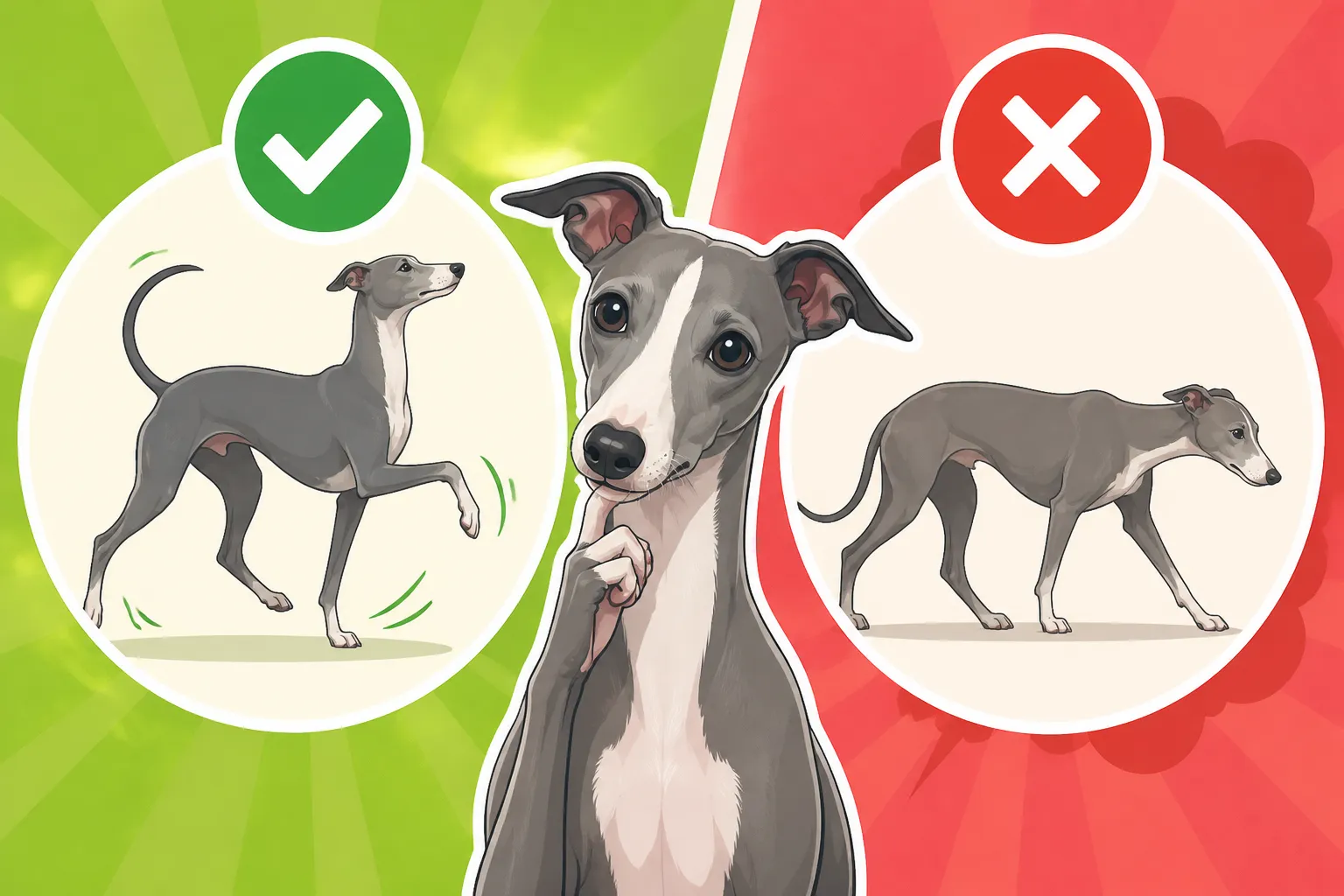
Whether an Italian Greyhound Should Hackney
An Italian Greyhound is known for a light, high-stepping way of moving, so it can be hard to tell where normal breed character ends and a hackney gait begins. The short answer: an Italian Greyhound should move freely and with lift, but should not exaggerate that action into a stiff, prancing hackney. Here’s how to tell the difference and when a change in movement deserves attention.
What hackney gait means in an Italian Greyhound
A high step is not automatically a hackney
“Hackney” describes an exaggerated, high, showy action, especially in the front legs. A dog may lift and flex the forelegs more than needed to move forward, making each step look like a deliberate prance. The movement can appear stiff or overly theatrical rather than easy and flowing.
Italian Greyhounds naturally have an elevated, light gait. That breed trait can make a normal step look more animated than the movement of a heavier dog. A little lift is not, by itself, evidence that the dog is moving incorrectly. The important questions are whether the steps stay fluid, whether the dog travels forward efficiently, and whether the hindquarters contribute a balanced push.
The distinction is easier to see when you watch the whole dog rather than focusing on one front foot. A sound, breed-appropriate stride should look coordinated and comfortable. The dog should not have to throw its forelegs dramatically upward to make progress.
What correct movement should look like
At a walk or trot, an Italian Greyhound should appear light-footed and free, with the legs moving in a coordinated pattern. As the dog moves faster, the legs may track closer to the centerline. The movement should still look purposeful, not like a series of stiff, high kicks. The topline and body should remain reasonably steady, without obvious rocking or twisting.
A correct high step is part of the breed’s character, but it should work with the dog’s forward motion. If the front legs rise conspicuously while the body barely travels, or if the dog looks as though it is marching in place, the action may be excessive. The same concern applies if one leg moves differently from the other or the dog seems guarded on a particular limb.
Breed standards and show-ring interpretation can use specific wording, so owners preparing for conformation should ask an experienced Italian Greyhound breeder or judge to assess the dog in motion. For a broader look at the breed’s movement, see The High Stepping Gait That Marks a Correct Italian Greyhound and What High Stepping Action Means in an Italian Greyhound.
Why the word can be confusing
People sometimes call any elevated step “hackney,” especially when an Italian Greyhound is excited, walking on a short lead, or moving across an unfamiliar surface. That casual description may not mean the dog has a persistent gait fault. A dog that prances briefly to greet someone may move quite normally once it settles.
In the show ring, the distinction is about the quality and consistency of the movement, not a single lively step. A handler can also affect what you see. A tight lead, an awkward pace, or a dog being encouraged to move faster than is comfortable can change its stride and make the front action look more exaggerated.
If you are unsure, record a short video of the dog walking and trotting on a level, nonslip surface, both toward and away from the camera and from the side. Share it with a knowledgeable breeder or veterinarian rather than relying on a quick impression from a single moment.
How to tell normal breed movement from exaggerated action
Compare the whole stride, not just the front legs
Start by watching the dog at a comfortable trot. Look at how the forelegs reach, how the hind legs push, and whether the body moves forward smoothly. A high step may still be normal if the dog remains balanced and the legs move evenly. The gait becomes more concerning when the forelegs lift sharply without a matching forward reach or the rear legs appear to trail behind.
Then watch the dog at a walk. Some dogs show a more obvious prance when they are excited or carefully placing their feet. A walk can reveal whether the movement is relaxed or if the dog consistently holds one limb differently. Do not force a dog to trot for a long time just to get a better look, particularly if it seems uncomfortable.
| What you notice | More consistent with normal movement | Worth a closer look |
|---|---|---|
| Front-leg lift | Light, even lift that carries the dog forward | High, exaggerated lifting with little forward reach |
| Rhythm | Smooth and coordinated | Choppy, stiff, uneven, or repeatedly interrupted |
| Left and right sides | Similar movement on both sides | One leg swings, lands, or bears weight differently |
| Hind-leg action | Helps drive the dog forward | Seems weak, delayed, or out of sync with the front |
| When it happens | Mainly during brief excitement | Persistent, worsening, or present at different speeds |
| Other signs | Dog appears relaxed and comfortable | Limping, reluctance, toe-touching, yelping, or stiffness |
The table is a practical observation guide, not a diagnosis. A dog can have an unusual-looking gait for several reasons, and a video cannot replace an examination if there are signs of pain.
Consider the setting and the dog’s age
A puppy may be awkward as coordination develops. Excitement can make a young dog bounce, skip, or prance for a few strides, while a slippery floor may make it shorten its steps or lift its feet cautiously. These brief changes do not necessarily indicate a lasting gait problem. Observe the dog in a calm, familiar place with good traction before drawing conclusions.
An adult dog’s established movement is a useful point of comparison. If the gait changes suddenly, especially if the dog starts lifting one leg, shortening a stride, or resisting walks, do not assume it is simply “being dramatic.” Italian Greyhounds can keep moving despite discomfort, so a lack of obvious crying does not rule out a problem. How an Italian Greyhound Hides Pain explains why subtle changes in posture and activity matter.
If your dog’s movement looks different after a jump, rough play, or a slip, keep activity quiet and contact your veterinarian for advice. A new limp, swelling, marked tenderness, or refusal to put weight on a leg needs prompt veterinary attention. Italian Greyhounds’ fine limbs deserve careful handling; Why an Italian Greyhound's Leg Bones Break So Easily explains why a suspected injury should not be dismissed just because the dog can still move.
Watch for changes rather than trying to label the gait yourself
“Hackney” is a description of movement, not a medical diagnosis. A high step that has always been present and is symmetrical may be a question of conformation or presentation. A new high step on one side, a sudden change in stride, or a repeated skip can point to discomfort or a mechanical issue that needs a professional assessment.
Look for patterns over several ordinary moments: getting up after a nap, walking on a level surface, turning, and moving at a relaxed pace. Note whether the dog favors a limb after exercise or seems less willing to jump onto furniture. Keep the observation short and calm; repeatedly testing a sore leg can make the dog more uncomfortable.
What can make an Italian Greyhound look as if it is hackneying
Excitement, handling, and leash tension
A delighted Italian Greyhound may bounce or lift its front feet dramatically when greeting a favorite person. That kind of brief excitement-driven movement usually settles when the dog calms down. It is different from a consistent, repeated action seen whenever the dog walks or trots.
Leash handling can affect stride, too. A lead held tight or high may restrict the dog’s natural head and neck position, while an uneven pace can encourage short, choppy steps. For a useful view of the dog’s natural gait, use a secure, well-fitted harness and let it move at a comfortable speed on a level surface. Avoid pulling the dog into a trot for a better-looking video.
If you are replacing gear because the current setup is difficult to fit, Chewy is one retailer where owners may compare harness styles, but fit matters more than the place of purchase. The harness should not restrict the shoulders or rub under the legs. Stop if the dog moves less comfortably while wearing it.
Slippery floors and long nails
On polished hardwood, tile, or slick laminate, a dog may take short, cautious steps and lift its feet more than usual to avoid sliding. That can resemble a prance, even though the dog is simply trying to stay steady. Add rugs or nonslip runners in the areas where the dog walks and turns most often, then see whether its movement becomes more relaxed.
Chewy and other pet retailers carry nonslip runners and traction products, but start by checking that any item lies flat and cannot bunch underfoot. A loose rug can create another tripping hazard. If the dog still moves oddly on a stable, nonslip surface, the floor may not be the whole explanation. For more on footing, see Why an Italian Greyhound Slips on Hardwood.
Overgrown nails can also change how a dog places its feet. If nails touch the floor when the dog stands naturally, they may interfere with comfortable foot placement. Ask your veterinarian or groomer to show you a safe trimming approach, especially if your dog is nervous about paw handling. Chewy may be useful for comparing nail-care tools, but a tool is only helpful if you can use it safely and your dog tolerates it.
Discomfort or a movement problem
A repeated high step can sometimes be a response to discomfort, weakness, or restricted movement rather than a breed trait. Causes can involve the paw, toes, leg, shoulder, back, or joints. Owners should avoid trying to identify the precise cause by watching a gait alone; a veterinary exam is needed to assess pain and movement properly.
Notice whether the dog skips for a stride and then returns to normal, holds a leg up, or seems stiff after resting. Repeated skipping can occur with kneecap problems, among other possibilities. Signs an Italian Greyhound's Kneecap Slips describes a movement pattern worth discussing with a veterinarian, particularly if it happens often or worsens.
Arrange a veterinary appointment if the gait is new, persistent, asymmetric, or accompanied by pain, swelling, reluctance to walk, or a change in behavior. If the dog suddenly cannot bear weight or appears severely distressed, seek urgent veterinary care rather than waiting to see whether the movement resolves.
What to do if your Italian Greyhound has a hackney-like gait
Make a useful observation without overworking the dog
Choose a quiet, familiar place with a flat surface and good traction. Let the dog move at its natural pace for a short time, then record a few seconds from the side and from the front and rear. Keep the lead slack without letting the dog become unsafe, and do not chase, repeatedly turn, or encourage sprinting for the camera.
Write down when you first noticed the movement and whether it happens every time or only in particular settings. Mention recent slips, unusually vigorous play, jumps, or changes in exercise. A simple note such as “front left lifts higher after a walk” is more useful to a veterinarian than a guess about the cause.
If the movement appears only when the dog is excited and disappears when it relaxes, keep observing without making the dog perform. If it persists, appears one-sided, or comes with signs of discomfort, contact your veterinarian and share the video.
Ask the right professional for the right question
For a possible health issue, start with your veterinarian. Explain whether the movement is new, whether it happens at a walk or trot, and whether the dog shows any pain or reluctance. The vet can examine the dog and decide whether further assessment is needed.
For a show-quality movement question in a dog that is comfortable and moving normally, ask a reputable Italian Greyhound breeder, experienced handler, or judge to evaluate the dog at an appropriate pace. They can help distinguish a naturally elevated step from exaggerated action in the context of the breed. A show opinion should never replace veterinary care when the movement has changed or the dog appears sore.
It is also useful to keep expectations realistic: one video or one brief moment cannot determine whether a dog has a persistent gait fault. The pattern over time, the dog’s comfort, and a qualified assessment matter more than a label.
Support comfortable movement at home
Keep nails appropriately short, provide traction where the dog turns or launches into a run, and avoid encouraging repeated jumps from furniture. These measures will not correct a structural gait fault, but they can reduce avoidable slipping and make it easier to see how the dog moves when comfortable. If your Italian Greyhound is still learning safer furniture habits, Teaching an Italian Greyhound to Use a Ramp offers a practical way to reduce jumping.
For a suspected injury or ongoing limp, restrict vigorous play until you have veterinary guidance. Do not give human pain medication unless a veterinarian specifically instructs you to do so. Some medications that are safe for people can be dangerous for dogs.
If the dog moves comfortably, evenly, and with a light forward-flowing stride, a little natural lift may simply be part of its breed character. If the movement is exaggerated, stiff, one-sided, or newly developed, focus less on whether to call it “hackney” and more on finding out why it looks that way.
Disclaimer
This article is for general informational purposes only and does not constitute professional advice. Laws, prices and regulations vary by location and change over time. Consult a qualified professional for guidance on your specific situation.