How an Italian Greyhound Steals Food
Ah, the Italian Greyhound. So elegant, so refined, a picture of grace… right up until they've deftly snatched a rogue piece of cheese off the coffee table or, worse, helped themselves to an entire sandwich you just turned your back on. If you've ever felt like your delicate companion has a secret life as a culinary commando, you're not alone. Italian Greyhounds are notoriously clever and persistent when it comes to food, and it can be incredibly frustrating to feel like you're constantly guarding your meals. This guide is going to dive deep into exactly how these pint-sized pirates manage their heists, why they're so driven to do it, and, most importantly, how you can outsmart them and create a more peaceful, food-secure home.
The Italian Greyhound's Stealthy Tactics: More Than Meets the Eye
You might look at your dainty Italian Greyhound, often weighing in at a mere ten to fifteen pounds, and wonder how on earth they manage to reach that plate on the counter or extract a forgotten snack from a bag. But beneath that fragile exterior lies an athlete with surprising agility, speed, and a tactical mind honed by generations of sighthound instincts. They are not just cute lapdogs; they are master strategists when a delicious morsel is involved.
Counter Surfing and Table Diving: The Vertical Assault
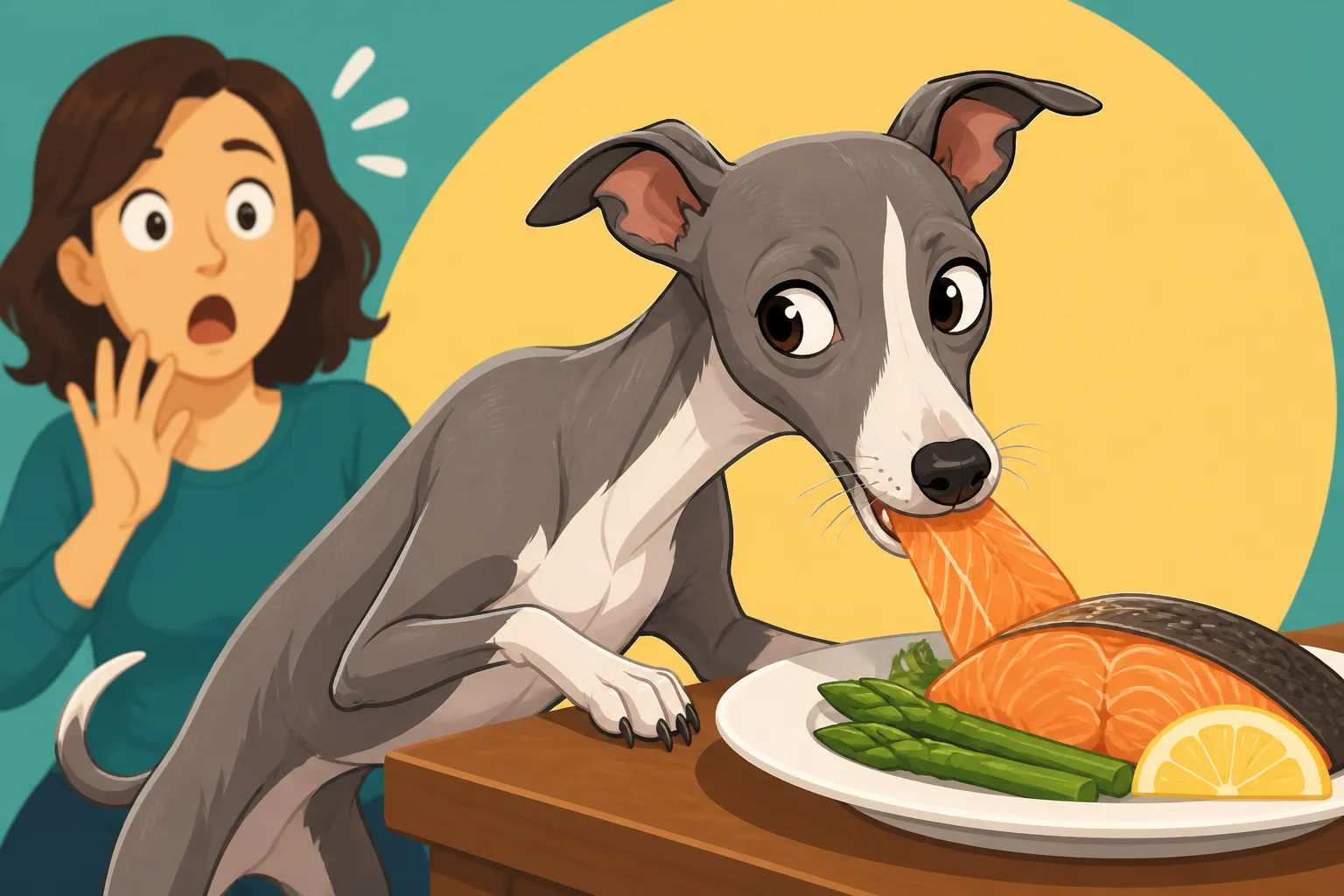
This is perhaps the most audacious of their food-stealing endeavors. Many Italian Greyhound owners are shocked to discover their seemingly ground-bound dog can suddenly launch themselves onto surfaces thought to be out of reach. It's not always a direct, graceful leap, though some Iggies can certainly manage that! More often, it's a series of calculated maneuvers.
Imagine this: you're making dinner, and your Italian Greyhound is calmly resting on their bed, or so you think. You turn to chop vegetables, and in a flash, they've used the kitchen chair as a springboard to the counter, or perhaps even scaled the lower cabinet doors to gain elevation. Their long, powerful hind legs are surprisingly adept at propelling them upward, and their lean bodies allow them to navigate tight spaces. A common scenario is when a low-lying chair is too close to the kitchen island or dining table. An Italian Greyhound views this not as a place to sit, but as a strategic launching pad. They'll spring onto the chair, then onto the table, grabbing whatever is within reach, often before you've even registered their ascent. Sometimes, they don't even need furniture. Some Iggies are absolute masters of the vertical jump, able to spring straight up onto surprisingly high surfaces. It's almost as if they've mentally mapped out the most efficient trajectory to get to that plate of cookies. Their thin frames mean they can often squeeze into tight spots, too, making them particularly good at retrieving items pushed "just a little further back" on a counter. You might think a plate is safe because it's not right on the edge, but for an Italian Greyhound, that's just an extra challenge.
Opportunistic Raiding and Silent Infiltration: Ground-Level Operations
While the vertical game is impressive, many Italian Greyhound food thefts happen much closer to the ground, relying on pure speed and an uncanny ability to go unnoticed. Think of them as tiny ninjas, silently infiltrating your space.
The most common scenario here is the "dropped crumb" or the "forgotten plate" on the coffee table. You drop a piece of toast, and before your brain can even register "oops," your Italian Greyhound has swooped in, devoured it, and is now looking at you with an expression of pure innocence, as if nothing ever happened. Their sighthound speed, designed for chasing prey, translates perfectly to snatching dropped food with lightning-fast reflexes. They can cover a surprising amount of ground in a blink. Another classic move is the silent approach. You're engrossed in a show, a book, or a conversation, and your Italian Greyhound is quietly circling the perimeter. Their light footfall and ability to stay out of your direct line of sight allow them to creep up to a low table or even a plate on your lap. One moment, the food is there; the next, it's gone, and they've retreated to a safe distance, usually under a blanket or furniture, to enjoy their spoils. They're particularly good at identifying which family member is the "weak link" – the one most likely to leave a plate unattended or drop food. They learn patterns quickly, observing your habits and timing their moves for maximum success. Why an Italian Greyhound Looks Stubborn and Is Not sometimes applies here; it's not stubbornness, it's highly motivated tactical planning!
The Art of Distraction and Deception: Psychological Warfare
Beyond physical prowess, Italian Greyhounds often employ a level of cunning that would make a con artist proud. They understand human behavior and are masters of misdirection.
Have you ever noticed your Italian Greyhound staring intently at something other than your food, almost as if to say, "Oh, I'm just looking at that dust bunny, definitely not your delicious sandwich"? This is a classic tactic. They'll pretend disinterest, lying calmly a few feet away, only to spring into action the moment your guard drops. They might also use physical cues: a gentle nudge of your hand, a soft whine, or even a deep sigh, all designed to make you glance at them, giving them that crucial second to make their move on the unattended plate. They learn what works. If a puppy-dog-eye stare got them a crumb once, they'll try it again. If nudging your arm successfully caused you to drop something, that's now in their playbook. They are highly intelligent and will test boundaries constantly. Their charming, delicate appearance is their greatest weapon; who could suspect such a sweet, innocent creature of such devious plans? It's easy to dismiss them as merely curious, but often, there's a calculated motive behind those seemingly innocuous actions. How an Italian Greyhound Hides Pain is a completely different scenario, but it speaks to their ability to mask true intentions or states, which can also be applied to their cunning nature around food.
Understanding the "Why": Hunger, Instinct, and Opportunity
It's easy to get frustrated when your Italian Greyhound steals food, but understanding the root causes of this behavior can help you approach the problem with more patience and effective strategies. It's rarely out of malice; it's a combination of their unique physiology, deep-seated instincts, and learned behaviors.
The Sighthound Hunger Drive: A Metabolism in Overdrive
Italian Greyhounds are sighthounds, bred for speed and agility. This means they have a very high metabolism and very little body fat. Feeding an Italian Greyhound That Carries Seventeen Percent Body Fat goes into detail about their lean build, but the bottom line is they burn through calories quickly.
Because they are so lean and have such efficient digestive systems, many Iggies often feel genuinely hungry, even if they've just eaten. Their bodies are designed to be constantly on the alert for opportunities to fuel that lean, muscular frame. In the wild, a sighthound would gorge when food was available, as they never knew when the next meal would come. While our pampered pets don't face starvation, that primal instinct to seize and consume any available calories remains. This is why a regular, consistent feeding schedule with high-quality food is so important. If an Italian Greyhound is constantly feeling a low-level rumble in their tummy, they'll be even more motivated to scout for extra snacks. Sometimes, what looks like greed is simply their body's efficient processing system signaling "more fuel needed!" They might eat How Many Cups a Day an Adult Italian Greyhound Eats, but it still feels like not enough due to their fast metabolism. This isn't an excuse for bad behavior, but it helps frame their intense interest in your food.
The Power of Scent and Visual Cues: Irresistible Triggers
Dogs live in a world dominated by scent, and Italian Greyhounds are no exception. A forgotten crumb on the floor isn't just a tiny speck; it's a powerful olfactory beacon.
Their noses are incredibly sensitive, allowing them to detect the faintest scent of food, even if it's been cleaned up or hidden. That faint aroma of last night's pizza crust under the sofa? To your Italian Greyhound, it's practically a treasure map. Once they catch a whiff, their sighthound drive kicks in: they locate the source, often visually, and then the planning begins. Visual cues are also huge. They watch you. They see you prepare food, carry plates, and sit down to eat. The sight of food, especially your food, becomes a powerful trigger. The crinkle of a snack bag, the opening of the refrigerator, the sound of a fork hitting a plate – these are all signals that food is present and potentially available. They learn to associate these sounds and sights with the possibility of a treat or a stolen morsel. This heightened awareness means they're always "on," constantly scanning for opportunities. If you've ever wondered What an Italian Greyhound's Breath Should Smell Like, trust me, it should not smell like your dinner!
Learned Behavior and Reinforcement: The Cycle of Success
Perhaps the biggest reason Italian Greyhounds continue to steal food is because, at some point, it worked for them. Even once.
Every time they successfully snatch a piece of food, whether it's a crumb or a full meal, that behavior is reinforced. Their brain thinks, "Aha! That worked! I got a reward!" This positive reinforcement makes them more likely to repeat the action. Even if you scold them afterward, the immediate gratification of the stolen food often outweighs the negative consequence. Think about it: they got the tasty treat, and then you got mad. The order matters. If they learned that a quick snatch leads to deliciousness, they'll keep trying. This is why consistency is key. If you sometimes leave food out and they get away with it, but other times you're vigilant, you're inadvertently teaching them that it's a game of chance they might win. They'll keep playing. This also applies to begging. If begging ever works, even just once, they'll try it endlessly. A big part of breaking this cycle is preventing any success from happening, which means careful management and consistent training.
Fortifying Your Home Against the Food Bandit
Knowing how and why your Italian Greyhound engages in food thievery is the first step; the next is implementing strategies to prevent it. This isn't about punishment; it's about setting up your environment for success and teaching your dog appropriate behaviors.
Kitchen Security Protocol: Making Your Home a No-Go Zone
The kitchen and dining areas are prime targets for food raids. Making these zones less appealing and more secure is crucial.
First and foremost, clear your counters and tables completely. Don't just push things to the back; remove them entirely. Even empty plates with a few crumbs can be irresistible. Get into the habit of wiping down surfaces immediately after preparing or eating food. A clean counter offers no temptation. Invest in trash cans with secure, tight-fitting lids that your Italian Greyhound cannot nose open or tip over. Many Iggies are surprisingly adept at getting into bins, and discarded food can be not only a tempting snack but also dangerous. Consider using baby gates or pet gates to block off kitchen access, especially during meal prep or when you can't actively supervise. Whether Stairs Should Be Gated for an Italian Greyhound is often debated for leg safety, but a gate across a kitchen doorway is pure genius for food safety! This creates a physical barrier that removes the opportunity to counter-surf or scavenge. It's much easier to prevent the behavior than to try and correct it mid-theft.
Training for Impulse Control: Building Good Habits
Environmental management is vital, but so is teaching your Italian Greyhound self-control around food. This requires patience and consistency.
The "leave it" command is your best friend here. Start in a low-distraction environment. Place a treat on the floor, cover it with your hand, and say "leave it." The moment your IG looks away from the treat, reward them with a different, higher-value treat from your other hand. Gradually increase the difficulty: uncovered treat, treat on the floor but you're standing, then walking away. The goal is for them to understand that ignoring the tempting item leads to an even better reward. Practice "wait" as well, especially before they get their own meals or treats. Make them sit and wait for a release cue before eating. This builds impulse control. Remember, consistency is absolutely paramount. Everyone in the household needs to use the same commands and expectations. If one person lets them get away with something, it undermines all the hard work everyone else is doing. Use positive reinforcement and make training sessions short, fun, and rewarding.
Managing Meal Times and Table Manners: Establishing Boundaries
Human meal times are often the trickiest for Italian Greyhound owners. The smells, the activity, the deliciousness – it's a perfect storm for a food thief.
The most effective strategy is to remove the opportunity entirely. This means crating your Italian Greyhound in another room during your meals, or at least having them settled in a designated, distant spot (like their bed with a puzzle toy) where they cannot see or access your food. If they are accustomed to being near the table, this will take time and consistent effort. Start by feeding them their meal a few minutes before yours. A full stomach might reduce their immediate hunger drive, making them less desperate for your food. Then, have them settle in their designated spot with a safe, engaging chew or puzzle toy. This keeps them occupied and rewards them for staying put. Never, ever feed them scraps from the table or your plate. Even a tiny piece reinforces begging and the idea that your food is theirs. Explain this rule to guests as well; well-meaning visitors can easily undo weeks of training with a single dropped morsel. If you're looking for good quality, wholesome food for your IG, brands like Ollie offer fresh meal options, which might help keep them more satisfied and less inclined to scavenge.
Tools and Tricks of the Trade: Equipping Your Defense
Beyond training and general vigilance, there are specific tools and habits that can significantly help in your battle against the Italian Greyhound food bandit. These aren't just gadgets; they're strategic aids that bolster your efforts.
Strategic Placement and Storage Solutions: Physical Deterrents
When it comes to food, out of sight truly is out of mind for an Italian Greyhound, and out of reach is even better. This requires a conscious effort in how you manage your home environment.
Think about your countertops, shelves, and even low tables. Are there any spots that are surprisingly accessible to an agile Italian Greyhound? Often, we underestimate their vertical reach and their ability to leverage furniture. Consider investing in sturdy, tip-proof containers for pantry staples and snacks. Those tempting bags of chips or boxes of cereal should be stored in cabinets with childproof latches if necessary, or in airtight containers that cannot be chewed through. Leaving grocery bags unattended on the floor, even for a moment, is an open invitation. Put them away immediately. For small items, a lidded basket on the coffee table might deter casual snatching. The key is to make food inaccessible before your Italian Greyhound even has a chance to plot their heist. Don't forget outdoor spaces either; secure compost bins and garden areas where tempting (and potentially toxic) items might be found.
Enrichment and Appropriate Chews: Redirecting Their Focus
A bored Italian Greyhound is a creative Italian Greyhound, and that creativity often manifests in seeking out forbidden snacks. Providing appropriate outlets for their energy and mental stimulation can redirect this drive.
Puzzle toys that dispense treats slowly are fantastic for keeping their minds and mouths busy. You can fill them with a portion of their regular kibble, making mealtime a mental exercise rather than a quick gobble. This not only engages them but also makes them work for their food, which can be very satisfying. Durable chew toys, especially those made for strong chewers, can also be a good distraction. Look for options on platforms like Chewy or Amazon that are specifically designed to withstand a dog's chewing. This provides an appropriate outlet for their oral fixation and prevents them from exploring your furniture or personal items with their mouths. Regular exercise is also critical. Even though they are small, Italian Greyhounds need daily walks and opportunities for safe, contained sprints – those famous "zoomies." A tired dog is generally a well-behaved dog. A good run can help satisfy their innate sighthound energy, leaving them less inclined to wander around looking for trouble. Don't forget that Whether Dental Chews Do Anything for an Italian Greyhound is a common question, and while they may have some dental benefits, their primary role here is mental and oral stimulation.
Nutrition and Feeding Routines: A Full Tummy, a Happy Heart
Ensuring your Italian Greyhound is adequately fed and on a consistent schedule can significantly reduce their desperate attempts to find extra food. This goes back to their high metabolism and constant hunger signals.
Work with your veterinarian to determine the appropriate amount of high-quality food for your Italian Greyhound's age, weight, and activity level. How Much an Adult Italian Greyhound Eats might seem small compared to larger breeds, but getting the balance right for their specific needs is crucial. Feeding smaller, more frequent meals throughout the day can sometimes help keep hunger at bay. Instead of one or two large meals, consider three smaller ones, or use a portion of their food in puzzle toys between meals. This consistent intake can help manage their intense hunger drive. High-quality food, whether it's kibble, fresh food (like offerings from Ollie), or a combination, is essential. Better ingredients often mean better satiety and fewer artificial fillers that can leave them feeling unsatisfied. Always make sure they have access to fresh water, as sometimes what seems like hunger can actually be thirst. A well-nourished Italian Greyhound is still an Italian Greyhound with an instinct to scavenge, but a physically satisfied dog will likely be less driven to risk life and limb for a counter-surfed crumb.
| Scenario | Italian Greyhound Tactic | Prevention Strategy |
|---|---|---|
| Counter Surfing | Leaps from chairs, scales low cabinets | Keep counters clear; push items far back; use gates; remove chair access. |
| Table Snatching | Quick grab from unattended plates on low tables | Crate or confine during human meals; don't leave plates unattended; educate guests. |
| Floor Scavenging | Lightning-fast retrieval of dropped crumbs | Clean spills immediately; vacuum regularly; secure trash cans. |
| Pantry Raiding | Nosing into bags, opening low cabinets | Store food in airtight containers; use childproof latches on cabinets. |
| Begging/Distraction | Puppy-dog eyes, nudges, feigned disinterest | Never feed table scraps; consistent "no" to begging; redirect with appropriate toys. |
| Unattended Bags | Rummaging through groceries or purses | Put groceries away immediately; keep bags off the floor and secured. |
Italian Greyhounds are magnificent, loving companions, but their intelligence and sighthound instincts often manifest in unexpected ways, especially around food. While it can be frustrating to constantly guard your snacks, remember that this behavior stems from their natural drives. By understanding their methods, recognizing their motivations, and implementing consistent training and environmental management, you can create a home where both you and your Italian Greyhound can enjoy meal times without constant vigilance. It takes effort, but the peace of mind (and the intact meal) is absolutely worth it.
Disclaimer
This article is for general informational purposes only and does not constitute professional advice. Laws, prices and regulations vary by location and change over time. Consult a qualified professional for guidance on your specific situation.