Whether an Italian Greyhound Is Faster Than a Whippet
An Italian Greyhound can look astonishingly quick when it launches across a field, but a Whippet is generally faster at top speed. That doesn’t make the smaller dog slow: Italian Greyhounds are agile sprinters with plenty of acceleration. This guide compares their speed, explains why individual dogs vary, and shows how to let either breed run without turning a fun outing into a dangerous chase.
Is an Italian Greyhound faster than a Whippet
Which breed usually reaches the higher top speed
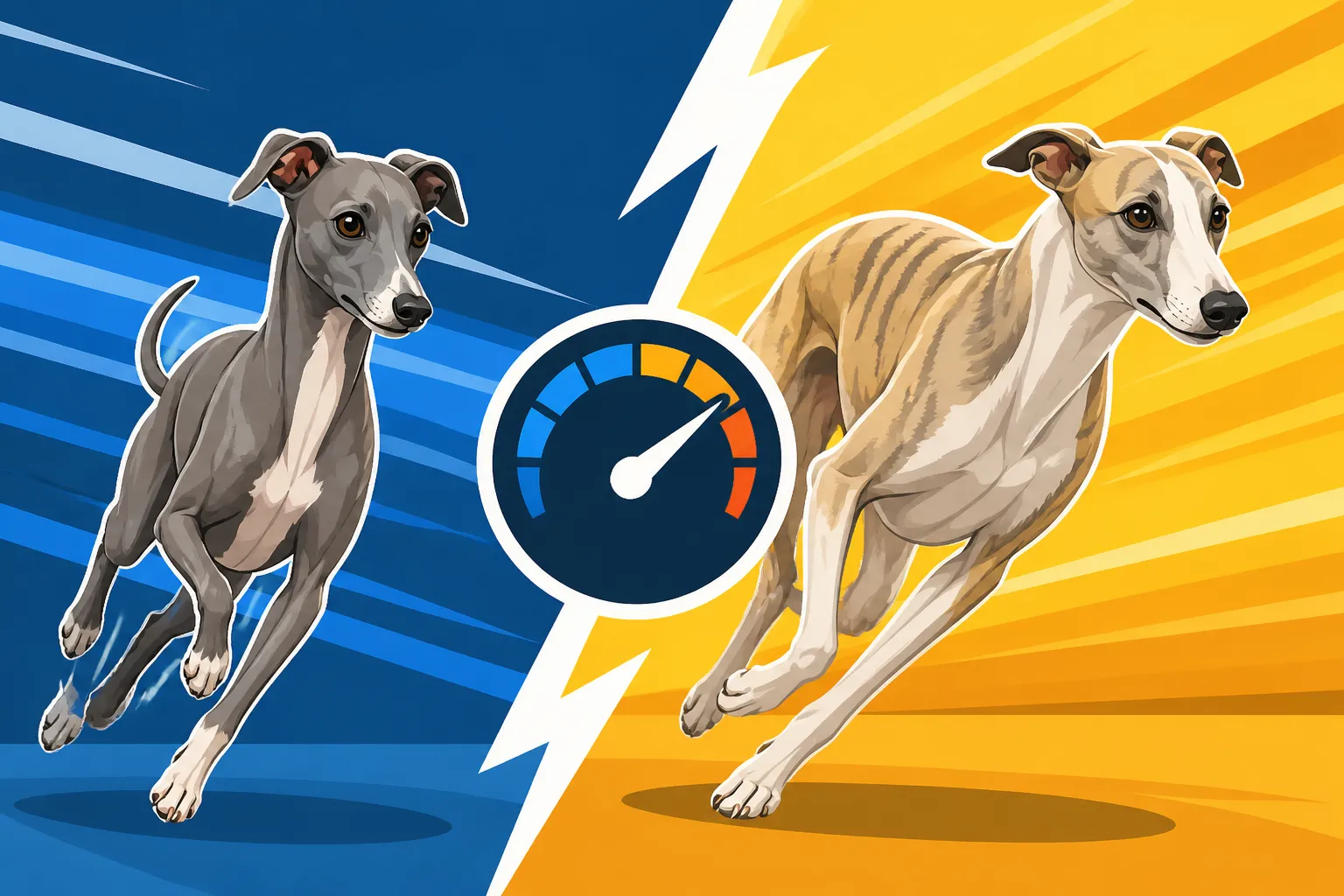
Usually, the Whippet. Whippets are larger sighthounds bred for speed, and they tend to have longer strides and more powerful bodies than Italian Greyhounds. Estimates of top speed vary, and there is no single reliable figure for every dog, but Whippets are often reported to reach speeds around the mid-30s in miles per hour. Italian Greyhounds are commonly estimated in the range of roughly 25 to 30 miles per hour.
Treat those numbers as approximations, not as a promise about what your dog will do. A dog’s speed depends on the individual, the surface, its fitness, its age, and whether it is healthy and keen to run. A particularly athletic Italian Greyhound may outrun a slower or less motivated Whippet in a short burst. Breed averages, though, favor the Whippet for maximum speed.
The difference can be hard to judge during an ordinary walk or a brief run in the yard. Both breeds may accelerate so quickly that the Italian Greyhound seems just as fast, especially over a short distance. The Whippet is more likely to pull ahead when both dogs are fit and running freely over a suitable stretch.
| Comparison | Italian Greyhound | Whippet |
|---|---|---|
| Typical speed pattern | Quick, agile short-distance sprinting | Faster top-speed sprinting in many individuals |
| Build | Smaller and finer-boned | Larger and more substantial |
| Stride | Shorter overall stride | Longer stride and greater reach |
| Common running style | Sudden bursts and sharp turns | Powerful acceleration and extended gallop |
| Safe off-leash running | Only in a securely enclosed area | Only in a securely enclosed area |
If you want to compare the breeds beyond speed, How an Italian Greyhound Differs From a Whippet looks at their size, build, and everyday differences. The Italian Greyhound’s smaller frame is part of what makes it feel so nimble, but smaller does not mean fragile in every movement—or safe from injury during a fall or collision.
Why a Whippet’s build gives it an advantage
Speed is not just a matter of enthusiasm. A Whippet’s longer legs and larger frame can produce a longer stride, while its body is built for efficient, powerful running. When a Whippet stretches into a full gallop, each stride can cover more ground. That is a meaningful advantage when the dog has room to build momentum.
An Italian Greyhound is also a sighthound, with a lean body, long legs for its size, and a strong instinct to chase movement. It can accelerate fast and dart around with impressive agility. But its smaller size and shorter stride generally limit its top speed compared with a well-conditioned Whippet. For a closer look at the size difference, see Whether an Italian Greyhound Is Smaller Than a Whippet.
A short backyard dash is not the same test as a sustained run. In a small space, quick starts and tight turns may matter more than top speed. In a long, open stretch, a Whippet’s reach and running power are more likely to show. That’s why someone watching two dogs chase each other around a yard may come away with a different impression from someone watching them run straight across a large, enclosed field.
What Italian Greyhound speed looks like in real life
Quick acceleration does not mean every run is safe
Italian Greyhounds can go from resting to full speed in a moment. A squirrel, rabbit, or dog taking off can trigger an immediate chase before an owner has time to react. This sudden acceleration is part of the breed’s appeal, but it can also make an uncontrolled run risky.
A fast dog needs space to slow down and turn. If an Italian Greyhound reaches full speed on slippery flooring, uneven ground, or a crowded path, the risk of a collision or fall increases. Their fine limbs and small frame deserve particular care around rough play and sudden leaps. Owners who are worried about injury can read A Broken Leg Is the Emergency Every Italian Greyhound Owner Fears and Why an Italian Greyhound's Leg Bones Break So Easily for more on the breed’s fracture concerns.
The safest way to enjoy a sprint is to use a well-maintained, securely fenced area with enough room for the dog to run without meeting obstacles or other dogs at speed. Check the fencing before letting your dog loose, including gates, gaps near the ground, and places where a dog might squeeze through. A dog that spots prey may be far more determined than it is during a casual recall practice.
Individual fitness and conditions change the result
Age, health, conditioning, and motivation all affect how fast a dog runs. A young, healthy dog may sprint differently from a senior dog, while a dog recovering from illness or injury should not be encouraged to race. Even a fit dog may choose not to run on a hot day, in cold weather, or on a surface that feels uncomfortable underfoot.
The ground matters. Grass with good footing is usually a more sensible choice than slick pavement or loose, uneven terrain. Avoid encouraging high-speed running on wet floors, icy paths, or areas with holes and hidden debris. If your dog is sprinting and suddenly limps, holds up a leg, or seems reluctant to move normally, stop the activity and contact a veterinarian for advice.
Do not try to test your dog’s maximum speed by racing it beside a bicycle, car, or other moving vehicle. That creates a serious risk of collision and gives you little control over how the dog reacts. A safe sprint should be voluntary, brief, and contained in an appropriate space. For more context about speed and running behavior, see How Fast an Italian Greyhound Runs.
Letting an Italian Greyhound run safely
Use secure containment instead of relying on recall
A reliable recall is useful, but it is not a physical barrier. Italian Greyhounds have a strong instinct to chase, and a dog that is normally responsive may ignore a familiar cue once it locks onto fast-moving prey. A fenced run is the safest option for off-leash exercise.
An ordinary unfenced park, open field, or beach is not a safe place to assume your dog will come back. A long line can give a dog room to move during training, but it must be used thoughtfully: keep it away from legs, avoid attaching it where a sudden sprint could injure the dog, and do not use it as a substitute for secure fencing during full-speed running. For a deeper look at the breed’s chase instinct, read How Strong an Italian Greyhound's Prey Drive Is and How Reliably an Italian Greyhound Comes When Called.
Before a run, scan the area for other dogs, holes, debris, and open gates. Choose a time when the space is quiet enough for your dog to focus, and keep early sessions short. If your Italian Greyhound is still learning to come when called, reward check-ins and returns in a controlled setting rather than waiting until a high-speed chase begins.
Choose well-fitting gear for walks and training
A properly fitted harness and a secure leash can help keep your dog safely under control on walks and during training. Check that the harness cannot slip over the dog’s head or shoulders, and that it does not rub under the front legs. Italian Greyhounds have a narrow shape, so a harness that fits a broader-bodied dog may gape or shift when your dog pulls.
When comparing harnesses and long lines, focus on measurements, adjustability, secure fastenings, and return policies rather than relying on a breed label alone. Chewy is one place owners may browse for walking gear, but any item needs to fit your individual dog; check its sizing information carefully before ordering. If a harness arrives and shifts, pinches, or lets your dog back out of it, stop using it and try a different fit.
Chewy may also be useful for comparing basic training supplies, such as lightweight leads or treat pouches. The goal is not to outfit a dog for racing. It is to make everyday walks and recall practice safer and easier to manage. When you’re deciding on gear, Which Harness Suits an Italian Greyhound's Neck offers breed-specific considerations, and How an Italian Greyhound Breaks a Leg in Its Own Yard explains why a familiar space can still hold hazards.
What speed means for an Italian Greyhound owner
A fast dog still needs more than sprinting
A few exhilarating bursts do not replace regular, appropriate exercise. Many Italian Greyhounds enjoy short runs, but they also need walks, play, sniffing, and time to rest. Build activity around your dog’s age and health, and avoid pushing for speed when the dog is tired, overheated, or uncomfortable.
Watch how your dog moves before, during, and after activity. A normal sprint should look coordinated, with the dog willingly returning to rest or play. Limping, stiffness, unusual reluctance, or a change in gait deserves attention. If you are uncertain whether a particular activity is suitable—especially for a puppy, senior dog, or dog with a past injury—ask your veterinarian for individual guidance.
An Italian Greyhound does not need to beat a Whippet to enjoy running. The point is a safe, satisfying outlet for natural behavior, not a race or a speed record. For many owners, a few minutes of joyful zooming in a secure area is plenty; the rest of the day may be spent under a blanket.
The practical answer to the comparison
If you’re asking which breed is faster in a straight, full-speed sprint, the Whippet generally has the advantage. If you’re asking whether an Italian Greyhound is fast, absolutely: it is a quick, athletic little sighthound capable of startling bursts of speed. The difference is most noticeable when a fit Whippet has room to stretch out and run.
It’s also worth remembering that speed does not predict how easy a dog will be to manage. A smaller Italian Greyhound can still accelerate faster than an owner can react, and a strong recall is never guaranteed when prey appears. Secure fencing, good footing, suitable equipment, and sensible supervision matter more than knowing an exact top-speed figure.
Chewy can be one option for finding everyday walking and training supplies, but choosing the right fit and using it safely matter far more than where it is purchased. Keep running sessions controlled, let your dog set a comfortable pace, and treat any sudden change in movement as a reason to pause. That approach lets you appreciate the Italian Greyhound’s speed without needing to test its limits.
Disclaimer
This article is for general informational purposes only and does not constitute professional advice. Laws, prices and regulations vary by location and change over time. Consult a qualified professional for guidance on your specific situation.