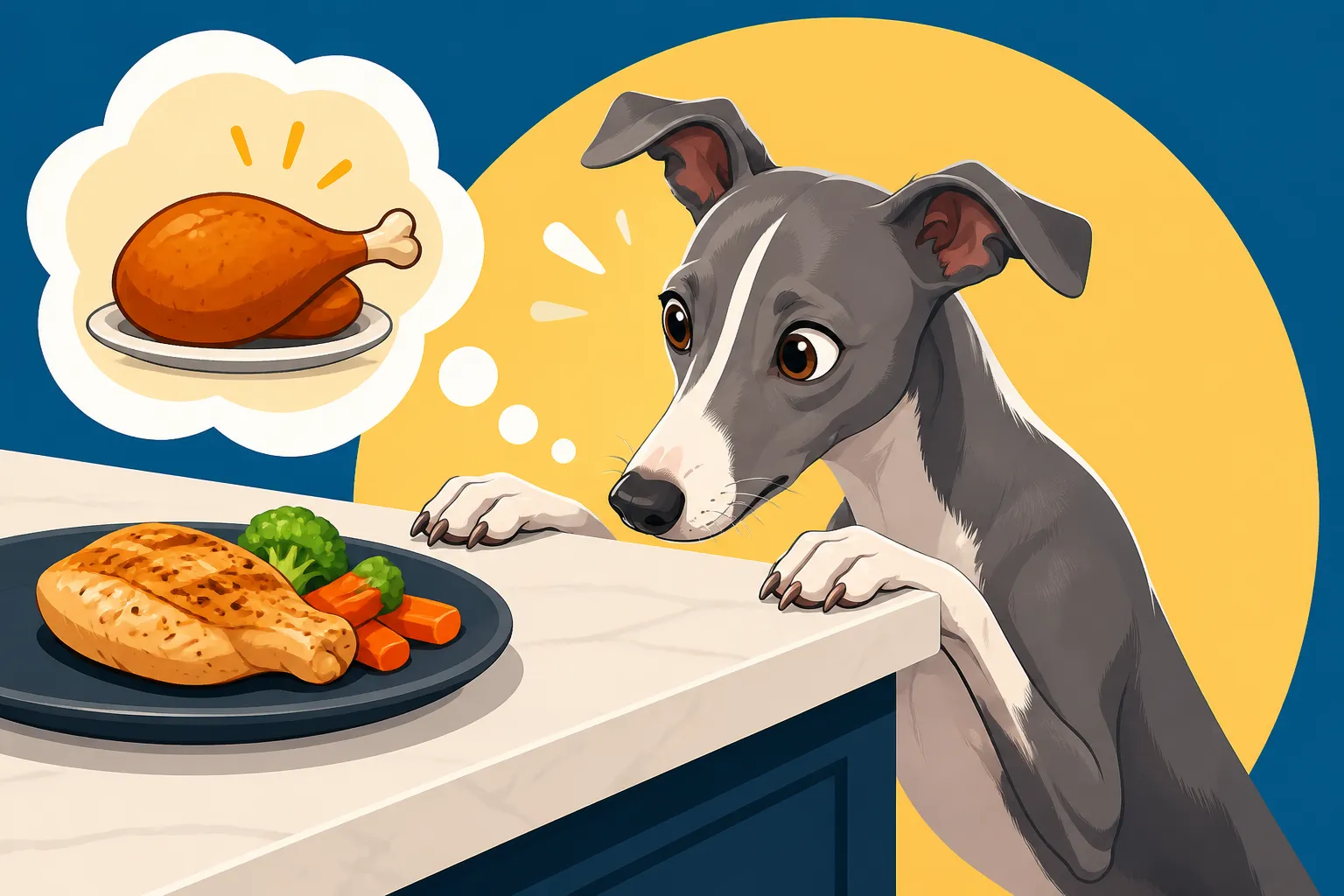
Why an Italian Greyhound Counter Surfs
It's incredibly frustrating, isn't it, when you walk into your kitchen and find your sleek, seemingly delicate Italian Greyhound with their nose where it absolutely doesn't belong – right up on your kitchen counter! You might be thinking, "How did my tiny dog even reach that?" or "I thought I put that away!" This guide is here to shed light on why your Italian Greyhound might be turning into a four-legged counter surfer and, more importantly, what you can do to manage this persistent and sometimes dangerous habit.
Understanding the Italian Greyhound's Drive
When we think of counter surfing, we often picture bigger, bolder breeds, but Italian Greyhounds, despite their petite stature, possess a unique combination of traits that make them surprisingly adept at this particular mischief. It's not just about naughtiness; it's often rooted in their inherent instincts and physical makeup.
Natural Curiosity and Sighthound Instincts
Italian Greyhounds are sighthounds through and through, which means their world is often processed through their keen vision and an intense curiosity about their surroundings. They are naturally alert and observant, constantly scanning their environment. This isn't just about spotting a squirrel in the yard; it extends to everything inside your home as well.
Imagine your kitchen from their perspective. The counter, to us, is a functional workspace. To your Italian Greyhound, it's a raised landscape, a fascinating new territory with an ever-changing array of smells and sights. A half-eaten sandwich left cooling, a grocery bag full of intriguing possibilities, or even just the lingering scent of something delicious you cooked for dinner – all of these become irresistible beacons. Their sighthound nature means they are quick to notice anything new or out of place. That glint of silver from a forgotten butter knife or the vibrant color of a piece of fruit can instantly draw their attention. They aren't just sniffing blindly; they are seeing the opportunity, assessing the situation, and often, making a move with surprising agility. This innate drive to investigate isn't malicious; it's simply how they interact with their world, often seeking out novel stimuli, especially those associated with food.
The Allure of Novelty and Scent
There's no denying it: Italian Greyhounds are incredibly food-motivated, and their sense of smell, while perhaps not as powerful as a Bloodhound's, is certainly keen enough to lead them astray. To a dog, food isn't just sustenance; it's a primary motivator, a source of pleasure, and an object of intense interest. The kitchen counter often becomes a treasure trove of tantalizing aromas.
Even if you think the counter is clean, the ghost of a delicious meal can linger. The faint scent of roast chicken from last night's dinner, the subtle sweetness of a fruit bowl, or the alluring aroma of freshly baked cookies cooling on the rack – these are powerful attractants. Your Italian Greyhound's nose will pick up on these cues long before you even consider them. For a breed that naturally carries very little body fat, the instinct to seek out caloric rewards can be incredibly strong. They are built for speed and efficiency, and that often translates to an opportunistic approach to food. A successful counter surfing attempt, even if it yields only a tiny crumb, is a massive win in their mind, reinforcing the behavior for future attempts. It's like finding a hidden jackpot – once they know it's there, they'll keep checking. This drive is so primal, that it often overrides any previous training or perceived boundaries, especially if the reward is high-value. How Much an Italian Greyhound Cares About Food
Physical Capabilities and Opportunism
Many people underestimate the physical prowess of an Italian Greyhound, dismissing them as too small or fragile to reach high places. This is a common misconception that often leads to owners being completely blindsided when their dainty little dog suddenly becomes a parkour master on the kitchen cabinets.
Surprising Agility and Vertical Reach
Despite their delicate appearance and fine bone structure, Italian Greyhounds are incredibly agile and possess a surprising vertical leap. They are miniature athletes, built for bursts of speed and remarkable spring. While they might not be able to clear a six-foot fence like a larger sighthound, their ability to launch themselves upwards, especially if they have a slight advantage, is truly remarkable.
Think about it: they are known for their "zoomies," those sudden explosions of energy where they dart and spin. That same athletic capability translates to their jumping ability. They can often jump from a standstill onto a sofa, and from there, a chair, and then, voila, the counter. I've seen Iggies use an open dishwasher door as a ramp, a laundry basket as a spring board, or even just a strategically placed kitchen stool as a stepping stone to launch themselves to the promised land of forbidden snacks. They are incredibly clever at using their environment to their advantage. A light tap of their paw to test stability, a quick stretch of their long neck, and then a gravity-defying leap – it all happens faster than you can blink. It's precisely this combination of physical agility and problem-solving that makes them such effective counter surfers. How High an Italian Greyhound Can Jump From Standing
Learning from Experience (and Success!)
The phrase "success breeds success" is never truer than when it comes to a dog's learning. For an Italian Greyhound, or any dog really, a single successful counter surfing attempt is often all it takes to solidify the behavior. Even if they only manage to snag a forgotten bread crust or lick a greasy plate, that immediate gratification is a powerful reinforce.
Dogs are incredibly good at making associations. If they jump on the counter and get food, they quickly learn: "Jumping on the counter = food." It doesn't matter if it happens every time; intermittent reinforcement (sometimes they get something, sometimes they don't) can actually make a behavior even more persistent. They become little gamblers, always hoping that this time, their efforts will pay off. This makes the habit incredibly difficult to break once it's established, because they've already experienced the ultimate reward. They're not being stubborn; they're being rational from a dog's perspective. Why wouldn't they try again if it worked before? This is why prevention is so crucial – preventing that first "win" is far easier than trying to un-teach a deeply ingrained, self-rewarding behavior.
Environmental Factors and Management
While your Italian Greyhound's natural inclinations play a big part, the environment you provide also heavily influences whether they become a dedicated counter surfer. Often, it's less about the dog being "bad" and more about the opportunities presented to them.
Unsecured Food and Temptation
Let's be brutally honest with ourselves: the number one reason an Italian Greyhound counter surfs is because there's something on the counter worth surfing for. It sounds simple, but it's the easiest thing to overlook in a busy household. We often assume that because it's "up high," it's safe. For an Italian Greyhound, "up high" is just a challenge.
Think about those moments of distraction: you're answering the phone, grabbing a drink, or quickly stepping out of the kitchen for just a second. That's all the time an opportunistic Ig needs. Leftover toast crumbs, a cooling plate of dinner, a grocery bag with a loose bread roll, or even an "empty" take-out container with lingering scents – these are all irresistible lures. I've heard stories of Iggies getting entire sticks of butter, bags of chips, or even a child's forgotten snack. The aroma alone is enough to trigger their investigation. It's a classic example of "out of sight, out of mind" for humans, but "out of reach, still in mind" for an Italian Greyhound. To truly prevent this, you need to adopt a "nothing on the counters" policy, at least until your Ig has proven they can respect boundaries.
Access Points and Stepping Stones
Another critical environmental factor is how your Italian Greyhound gains access to the counter. They rarely just fly up there; they use aids. We might unknowingly provide these "stepping stones" without even realizing it.
A kitchen chair pushed too close to the counter is an open invitation. A sturdy stool, a stack of books, a laundry basket, or even a large bag of dog food can all become strategic launchpads for your agile little thief. They are surprisingly intelligent problem-solvers. If they can't make the jump directly, they'll often scope out alternative routes. You might come home to find a chair askew, revealing the secret pathway your Ig has been utilizing. It's crucial to observe your dog, if possible, or at least play detective by looking for displaced items. Understanding how they're getting up there is the first step to blocking their access. Consider your kitchen layout and identify any furniture or objects that could be repurposed as climbing aids. Even pet steps or Ramps and Steps for an Italian Greyhound's Furniture designed for easier access to sofas can inadvertently serve as a ladder to higher ground if left near the forbidden zone.
Behavioral Roots and Training Challenges
While environmental factors and physical abilities contribute, there's also a strong behavioral component to counter surfing. It often stems from a lack of clear boundaries, insufficient mental engagement, or an owner's inconsistent response.
Lack of "Leave It" or "Off" Training
One of the most fundamental reasons an Italian Greyhound might counter surf is simply that they haven't been adequately taught the concept of "leave it" or "off." These aren't just polite commands; they are essential impulse control cues that teach your dog to disengage from something tempting and to remove themselves from a forbidden area.
Many owners focus on basic obedience like "sit" or "stay" on the floor, but neglect to extend this training to higher surfaces or high-value temptations. "Leave it" needs to be practiced in increasingly challenging scenarios, starting with low-value items on the floor and gradually progressing to more exciting items, and eventually, to items on a counter. If your Italian Greyhound hasn't learned that a specific item or area is off-limits, they can't be blamed for exploring it. The "off" command is equally vital, teaching them to remove all four paws from a surface. Consistency is key here. Every time they are told "off" and comply, or "leave it" and ignore a temptation, you are reinforcing the desired behavior. Without these foundational commands, you're essentially asking your Ig to guess what you want, and when food is involved, their instincts will almost always win out. Which Rewards an Italian Greyhound Works For can be excellent tools for building this positive association with good behavior.
Boredom or Lack of Mental Stimulation
An Italian Greyhound with too much time on their paws and not enough mental stimulation is a recipe for creative mischief. They are intelligent, curious dogs, and if their minds aren't engaged through appropriate activities, they'll often find their own "jobs," which can include exploring forbidden territories like your kitchen counter.
Think about it: a bored dog doesn't just sit there. They seek stimulation. This might manifest as chewing inappropriate items, excessive barking, or, yes, investigating every nook and cranny of your home, including high-up surfaces. If your Ig isn't getting enough walks, interactive play, or puzzle toys, they might view the counter as a stimulating challenge. The act of planning the jump, sniffing out the goodies, and successfully snatching a prize can be a highly engaging activity for them. It's a puzzle, a hunt, and a reward all rolled into one. Ensuring your Italian Greyhound has a rich environment with plenty of appropriate outlets for their energy and intelligence can significantly reduce the likelihood of them seeking out counter surfing as a form of entertainment. What an Italian Greyhound Does When Bored helps us understand that these dogs need more than just physical exercise; their minds need a workout too.
Strategies for Prevention and Correction
Dealing with counter surfing requires a multi-faceted approach, combining proactive prevention, clever management, and consistent training. It's not about punishing your Italian Greyhound, but about teaching them the rules of your home in a way they understand.
Proactive Prevention: The "Nothing on the Counters" Rule
This is, by far, the most effective strategy for preventing counter surfing, and it's also the simplest, though it requires rigorous consistency from every member of the household. The "nothing on the counters" rule means exactly that: if it's edible or valuable and you don't want your Italian Greyhound to get it, it doesn't go on the counter, ever, even for a second.
This means:
- Put all food away immediately: No cooling pies, no bread left out, no forgotten plates.
- Clean up crumbs and spills: Even microscopic remnants can attract your Ig's keen nose. Wipe counters thoroughly after every meal prep.
- Don't leave grocery bags unattended: Especially those containing tempting items. Put them away as soon as you walk in.
- Secure trash cans: Italian Greyhounds are clever. If they can knock it over or open the lid, they will.
- Consider non-food items: Even things like wallets, keys, or medications can be knocked off, chewed, or ingested if left within reach.
- Educate everyone: Ensure family members, guests, and especially children understand and adhere to this rule. One slip-up can undo weeks of diligent effort.
By eliminating the reward, you eliminate the motivation. If your Italian Greyhound repeatedly jumps on a counter and finds nothing, the behavior will naturally diminish over time because it's no longer self-rewarding. This rule is a commitment, but it's the strongest defense against this troublesome habit.
Management Tools and Deterrents
Sometimes, despite your best efforts at prevention, you need an extra layer of defense, especially when you can't be in the kitchen supervising constantly. This is where management tools and humane deterrents come into play.
- Baby Gates: The simplest and often most effective method is to use a baby gate to block access to the kitchen entirely when you're not present or actively supervising. This creates a physical barrier that most Italian Greyhounds cannot scale. Look for gates that are tall enough and securely fastened.
- Scat Mats (or similar electronic mats): These mats, often found on Amazon, deliver a mild static pulse when stepped on. They are designed to be unpleasant but harmless. Placed directly on the counter or in areas where your Ig might launch themselves, they create a negative association with the forbidden surface. The key is to introduce them consistently so your dog learns that the counter itself is the source of the unpleasant sensation, not you.
- Noise Makers: Some owners create homemade deterrents by stacking empty soda cans or lightweight baking sheets precariously on the edge of the counter. If the dog jumps up, the noise and clatter might startle them, discouraging future attempts. Be cautious with this method to ensure nothing heavy can fall and injure your dog.
- Sticky Paws (or double-sided tape): Some dogs dislike the sticky sensation on their paws. Applying wide, double-sided tape to the counter edges can be a deterrent for some Iggies, making the surface feel unpleasant.
The goal of these tools is not punishment, but to create a clear consequence for the undesirable behavior without your direct intervention. This helps your Italian Greyhound understand the boundary on their own terms.
Consistent Training and Redirection
While prevention and management are critical, active training remains an indispensable part of solving counter surfing. You want to teach your Italian Greyhound what to do instead of focusing solely on what not to do.
- Reinforce "Leave It": Regularly practice the "leave it" command with increasing distractions and higher-value items. Start on the floor, then move to low tables, and eventually, under close supervision, near the counter. Reward heavily when they successfully disengage.
- Teach "Off": This command teaches your Ig to remove all four paws from a surface. Practice it by luring them onto a low surface and then using the "off" command to get them to step down, rewarding them when they do.
- Redirection: When you see your Italian Greyhound eyeing the counter, don't just scold them. Interrupt the behavior with a cheerful "Nope!" or "Uh-oh!" and then immediately redirect them to an appropriate activity. Offer a favorite toy, start a short play session, or ask them to perform a known command like "sit" or "down" for a treat on the floor. This teaches them that engaging with you or an appropriate toy is more rewarding than attempting to surf.
- Positive Reinforcement for Staying Down: Actively reward your Italian Greyhound for simply existing calmly in the kitchen while you're cooking or cleaning. Toss treats on the floor near their mat or bed when they're settled. This builds a positive association with staying off the counter, making it a more appealing choice.
- Professional Help: If counter surfing is persistent and dangerous, consider enrolling in an online dog training program. Services like BAXTER & Bella offer structured, positive reinforcement-based training plans that can help address impulse control and build a strong foundation of obedience, often with one-on-one coaching to help with specific challenges like counter surfing.
- Manage Excitement: Italian Greyhounds can get very excited, and sometimes that excitement can lead to impulsive behavior. Keep kitchen interactions calm. Avoid hyping them up with excited chatter or rough play when food is present.
Remember, consistency is your most powerful tool. Every time your Italian Greyhound successfully counter surfs, the behavior is reinforced. Every time you prevent it or redirect them successfully, you weaken the habit and strengthen desired behaviors. It takes patience, vigilance, and a united front from everyone in the household, but with persistence, you can teach your Italian Greyhound to keep their paws on the floor.
Counter Surfing Prevention Methods
| Method | Description | Pros | Cons |
|---|---|---|---|
| "Nothing on Counters" | No food or tempting items left on any elevated surface, ever. | Highly effective; removes temptation entirely. | Requires strict consistency from all household members; can be inconvenient if not meticulously followed. |
| Baby Gates | Physical barriers to block kitchen access when unsupervised. | Prevents access completely; very safe. | Can be cumbersome for humans; doesn't teach impulse control directly, only manages access. |
| "Leave It" Training | Teaching the dog to disengage from tempting items. | Builds impulse control; applicable in many situations. | Requires consistent, ongoing training; may not hold up under very high-value temptations if not generalized. |
| "Off" Training | Teaching the dog to remove all paws from a forbidden surface. | Teaches clear boundaries for elevated surfaces. | Requires consistency; dog might learn "off when you're looking." |
| Electronic Mats | Mats that deliver a mild static correction when stepped on. | Creates a direct, immediate consequence for counter access. | Can be startling for the dog; requires careful placement; doesn't teach alternative behaviors, only deters. Some dogs learn to avoid the mat rather than the counter entirely. |
| Noise Makers | Precariously stacked cans/trays that fall and make noise if disturbed. | Startles the dog; creates a negative association. | Risk of injury if items are heavy; can desensitize over time; dog may learn to avoid only when items are present. |
| Redirection | Interrupting unwanted behavior and guiding the dog to a desirable alternative. | Positive approach; teaches appropriate outlets. | Requires constant vigilance and quick intervention from the owner; can be time-consuming initially. |
| Increased Mental/Physical Exercise | Providing adequate outlets for boredom and energy. | Reduces overall mischief; holistic approach to behavior. | May not directly address counter surfing if other methods aren't also used; requires commitment to daily routine. |
Disclaimer
This article is for general informational purposes only and does not constitute professional advice. Laws, prices and regulations vary by location and change over time. Consult a qualified professional for guidance on your specific situation.