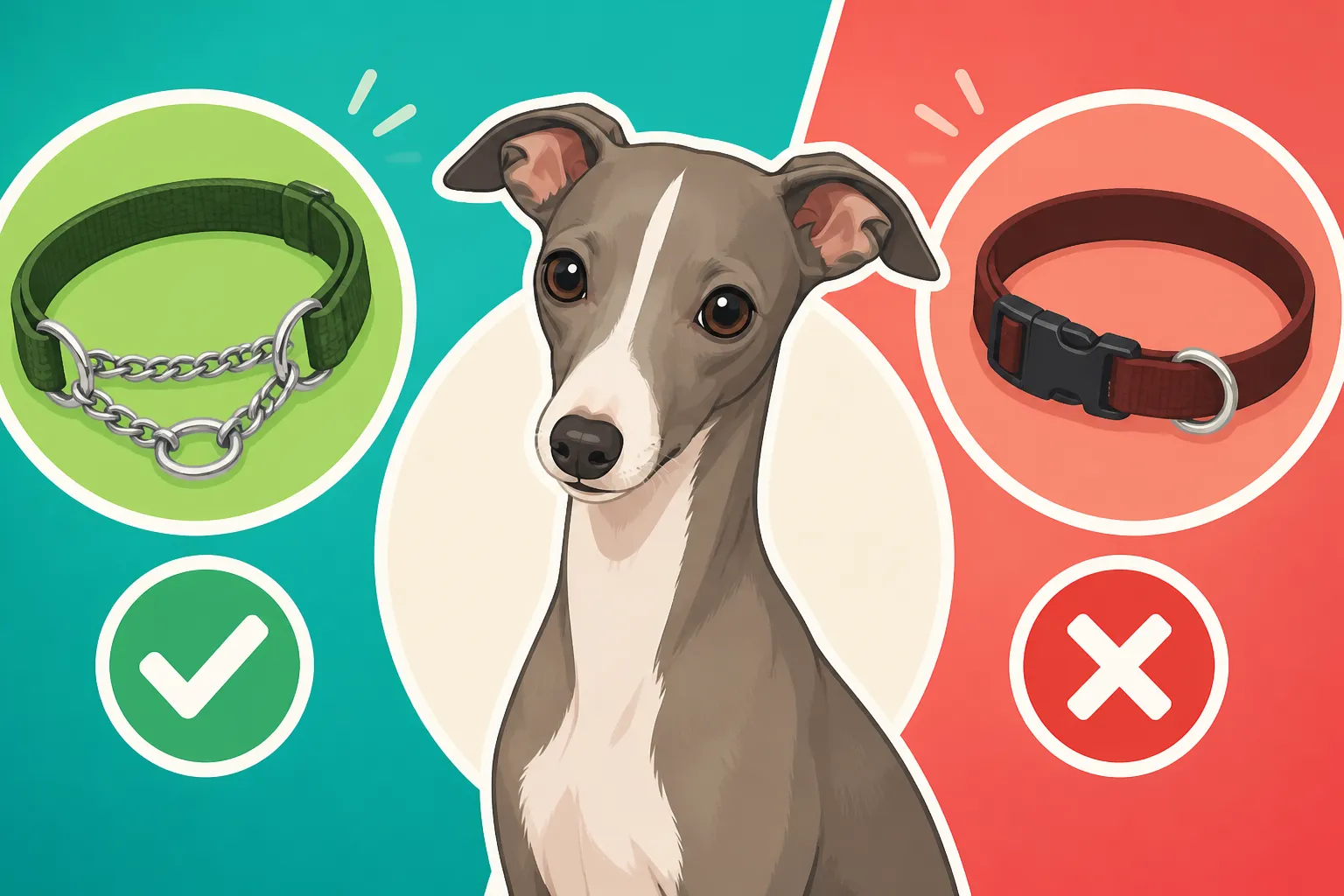
Whether a Martingale Collar Suits an Italian Greyhound
Every Italian Greyhound owner has experienced that gut-wrenching moment: you're out for a walk, your beautiful Iggy gets spooked or spots a squirrel, and in a blink, they've wiggled out of their collar, leaving you with an empty leash and a heart pounding in your throat. This terrifying scenario is all too common due to their unique build. This guide will delve into whether the Martingale collar is the secure solution you've been searching for to keep your Italian Greyhound safe and sound on every adventure, along with how to choose and use one properly.
The Unique Challenge: Why Standard Collars Fail Italian Greyhounds
Let's be honest, Italian Greyhounds are built differently. They have this sleek, elegant, almost aerodynamic structure that makes them incredible sprinters, but it also creates a unique challenge when it comes to collar security. Most dog breeds have a head that's roughly the same size as, or larger than, their neck. Not our Iggys! Their heads are often considerably smaller than the circumference of their graceful, muscular necks.
The "Inverted Cone" Problem
Imagine an ice cream cone, but upside down. That's essentially what an Italian Greyhound's neck and head profile looks like. A standard flat buckle collar, when properly fitted to their neck to prevent it from slipping off over their head, often ends up being uncomfortably tight when they're simply walking. But if you loosen it just enough for comfort, it becomes dangerously easy for them to back out of it or slip free when they pull against the leash or get startled. This is why you often hear the urgent advice: never trust an Italian Greyhound off-leash in an unfenced area. Their ability to escape a regular collar is legendary, and often the reason owners say Why an Italian Greyhound Cannot Be Trusted Off Leash, Ever. It’s not a flaw in their temperament; it’s a design feature, if you will, that we need to accommodate with the right equipment.
The Risks of a Poorly Fitted or Standard Collar
The immediate and most terrifying risk is, of course, escape. A loose Italian Greyhound can dart into traffic, chase wildlife, or simply get disoriented and lost in unfamiliar territory. The speed at which they can disappear is truly astounding, which makes understanding What to Do When an Italian Greyhound Gets Loose incredibly important. Beyond the outright escape, a regular collar can put undue pressure on their delicate trachea if they constantly pull. Because their skin is so fine and they have minimal padding, rubbing and chafing are also concerns with ill-fitting collars. It's not just about keeping them from running off; it's about their comfort and long-term health, too.
Understanding the Martingale Collar: A Secure Design for Sighthounds
Enter the Martingale collar. For many Italian Greyhound owners, this piece of equipment is not just a preference; it's a necessity. It was, in fact, originally designed with sighthounds in mind, specifically to address the very anatomical challenges we just discussed.
How a Martingale Collar Works
A Martingale collar looks like a flat collar with an extra loop of fabric or chain attached. When your Iggy pulls on the leash, or when you gently tug, the smaller loop tightens, which in turn causes the main loop of the collar to constrict around their neck. The brilliant part is that it only tightens to a certain point – just enough to prevent the collar from slipping over their head, but not so much that it chokes them. It's often referred to as a "limited-slip" collar for this reason. The tension is evenly distributed around the neck, which is far gentler than the sudden pressure from a choke chain or the focused pressure of a flat collar that digs into one spot. It provides a humane way to give you control without causing pain or injury.
Fabric vs. Chain Martingales
Martingale collars typically come in two main styles for the control loop: a chain section or an all-fabric loop. Each has its pros and cons. A chain Martingale provides a distinct sound and feel when it tightens, which some owners find useful as an auditory cue for their dog during training. It can also be very durable. However, some dogs might find the sound jarring, and the chain can be heavier. An all-fabric Martingale offers a quieter, softer tightening action. This might be preferable for sensitive Iggys or those with very short, sparse coats where a chain might feel cold or rub. Both types work effectively to prevent escapes, so the choice often comes down to your personal preference and what your Italian Greyhound seems most comfortable with. You can find a wide variety of both types from many online retailers, like through a quick search on Amazon, which offers countless options.
Benefits and Considerations of Using a Martingale for Your Iggy
The popularity of Martingale collars among Italian Greyhound enthusiasts isn't just a trend; it's born from genuine necessity and proven effectiveness. They offer a unique blend of security and comfort that many other collar types simply cannot provide for this breed.
The Peace of Mind of an Escape-Proof Design
The primary benefit, and perhaps the most important one for an Italian Greyhound owner, is the collar's escape-proof nature. The limited-slip mechanism means that no matter how hard your Iggy tries to back out, the collar will snug up just enough to keep it safely on their neck. This brings immense peace of mind during walks, especially if your Italian Greyhound has a high prey drive and is prone to lunging or bolting unexpectedly. Knowing that your dog won't suddenly slip free when a squirrel darts across the path or a loud truck goes by can make walks a much more relaxed and enjoyable experience for both of you. It frees you up to focus on enjoying your time together, rather than constantly worrying about a potential escape. For more on their natural inclinations, consider What an Italian Greyhound Does All Day to understand their drive.
Gentle Pressure and Enhanced Training Opportunities
Unlike traditional choke chains or prong collars, a Martingale distributes pressure evenly around the neck when it tightens. This means there's no single point of painful pressure, and it's designed not to restrict breathing or cause discomfort. This gentle correction makes it a kinder alternative for training. When your Italian Greyhound pulls, the collar provides a clear, consistent signal without hurting them. This can be a valuable tool when teaching leash manners, helping them understand that pulling leads to a gentle, temporary snugging sensation, rather than a sharp yank or discomfort. It encourages them to walk politely by your side, which is especially helpful when working on cues like Teaching an Italian Greyhound to Wait at a Door.
Important Considerations for Martingale Use
While Martingales are excellent for Italian Greyhounds, they aren't without their considerations. First and foremost, proper fit is absolutely crucial. An ill-fitting Martingale can still allow escape if it's too loose, or become uncomfortable if it's too tight. It's not a "set it and forget it" item; regular checks for fit, especially as your dog grows or their weight fluctuates, are essential. Secondly, Martingales are generally not recommended for tie-out situations. If your Iggy becomes entangled or attempts to jump, the collar could tighten excessively, leading to a dangerous situation. Always supervise your dog when wearing a Martingale, and remove it when they're unsupervised, especially if they are crated or playing with other dogs, as the extra loop could get snagged. Finally, some Italian Greyhound owners express concern about the Martingale potentially matting the delicate fur of their Iggy, especially if it has a slightly longer or finer coat. While this is more commonly a concern for other sighthound breeds with more luxurious coats, like Borzoi or Afghan Hounds, it's worth noting. However, for most Italian Greyhounds, whose coats are typically very short and fine, matting isn't usually an issue, though prolonged wear of any collar can cause some friction.
Here’s a quick comparison of popular collar types for Italian Greyhounds:
| Collar Type | Primary Function | Key Benefit for Italian Greyhounds | Potential Drawback for Italian Greyhounds | Best Use Case |
|---|---|---|---|---|
| Flat Buckle Collar | Identification, leash attachment | Simple, widely available | Easily slipped due to head/neck ratio, potential for choking if too tight, rubbing if too loose | For ID tags only, when supervised indoors or in a secure yard |
| Martingale Collar | Training, escape prevention | Secure, prevents escapes, gentle, even pressure | Must be properly fitted, not for tie-out, requires supervision | Leash walking, training, public outings |
| Harness | Leash attachment, control | Distributes pressure over chest, prevents neck injury | Can restrict shoulder movement if ill-fitting, some dogs can back out of certain designs | Everyday walks, car travel, dogs with neck sensitivities |
| Head Halter | Training, control | Redirects dog's attention, good for strong pullers | Can be disliked by some dogs, requires careful introduction, not "escape-proof" | Intensive leash training, managing very strong pullers |
When you're looking for that perfect Martingale, many specialized pet supply stores online cater to sighthounds. Of course, a general retailer like Amazon is a great place to start looking for options and comparing reviews and prices. Just remember to double-check sizing guides!
Choosing, Fitting, and Using a Martingale Collar Safely
Getting a Martingale collar is only half the battle; knowing how to properly size and use it is paramount to your Italian Greyhound's safety and comfort. A poorly fitted Martingale is almost as useless as a regular collar when it comes to preventing escapes.
Sizing and Fitting: The Goldilocks Principle
The key to a Martingale's effectiveness lies in its fit – not too tight, not too loose, but just right. To measure your Italian Greyhound, you'll need two measurements:
- Around the widest part of their head (just in front of their ears, under the chin).
- Around their neck where a regular collar would sit.
A good Martingale collar should be sized so that when the control loop (the smaller loop) is fully tightened, the two O-rings (where the leash attaches) do not touch. There should be at least an inch or two of space between them. This ensures that the main loop of the collar is snug enough to prevent slipping without choking your dog. When the collar is relaxed, you should be able to comfortably slide two fingers under the main collar band around your Iggy's neck. If the rings touch when tightened, the collar is too large and your dog can still slip out. If you can't slide two fingers under the relaxed collar, it's likely too small and could be uncomfortable or even harmful. Taking the time to get these measurements right is crucial. Remember, an Italian Greyhound's neck is longer and more slender than many breeds, so standard sizing charts might need careful interpretation.
Proper Usage for Walks and Training
Once you have the perfectly fitted Martingale, using it correctly is straightforward but important. Always attach your leash to the D-ring on the smaller, control loop of the collar, not to the main loop. This is how the "limited-slip" mechanism engages. If you attach it to the main loop, it functions essentially like a regular flat collar, defeating its escape-proof purpose. The Martingale is primarily a walking and training collar. For identification purposes, you can use a separate, lightweight flat collar to hold ID tags and contact information, worn loosely around the neck, or simply have your Iggy microchipped and make sure they wear their Martingale when out and about. We often recommend taking it off when your Iggy is home and unsupervised, or in their crate, to prevent any snagging or entanglement. This also prevents constant rubbing on their fine coats, which can sometimes lead to thinning in that area over time.
Complementary Tools and Training Aids
While a Martingale collar is a fantastic tool for safety and leash control, it's not a magical fix for all training issues. It works best when combined with positive reinforcement training. For example, if you're working on leash manners, treat rewards and verbal praise when your Iggy walks politely can make a huge difference. Resources like BAXTER & Bella, an online puppy school, offer comprehensive training programs that can help you integrate your Martingale collar into a broader training strategy, teaching your Iggy to respond to cues and walk calmly beside you.
Sometimes, especially for puppies or Italian Greyhounds with very sensitive necks, a harness might be considered a complementary tool, or even an alternative for certain situations. However, not all harnesses are created equal for Iggys. Many can rub their delicate skin or restrict their unique gait. When considering a harness, look for designs specifically made for sighthounds or those that are well-padded and don't sit directly on their shoulder joints. For more on this, you might find Which Harness Suits an Italian Greyhound's Neck helpful. Ultimately, the Martingale collar shines because it addresses the specific anatomical challenge of an Italian Greyhound's neck, offering a secure and humane option that protects them from their own fast-paced instincts when out exploring the world.
Disclaimer
This article is for general informational purposes only and does not constitute professional advice. Laws, prices and regulations vary by location and change over time. Consult a qualified professional for guidance on your specific situation.